
Film Review: “Oh, Canada” — Remembrance of Uncertainty Past
By Steve Erickson
The aim is to evoke, critically, a period when adventure, for men, was about running away to Cuba or going on Kerouac-inspired road trips.
Oh, Canada, written and directed by Paul Schrader. Opens at the AMC Liberty Tree Mall (Danvers, MA) on December 13.
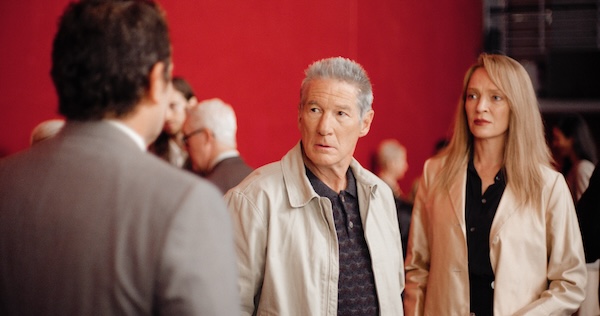
Richard Gere and Uma Thurman in a scene from Oh, Canada.
Leonard Fife (played by Richard Gere in old age and Jacob Elordi in youth) is a respected documentarian in the process of being turned into a memory. As the man is being filmed by a former student, his body is breaking down. And this decline isn’t just physical. It’s reflected in the film’s style; Fife is continually framed through a video monitor. (Compared to the warmer lighting in flashbacks, Oh, Canada’s present is a very cold place.) It’s impossible to draw a firm line between reality and illusion, to tell the difference between when he’s communicating with real people or imagining conversations. Oh, Canada also includes fragmented close-ups of Fife’s face and hands as well as huge projections of the man. It is as though these images were already being shown in a movie theater.
Over the course of a day, Montreal-based filmmaker Malcolm (Michael Imperioli) shoots an interview with his one-time teacher, Fife. As his wife Emma (Uma Thurman) stands in witness, the ailing man reminisces about a key moment in his life. When he was 22 in 1968, his wife Alicia (Kristine Froseth) was pregnant; her father offered him the chance to become the CEO of the company he owned. Accepting the offer would require Fife, who was born in Vermont, to remain in Virginia, cut his hair, and shave off his mustache. Alicia’s family assured him that he could work part-time hours thus keeping up his dream of becoming a novelist in his spare time. But Fife was skeptical. He turned down the offer, abandoned his wife and unborn child, and emigrated to Canada as a “draft refugee.” There, he became an acclaimed documentarian, starting with a 1970 short about the U.S. testing Agent Orange in New Brunswick. As he looks back at his past, Fife’s memories become increasingly confused. He pictures himself as an old man physically entering places from the past and reliving his experiences.
Gere’s first team-up with Schrader, American Gigolo, eroticized the actor’s body and decked him out in designer clothes from Giorgio Armani. 44 years later, Gere displays considerably less vanity. As the ailing Fife, the few hairs left on his head are barely longer than his scruffy stubble. Oh, Canada does not dwell on the decay of the actor’s body, but Fife continually brings it up. No matter how often others flatter him, saying “you look wonderful,” the fact that he’s about to die is impossible to avoid. In flashbacks, Gere looks closer to his real-life self.
Schrader adapted Oh, Canada from Russell Banks’ 2021 novel Foregone. Both works may reflect the autobiographical concerns of either man, but the primary intent was to speak for their generation of men. (Currently, Schrader is a caretaker for his wife, Mary Beth Hurt, who suffers from Alzheimer’s.) Interestingly, the ‘60s flashbacks are the most awkward element in Oh, Canada. Not much music from the period is used, while composer Phosphorescent’s mediocre indie folk soundtrack — an attempt to evoke the singer/songwriters of Fife’s generation? — lands closer to a Whole Foods manager’s idea of cool. The aim is to evoke a period when adventure, for men, was about running away to Cuba or going on Kerouac-inspired road trips. Oh, Canada digs, critically, into the cruelty and irresponsibility that propels this masculine idea of freedom. That said, Schrader’s cinematic vision of “God’s lonely man” can degenerate into repetitive, macho bluster, sometimes building to a desire for martyrdom. Fortunately, the director/screenwriter stays away from this in Oh, Canada. There are no scenes of violence (except for documentary footage of a seal being slaughtered.) The word “Canada” also begins to take on a notion of spiritually, an idea of freedom that also stands in for the inevitability of death.
Given its hall of memories set up, Oh, Canada is predictably muddled and confusing in places. Some of this is intentional. If all the women Fife dated have similar names, are they really all one woman? (Underlining this possibility is the casting of Uma Thurman to play two roles.) It reconstructs Fife’s world out of his memories, creating images filled with anachronisms. Why do flashbacks set in the early ‘60s resemble a film noir from the ’40s? Why do the colors turn lime-green and orange as Fife grows further into adulthood. Of course, Banks’ novel could bring the reader into Fife’s interior life more deeply because literature requires one to imagine images created by the character’s voice. Oh, Canada seems to want it both ways: there’s a tug-of-war between a desire for ambiguity and the need to spell out clear answers that will reassure viewers. Schrader never resolves this epistemological give-and-take.
In the same way Oh, Canada hedges its bets in its departures from conventional storytelling. By Hollywood norms, it’s experimental, but compared to the efforts of Alain Resnais or Raul Ruiz, the narrative clings to the coherent reality it tries, at least stylistically, to undercut. Instead of compelling mysteries, we are given schematic handrails, including shifting aspect ratios and colors that conveniently alert viewers to what period they are watching. The end of the film neatly lays out the lies and hypocrisy that defined Fife’s public persona. Even though it refuses to offer a definitive answer to the truths of Fife’s life, Schrader’s critical message undercuts his stylistic aspirations.
Steve Erickson writes about film and music for Gay City News, Slant Magazine, the Nashville Scene, Trouser Press, and other outlets. He also produces electronic music under the tag callinamagician. His latest album, Bells and Whistles, was released in January 2024, and is available to stream here.