
Book Commentary: “Taming Silicon Valley” — Man Over AI
By Jeremy Ray Jewell
The kinds of regulations Gary Marcus proposes, however well-intentioned they may be, would — in practice — only end up further disenfranchising the masses.
Taming Silicon Valley: How We Can Ensure that AI Works For Us by Gary F. Marcus. MIT Press, 248 pages, $18.95 (paperback).
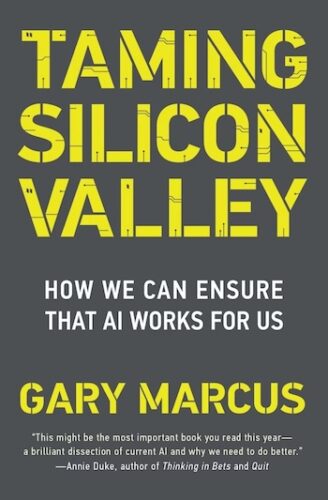
Gary Marcus is a respected figure in the field of artificial intelligence and cognitive science. He is an MIT alumnus and professor emeritus of psychology and neural science at New York University. He has argued for hybrid approaches against strict adherents of deep learning and symbolic AI, holding that neither is sufficient in itself to produce AGI (artificial general intelligence). He also co-founded the AI startups Geometric Intelligence and Robust.AI. Along the way, Marcus has acquired a reputation in tech circles as a contrarian and gadfly, often denouncing AI boosters’ hype and highlighting issues of privacy, misinformation, and the threats posed to workers. His new book, Taming Silicon Valley, explores how AI can be shaped to serve humanity rather than exploit it.
It is surely a difficult position to be in. Keenly aware of the concentration of power and resources spurred by new technology yet also an outspoken critic of its social ramifications. Yet, one can’t help but be dubious about some of Marcus’s formulations regarding the benefits and dangers of AI. On the one hand, he may be accused of being overly pessimistic and regulation-friendly, particularly by those poised to continue making unheard of profits on the technology. On the other, he also appears out of touch with the mood of the masses, whose response to these matters will inevitably be crucial when governments become involved. If one can’t break through the populist appeal of an Elon Musk — made abundantly clear in his prominence in the most recent presidential election — then one has, in reality, said very little of practical utility when it comes to the realm of regulations, at least insofar as the health of democracies are concerned. This appears to be something that Marcus himself is grappling with, particularly in the wake of suspicions that UnitedHealth CEO Brian Thompson’s assassination could be motivated in part by his company’s use of AI to deny claims
Positively citing Henry Kissinger’s call for a “global AI order” is one example of how Marcus’ optimism can veer off political disconnect. But let’s begin, instead, by considering the average citizen’s relationship with such issues as intellectual property, digital privacy, labor, and information. Piracy has become a fundamental (and formative) principle in modern culture, afflicting everything from musical sampling to game assets. The liquidity of intellectual property, despite the growth of restrictive IP laws created to benefit the few and powerful, has shaped emerging AI technologies. Open-source code, in particular, has been crucial in generating our current technological ecosystem. Privacy in the digital realm is now routinely sacrificed without much demur, the reflection of a state of complacency among the general populace that has doubtlessly been encouraged by the US government’s ever-increasing mass surveillance activities.
As for labor, it is being undercut by stagnating real wages and deteriorating conditions related to “gig” work and unregulated outsourcing (both of which AI promises to exacerbate). Inequality increases while the concentration of wealth grows among the investment class and the oligarchs, the owners and investors in AI among them. Add to that top-heavy situation a mounting distrust in experts and institutions — exacerbated by regulatory actions contoured to protect the free market, and it is no wonder that the fate of how AI works is of little concern to the general populace. (How often were the dangers of AI mentioned in the last presidential campaign?) Marcus doesn’t bother to acknowledge issues that touch on the virulence 0f popular apathy.
The closest Marcus gets to dealing with our acceptance of piracy (to the extent that the powerful allow it, at least) is when he refers to what has been called “the Great Data Heist— a land grab for intellectual property”. This correlation of information robbery to large-scale expropriation of land, which marked the beginning of capitalism, is acutely appropriate. While condemnation of the injustice of this digital “land grab” grows, however, we are not likely to see solutions. What appears to be coming are fissures between different analyses of the causes of the “big steal” and possible solutions.
It is fair to say that what our new data-driven economy is doing is realizing new extremes of commercial value where there previously was little or none. The traditional labor theory of value would suggest that data rightfully belongs to those who develop it (into profitable algorithmic models). But — applying the oft-overlooked “Enough-and-as-Good” which has been at the heart of modern economic thought since its inception — it would only make fair economic sense if there was open access to developable digital resources. In other words, everyone would need to have the education necessary to access and utilize code, have meaningful access to training data, and have a say in how such data is sourced. It is hard to see how that balance of openness and accumulation of (increasingly valuable) resources could be maintained, however equally hard it is to imagine the current level of technological development without both.
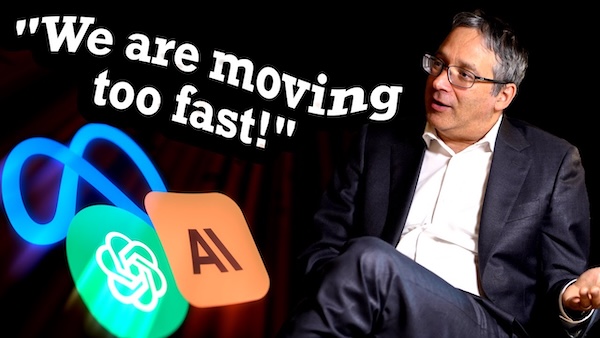
Gary Marcus in a YouTube talk about his book.
Marcus’s critique, insightful as it is, falls flat when it asks the multitudes to rally behind the billionaires who have at this point unjustly concentrated, for decades, obscene amounts of intellectual property by creating regulations that only serve those in power. That free-for-all has already juiced our current culture of piracy along with its twin ingrained dependency on open source development. It all goes hand-in-hand: a tolerance for free labor goes along with a consolation of free media, and a sacrifice of privacy goes along with newer digital conveniences. They are all prerequisites, so it seems, in a market where consumers themselves have become the most valuable products.
That, taken together with questions of just how much society’s disempowered will be able to take advantage of the AI boom even as their conditions may be worsened by it, undercuts any moral appeals for an ‘equal playing field’. Even in terms of early capitalism, you had displaced peasants in Europe who then became the colonial homesteaders displacing others on the peripheries in the names of the same societies which had displaced them. If this is a good, old-fashion “land grab”, then it would be best if we acknowledged how we are all already complicit when we download that torrent of Adobe Illustrator or when we share our portfolio projects in a GitHub repo. This fact underlines the reality that moralizing will often produce the opposite effect upon the masses, and inspire a very different kind of regulatory outcome than that which was envisioned.
It is hard to imagine today’s technological landscape emerging without the immense concentration of resources that we see in the hands of a few. Then again, the few have also permitted us to ameliorate the imbalance with coping mechanisms and individual investments in their futures. Marcus identifies essential problems in this deeply troubling landscape. And his model solutions don’t even sound that bad; Universal Basic Income, for example, is a dream for all of us fantasizing about a post-labor economy. But most of us know, all too well, that a model is only as good as the data it’s built out of, and the data footprint our civilization has thus far left behind on these issues leaves little doubt as to how that next great regulatory innovation will look … toes and fingers melded together, because the modeller never knew their purpose.
Jeremy Ray Jewell writes on class and cultural transmission. He has an MA in history of ideas from Birkbeck College, University of London, and a BA in philosophy from the University of Massachusetts Boston. His website is www.jeremyrayjewell.com.
Tagged: "Taming Silicon Valley", AI, Gary Marcus, MIT Press, corporate piracy