
Book Review: Ada Limón’s “Against Breaking” — Faith in Poetry or Faith as Poetry?
By Ed Meek
In praising poetry’s power, Ada Limón leaves clarity—and craft—behind.
Against Breaking, On the Power of Poetry by Ada Limón. 56 pages including illustrations. Scribner, 56 pages including illustrations, $16.99.
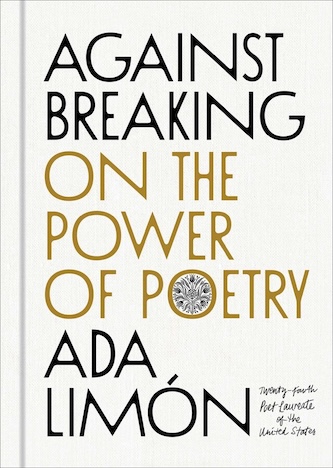 “When clarity is hard to come by, when language has morphed into a tool for confusion, I put my faith in poetry,” proclaims Ada Limón in this very short book on the value of poetry, written after she was named, in 2022, the 24th poet laureate of the United States. During her three-year tenure, her chosen mission was to place poetry in unusual locations all over the U.S., including parks, seashores, and mountains. As part of the project, she traveled around the country and spoke with people about verse. This is similar to Robert Pinsky’s approach, when he traveled across America and asked audience members to bring their favorite poems to readings. Then he recorded these events onto CDs—and sold them.
In asking people to choose the poems used at his events, Pinsky gave away the responsibility for what verses were to be read. Limón, on the other hand, chose the poets whose works were recorded for You Are Here: Poetry in the Natural World. In this book, she makes a brief attempt to explain what it is she loves about poetry. The quote above reminds me of something Richard Hugo used to say in classes—that the news and advertising were the opposite of poetry; the former were used to sell products and distort the truth. This is even truer today, when journalists are pressured to report lies by politicians as if they are facts. But when Limón says that she puts her faith in poetry, she is drawing on a religious term. To me, this suggests one of those flags liberals hang outside their houses that say, “I believe in science.” Well, we don’t have to believe in science for its findings to be true. And we do not have to have faith in poetry to love hearing it or reading it.
Speaking of bromides, in another place in the book, Limón states, “If everything we know about the world is true, then we will all die one day.” Huh. Whether we know anything or not, we are going to die. “This is a fact most poets are intimately aware of,” she goes on to argue. Aren’t all people pretty intimately aware that they are going to die one day?
“What is a poem?” Limón asks. “What is a soul?” is her answer. Yes, it is difficult, if not impossible, to define what an art form is, but there is no reason Limón could not simply quote poetry she admires and explain why she thinks it is great. She says poetry appeals to our feelings, but apparently that means, for Limón, that we should love everything that calls itself poetry. It would have been helpful if she had talked about her own poetry—where it comes from and what she is trying to do with the form. Instead, we get puzzling claims that poetry is made “in the cement mixer of the soul.” (That is not an improvement on “in the rag and bone shop of the heart.”) She also declares that poetry “holds no answers.” “It exists in the questions.” Of course, poems raise questions; poems are forms of rhetoric, so they inevitably present an argument to readers.
And the quality of the argument matters. In Limón’s poem “What I Didn’t Know Before,” she describes the birth of a colt: “then suddenly there are two horses, just like that. That’s how I loved you.” So, yes, she raises a question about the differences between how horses are born in comparison to humans. But she uses this analogy as a metaphor for romantic love. Is this a recommendation for love at first sight? My point is that many of our most famous poems end with statements: “Rage, rage against the dying of the light.” Even the question “And what rough beast, its hour come round at last, slouches towards Bethlehem to be born?” makes a threatening statement. And Yeats is using rhythm, imagery, and repetition to drive the meaning.
Refraining from a thoughtful analysis of poetry—probing its history and evolution—Limón is content to quote from poets and then refer to the content as a way to say why she loves their poetry. But don’t we read poetry because we are drawn to the way the content is presented—that is, the linguistic art, the splendid articulation of meaning?
“The heart breaks and breaks, and lives by breaking” is a line from a poem by Stanley Kunitz. The sentiment is flipped in Limón’s title: Against Breaking, On the Power of Poetry. Ironically, she quotes from Kunitz’s poem in the book, claiming it helped her “get out of bed in the morning.” Perhaps this is just another example of “clarity being hard to come by, language as a tool for confusion.”
Like Ada Limón, I am a fan of the distinctive emotional power of verse, but her tiny promotional book doesn’t do justice to poetry’s power.
Ed Meek is the author of High Tide (poems) and Luck (short stories).