
Film Review: When Marketing Buries Meaning — “The Drama” and the Culture of Concealment
By Hannah Brueske
Kristoffer Borgli’s A24 feature flirts with social relevance but ends up exploiting a reality it refuses to confront.
The Drama, directed by Kristoffer Borgli. Screening at several Boston-area theaters, including AMC Causeway 13 and AMC Boston Common 19, also the Coolidge Corner Theatre and Kendall Square Cinema in Cambridge.
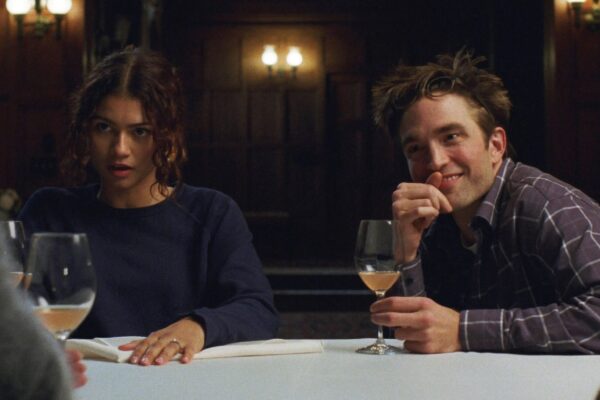
Zendaya and Robert Pattinson in The Drama. Photo: A24/Everett Collection
Since its theatrical release last week, Norwegian writer/director Kristoffer Borgli’s latest A24 feature The Drama has sparked passionate debate online, both for how it handles its ‘secret’ subject matter and the manipulative strategy of its marketing campaign.
Starring two of Hollywood’s most beloved current actors, Zendaya and Robert Pattinson, The Drama is a story of pre-wedding jitters pushed to an alarming extreme. It has been marketed as a romance with a dark undertone — with subtle hints of a twist in the trailer. What the merchandising ignores: the entire film revolves around the aftermath of Anna (Zendaya) confessing to her fiance Charlie (Pattinson) that, as a teenager she planned to commit a school shooting. A week out from their wedding, during a rehearsal dinner game of “What is the worst thing you’ve ever done,” Anna confesses to Charlie and their two best friends about how far her plans had progressed. She made manifesto-like videos, practiced shooting in the woods, and brought her father’s rifle to school. Ultimately, she got cold feet.
Didn’t anyone at A24 suspect that the issue of school shootings would generate controversy? The topic is never addressed or contextualized in a serious way, aside from generically predictable outrage from Anna’s friends that translates to “thoughts of gun violence are bad.” Instead, The Drama clumsily uses Anna’s confession as a spur to Charlie’s conscience. Predictably, he wonders if he really knows his soon-to-be-wife. Will her past actions, he frets, influence her future actions?
The story only sticks to its promised romcom energy for its first 20 minutes or so. We see the couple’s meet cute, which is followed by the stories of first dates and first kisses. (These are relived as both parties prepare their wedding speeches to each other.) After that, an anxiety-filled scenario dominates as we wait to see whether or not the two will follow through with their wedding plans, which, at last, they do.
There was potential here to spark interesting conversations about American violence, but any possibilities for discussion are pretty well squashed by the film’s absurd marketing campaign. It is mostly made up of lighthearted press interviews with Zendaya and Pattinson, along with some vague reviews by critics who were instructed not to raise the problematic subject matter. Maximum effort has been made to erase all clues to what is really going on in The Drama from the trailers and promotional materials.
It was intellectually and politically lazy (opportunistic?) of Borgli to think that gun violence could be used simply as a way to judge character, which is what viewers are asked to do with Anna. There is no attempt to show how her actions are situated within the horrific epidemic of mass shootings in our current culture. Anna’s motivation for the shooting is pinned purely on her love for the sociopathic aesthetic of school shooters and her troubles with the virulence of bullying in school.
There is one quick throwaway line about how Anna does not fit the usual profile of school shootings. We are told that it is usually guys who do the shooting. “Girls can be shooters too” — is Anna’s defensive response. End of discussion. This moment perfectly encapsulates Hollywood’s recent smug patting itself on its the back for challenging a stereotype by bringing in a minority. The Drama subverts the troubled white male teenage shooter caricature by swapping in Zendaya’s character, a Black woman. It is not implausible that Anna wanted to be a high school shooter — but her fantasy should have been looked at with depth, with illuminating perspective. Changing the perpetrator’s gender and race, but doing nothing to explore the psychological or gendered circumstances is irresponsible.
According to The Violence Project, 98% of perpetrators of mass shootings in recorded U.S. history are men — a vast majority of them white men. In an interview with NPR, Violence Project president, Jillian Peterson said that male perpetrators model themselves after their predecessor, seeing themselves in them. So, when Anna is attracted to the aesthetic of school shootings, who is she relating to?
Granted, issues of this sensitivity are not easy for a film to deal with delicately. But that doesn’t excuse exploiting gun violence as a device for a shocking plot twist. Gun violence never exists in a never-never-land. What’s the first question people ask after a mass shooting — “What was the shooter’s race and gender?” And that is quickly followed by, “Who did they vote for?”
Hannah Brueske is a senior journalism student at Emerson College, with a special interest in feature stories, arts reporting, and documentary filmmaking. She is active in campus publications as a projects editor for The Berkeley Beacon, Emerson’s only independent student newspaper, and the editor-in-chief of The Independent, an arts magazine that covers independent art. She just finished directing her first documentary short about the experience of transfer students and hopes to work on more documentary films soon. After graduating next December she plans to move to New York City to continue chasing and contributing to the worlds of art and culture.