
Classical Album Reviews: Ferdinand Hiller’s Symphonies — A Major Rediscovery from the Era of Mendelssohn and Schumann
By Ralph P. Locke
This is one of the most welcome, ear-opening recordings I’ve heard in recent years, easily capable of restoring Ferdinand Hiller to the position he once held as the composer of highly accomplished, enjoyable, and intriguing works.
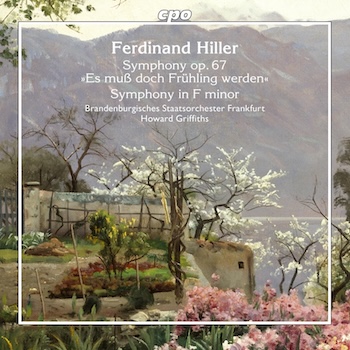
Ferdinand Hiller: Symphony in E-Minor, Op. 65, “Es muss doch Frühling werden”; and Symphony in F-minor.
Brandenburgisches Staatsorchester Frankfurt[-an-der-Oder], cond. Howard Griffiths. CPO (555625-2). Total time 61 minutes. Available from CD dealers (click here to try any track) or through major streaming outlets. Booklet downloadable here.
 What happens to the mainstream composers of a given era, the ones who didn’t create a fuss through manifestos about their bold innovations but composed in a confident and even nuanced manner along lines that had been well established by the best composers of the generation or two before them—and perhaps adding some fresh, imaginative touches of their own?
Music lovers will know the kind of composer I’m thinking of: Gounod, Saint-Saëns, and Cécile Chaminade in France; Donizetti, Ponchielli, Mascagni, and the Brazilian-born Carlos Gomes in Italy; Stanford and Parry in England; MacDowell, John Knowles Paine, and Amy Beach in the United States. In the case of some of these composers, one or a few works do remain in the repertory, yet much of his or her output has slid off the “mattering map” of the musical world.
One positive result of this is that hundreds of highly proficient and even stirring works are now getting rediscovered by later generations, and providing welcome variety to concert and operatic life. (Side by side, that is, with works by composers whose output was not, because of one or another form of prejudice, widely appreciated during their lifetime, such as notable female composers Louise Bertin, Marie Jaëll, and Dora Pejačević.)
Nineteenth-century Germany and Austria, in particular, were full of highly capable, even sometimes inspired composers, many of whose works achieved public recognition but then largely disappeared from musical life: e.g., Ludwig Spohr, Joachim Raff, Max Bruch, and, in the opera world, Albert Lortzing and Otto Nicolai. One of the best and most accomplished of these was Ferdinand Hiller (1811-85). The second of his three piano concertos remained in the repertory for decades after his death. But even his once-famous 1840 oratorio Die Zerstörung Jerusalems (The Destruction of Jerusalem [by the Babylonians]) eventually vanished from performance in churches and concert halls, despite the fact that Schumann had praised it heartily, considering it progressive for introducing much drama into a genre that he felt was at risk of becoming stodgy. Still, Hiller has never stopped being mentioned by music historians and biographers, because he wrote vividly about composers that he knew well during his lifetime, most notably Berlioz and Mendelssohn. (His book about Mendelssohn is found in hundreds of libraries around the world as well as online. His essay on Berlioz is summarized, with juicy excerpts, in an essay that fellow musicologist Jürgen Thym and I published in the 2024 book Berlioz and His World.)
(Hiller was born to a Jewish family in Frankfurt. No biography of him has ever been published. But there’s a very helpful entry on him in Grove/OxfordMusicOnline. Though he converted to Lutheranism before adulthood, mainly it seems for professional reasons, a new, racialist strain of antisemitism—which would eventually culminate in Nazi ideology and practices—insisted on a person’s family origins rather than on his or her current beliefs or affiliation. In his vivid account of an 1866 sacred-music competition, Hiller makes a point of exposing a moment when the debate among the jurors risked taking an antisemitic turn.)
One fact about Hiller has always remained part of the historical record: he signed the famous 1860 manifesto circulated by Brahms and Joseph Joachim against the one-sided claims of the New German School (which insisted that the future direction of music was being paved by Liszt, Wagner, and—a somewhat strange addition because he barely spoke a word of German—Berlioz). Indeed, Hiller’s music came to be considered passé in part because it was, much of the time, highly traditional, in the manner of Mendelssohn and Schumann, staying clear of the high chromaticism of Wagner and mid-to-late-period Liszt. Scurrilous and antisemitic attacks on Hiller from members of the Liszt circle in Weimar—whose antipathy was bolstered by that 1860 manifesto and by some of Hiller’s other writings (as Thym and I explain in a different book chapter)—further contributed to discouraging performers from performing the works and critics and historians from discussing them, especially of course during the Nazi era.
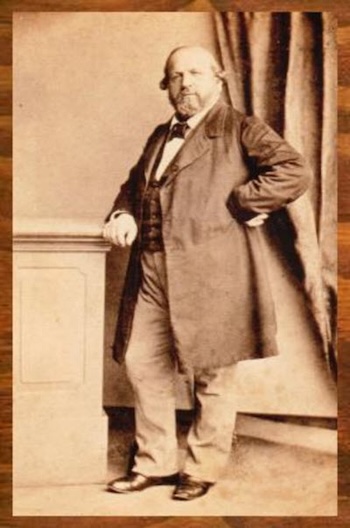
Ferdinand Hiller, pianist, conductor, and composer (1811-85). Photo: ca. 1860s.
Aside from the hostility aimed at him from Weimar, Hiller lived a long and gratifying life, becoming the chief conductor of the Gürzenich Concerts in Cologne and heading, for 34 years, that city’s conservatory, where his students included the aforementioned Bruch and also Engelbert Humperdinck (composer of the opera Hansel and Gretel).
It has taken the effort and dedication of many recent and current performers to bring Hiller’s numerous works back to public awareness. We can now hear, on disc or through streaming, most of his songs and piano pieces, the aforementioned Jerusalem oratorio (a truly splendid work), all three piano concertos, much chamber music, and—newly released—two of his four surviving symphonies. (Another two symphonies are lost; Hiller also composed some more modestly scaled orchestral works, such as overtures and symphonic fantasias.)
The recording of the mature E-minor symphony and the early F-minor one comes from Frankfurt-an-der-Oder, a medium-sized German city near the border with Poland. The Brandenburgisches Staatsorchester Frankfurt is renowned for playing new pieces (e.g., by American composer Samuel Adler) and for digging up somewhat older ones (e.g., by Siegfried Matthus and Paul Büttner). The conductor is Howard Griffiths, widely praised for his recordings of forgotten works from the eighteenth and nineteenth centuries, such as the eight symphonies of Beethoven’s student Ferdinand Ries. (He recorded the Ries works with the Zurich Chamber Orchestra.)
The only Hiller symphony to have been published during his lifetime—and thus the only one to carry an opus number—was the Symphony in E minor, op. 67, the first of three symphonies that he wrote in his middle and later years. Op. 67 was widely performed at the time, such as under the baton of Franz Liszt in Weimar. It was composed in 1848, when Hiller was around 37, revised in 1854-55, and finally published in 1865. It bears the title “Es muss doch Frühling werden” (“Springtime is surely coming”), a recurring line in the famous poem “Hoffnung” (Hope) by Emanuel Geibel. (Many music lovers know of Geibel from the colorful texts—co-authored with Paul Heyse—that Hugo Wolf set as the Spanisches Liederbuch.)
Hiller’s “Springtime” symphony—a work clearly in the tradition of those by his friends Mendelssohn and Schumann—opens the album in confident manner. Its first movement is laid out in a relatively conventional three-theme sonata-allegro form, yet each of those themes is very engaging, through alert uses of syncopation to keep the music heading constantly onward. By contrast to Schumann, in particular, Hiller is much more willing to break with the norms of four-bar phrases, sometimes extending them by an extra bar—in a surprising yet convincing manner. I couldn’t help but think of Brahms during one passage in which the second theme is accompanied by pizzicatos in the low and middle strings. (Hiller tried in vain to persuade Brahms to teach at the Cologne Conservatory. Brahms, throughout his career—and perhaps aware of Hiller’s precedent—was fond of creating unusual and sometimes unpredictable phrase lengths: five-bar phrases prevail in his “Haydn” Variations for orchestra, 1873, and his Rhapsody in E-flat, Op. 119, no. 4, 1893.)
Particularly cherishable in Hiller’s Op. 67 is the slow movement (marked Adagio)—richly melodic, in a vein familiar to those who have by now gotten to know some of Hiller’s Lieder or his works for solo piano or chamber ensemble. One contrasting section, for solo clarinet, could have been penned by some French master of melody, such as Gounod or Bizet. The orchestration is beautifully managed, with certain touches making me wonder if later composers beyond the German-speaking world were familiar with this symphony, such as Tchaikovsky or Sibelius. I particularly thought of Tchaikovsky during some of the lovely woodwind solos that comment on the main musical material that is being carried by the strings; and of Sibelius during a passage with brass fanfares urging us, through the ongoing rich music of the strings and winds, to some kind of decisive action.
The third movement (Allegro vivace) is a scherzo of a Mendelssohnian sort (such as in the Midsummer Night’s Dream music or in the early String Octet) but not remotely sounding like a copy. At a few points, Hiller (as in the first movement) expands a four-bar phrase into five. The symphony’s finale is energetic and determined—as if resolving the problem laid out by the contrasting moods and materials of the first movement and the two intervening ones.
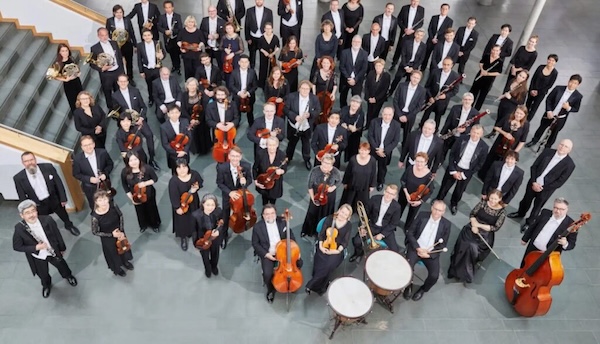
The Brandenburgisches Staatsorchester (Frankfurt an der Oder). Photo: courtesy of Brandenburgisches Staatsorchester/Frankfurt-an-der-Oder
The generally fine booklet essay, by Bert Hagels, emphasizes the ways in which Hiller’s Op. 67 departs from certain by-then-standard academic norms of sonata form. Hagels also proposes, plausibly, that the reference to “springtime” in the poetic title of the piece, as well as the positive-minded spirit of the finale, reflect Hiller’s confident feeling that political liberalism, as represented by the March Revolution of 1848 in Germany, would eventually triumph in Europe over the old system of aristocratic privilege and its attendant narrowness and abuses. Among these abuses—though Hagels does not even hint at it—was the aforementioned prejudice against Jews, an important issue that Hiller, in later life, exposed and combatted in writings for prominent magazines.
The album continues and concludes with Hiller’s much earlier Symphony in F minor (1832-33), a work that often sounds much like Beethoven, as one might well expect considering its date of composition. Some five years earlier, the 16-year-old Hiller had, with his teacher Hummel, visited the dying Beethoven, and Hiller had clipped a lock of Beethoven’s hair as a keepsake.
The F-minor symphony was actually Hiller’s third work in the genre (though newspaper articles referred to it as his second, perhaps because one of the previous ones never reached performance). It was written when Hiller was around 21 and living in Paris, where he became close friends with Berlioz, Chopin, Liszt, and the great operatic tenor Adolphe Nourrit. Hiller’s lifelong friend Berlioz, reviewing the work when it was performed, complained that the last movement submitted its Scottish-sounding tune to inappropriate complications, which Berlioz lumped under one of his favorite curse words: “fugue.” I’d say that the treatment is perfectly fine and appropriate: in a rather Beethovenish manner, the folklike tune is carved up into smaller bits for purposes of symphonic development, and these then get reassembled for a whirlwind finish. As for the specific accusation of inappropriate “fugal” intrusions, there is only one brief passage of imitative counterpoint (canon), toward the end of the movement, and it works just fine.
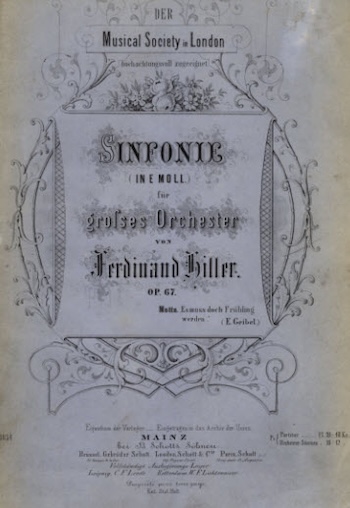
First edition of Hiller’s Symphony in E-minor, Op. 67, “Es muss doch Frühling werden.”
I particularly enjoyed the second movement, a duple-meter scherzo marked “Capriccioso, molto vivace,” which, like the one in Op. 67, is full of feather-light scurrying in the strings, but now with soft trumpet calls on the dominant, which sound to me as if beckoning us mysteriously from a (psychic, not physical) distance, much as happens in the development section of Mendelssohn’s overture “The Hebrides” (“Fingal’s Cave”), a work that was first performed two years before this Hiller symphony. Particularly striking, and, again, Beethovenian in effect, is a passage when the emphatic countersubject takes over so fully (in unisons, no harmony) that the music briefly gets restructured into emphatic three-beat units, like a stomping, three-legged giant. Hiller’s fascination with rhythm and meter clearly started early in his life! Indeed, an entire book has been devoted to Hiller’s metrical experimentation, by the German scholar—and violist—Michael Gehlmann.
I was truly moved by the third movement (Adagio non troppo), in which a series of lovely melodies are buoyed up by pulsing and sometimes syncopated accompaniments reminding me of some of Berlioz’s music from around the same time. The Symphonie fantastique had been given its first performance two years earlier, and, soon thereafter, Berlioz had, as he would later openly admit in his Memoirs, reworked its third movement—the Scene in the Fields—according to good advice from his friend Hiller. The mutual influence of these two composers (and close friends) during their early years is a topic deserving of further study.
I should add that the movement begins over a rocking, barcarolle-like figure, suggesting a possible programmatic allusion. And, halfway through, there is a sudden minor-mode episode (based on the movement’s main theme), reminiscent of similar intrusions in numerous works of Haydn, Mozart, and Beethoven.
The performances of both the E-minor Op. 67 symphony and the F-minor one are precise, clear, emphatic, and lyrical, as required. The recorded balance is clear and detailed, with wonderful interweavings from the brass and wind, and peppery appearances from the timpani. The only problem that I noticed is that Hiller’s delight in throwing the listener off rhythmically would sometimes be clearer if conductor Griffiths kept the pace steadier—thereby reminding us of the prevailing meter—especially when there is an accent on, say, the second or fourth beat in a four-beat measure. I lost a sense of the downbeat in the lead-in to the recapitulation of the first movement of Op. 67, and in the very first measures of the early F-minor symphony.
The booklet notes are generally well translated. But the word “doch” in the subtitle of Op. 67 is said to be “clumsy.” The equivalent word in the German version of the essay is “gesperrt.” But “gesperrt,” in regard to a printed text, means something very specific (having nothing to do with clumsiness), namely that the word “doch,” in Geibel’s poem, is printed with its individual letters spaced out: “d o c h.” This was the once-standard German equivalent of italicizing a word for emphasis: “Springtime must surely be coming!”
Oddly, a glance at the title page of the published score (accessible at IMSLP.org) shows that the word “doch” is printed normally, not gesperrt; perhaps the publisher (Schott, in Mainz) did not understand Hiller’s instruction. Or were they trying to soft-pedal the composer’s political message? (The year was 1865, and Bismarck was in the process of turning Germany into a unified, authoritarian-ruled state—as Hiller, an avowed supporter of democracy and equality his whole life long, made clear in some of his writings that he regretted.)
Another translation goof: In the bio section, we are startled to see that Griffiths has conducted “more than 40 symphonies by Beethoven’s contemporaries and the early Romanesque.” That last word is a mistranslation of “Romantiker”; the phrase should of course be “the early Romantics.” (“The early Romanesque” sounds like a reference to medieval architecture.) The recording firm, CPO, ought to hire an editor to catch this kind of error.
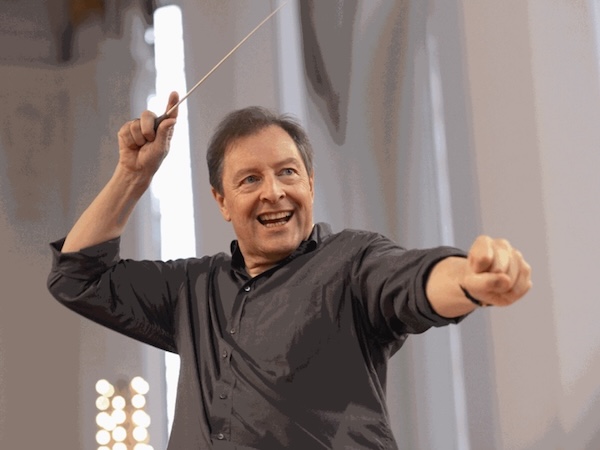
Conductor Howard Griffiths. Photo Tobias Tanzyna, courtesy of Brandenburgisches Staatsorchester/Frankfurt-an-der-Oder
Aside from those slips in the booklet, this is one of the most welcome, ear-opening recordings I’ve heard in recent years, easily capable of restoring Ferdinand Hiller to the position he once held as the composer of highly accomplished, enjoyable, and intriguing works. It’s available for free on YouTube or of course with a subscription to Spotify and other services, but those listening online won’t have access to the booklet. The young pianist Ronald Lau’s effective piano transcription of Op. 67 is likewise available on YouTube and elsewhere, as is a rather stiff MIDI realization of the F minor, with Hiller’s manuscript score being shown page by page.
If you like these symphonies, I recommend Hiller’s solo piano pieces, some of which are a bit more experimental, such as the Ghasele (printed as “Chasele”—another apparent error from a music publisher), op. 54, no. 1 in (more or less) C major. In it, a short cadential phrase recurs again and again after intervening passages that briefly wander elsewhere; and the refrain itself is harmonized differently at times. The piece is nicely recorded, with the score shown, on YouTube.
Or try Hiller’s Piano Sonata no. 2, whose first movement shifts entrancingly, and unpredictably, between two and three beats per measure, in ways that would not become widely practiced until such a work as Stravinsky’s The Rite of Spring. This sonata, too, is available on YouTube, excellently rendered by Adrian Ruiz, with the score visible.
Yes, even Hiller—despite being scorned at times by followers of Liszt as insufficiently progressive—had his bold and adventurous side. All in all, a fine composer worth rediscovering! All the more reason to hail the report that two other surviving symphonies by Hiller have been recorded by the same orchestra, for eventual release.
Ralph P. Locke is emeritus professor of musicology at the University of Rochester’s Eastman School of Music and Senior Editor of the Eastman Studies in Music book series (University of Rochester Press), which has published over 200 titles over the past thirty years. Six of his articles have won the ASCAP-Deems Taylor Award for excellence in writing about music. His most recent two books are Musical Exoticism: Images and Reflections and Music and the Exotic from the Renaissance to Mozart (both Cambridge University Press). Both are now available in paperback; the second, also as an e-book. Locke also contributes to American Record Guide and to the online arts-magazines New York Arts, Opera Today, The Boston Musical Intelligencer, and Classical Voice North America (the journal of the Music Critics Association of North America). His articles have appeared in major scholarly journals, in Oxford Music Online (Grove Dictionary), and in the program books of major opera houses, e.g., Santa Fe (New Mexico), Wexford (Ireland), Glyndebourne, Covent Garden, and the Bavarian State Opera (Munich). This review first appeared in Classical Voice North America and is republished here (and expanded), with kind permission.
Tagged: Brandenburgisches Staatsorchester/Frankfurt-an-der-Oder, Ferdinand Hiller