
Doc Talk: Hammer’s Gaze, Rimbaud’s Renunciation — Unyielding Queer Legacies
By Peter Keough
A pair of eminent lives — celebrated.
The Boston Wicked Queer Film Festival. April 3-16 at the Brattle Theatre, the Coolidge Corner Theatre, and the Museum of Fine Arts.
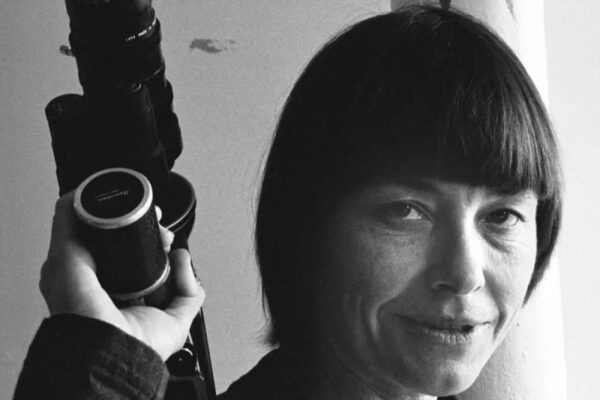
A scene featuring Barbara Hammer in Barbara Forever. Photo: estate of Barbra Hammer
For Barbara Hammer, subject of Brydie O’Connor’s Barbara Forever (2026; screens April 11 at 2 p.m. at the Museum of Fine Arts), a turning point in her life came early in her marriage to a hip guy, it seemed, who took her on a world tour on a motor scooter. “We were radical,” she recalls. “I wanted him to blow up the Bank of America.” Instead, they moved to cabin in the Sonoma woods in the late sixties where she noticed that though all the people hanging out at their hip household were talking about the cool creative stuff they were doing, she was stuck making coffee.
So, she took her Super 8 camera out and found an old cobwebby house where a stranger was sitting on the porch and shot footage. Then she sat where the man was sitting, put a mirror between her feet, and shot her reflection. “I had taken the power of a man,” she explains. Then she went home and told her husband she was a feminist. “He didn’t know how to handle it,” she recalls. “That’s how I separated from my husband.”
The clip, from the short Schizy (1968), one of her earliest films, is quintessential Hammer: blurred and achingly focused, beguilingly subjective, uncompromisingly realistic, and driven by a self-image dedicated to making subversive statements about power, patriarchy, and bodies. But she was not just a feminist artist; Hammer realized that she was a lesbian and decided to do everything with a woman she had done with a man, including taking another world tour on a motorcycle. She followed that feat with Dyketactics (1974), which she describes as “perhaps the first lesbian lovemaking film made by a lesbian.” Many more films, as many as a hundred, would follow, mostly shorts but also the feature length documentary Nitrate Kisses (1992), a critique of Hollywood’s depiction of gay people, and her memoir Tender Fictions (1996).
Like Hammer’s own work, this documentary is formally bold and unconventional, incorporating clips from the subject’s films and interviews with her and with her spouse Florrie Burke. It flits back and forth in time, opening with a clip of a middle-aged Hammer posing nude, grinning, and flexing her muscles, followed by one of her much later in which she is halting, pale, and hairless – but still standing. She would die in 2019 at 79 of uterine cancer, the progress of which illness she poetically and stoically records in one of her last films, A Horse is Not a Metaphor (2009).
Was Hammer satisfied with such a full life of love and art and looking? In one clip she walks down Hollywood Boulevard, repeating that she’s “looking for a lesbian” and pausing on such potential candidates as Phyllis Diller and Barbara Eden. Perhaps she was hoping that her own star might one day be the first. When she was a child, her mother wanted to make her into the next Shirley Temple, then the most popular female performer in the movies. That didn’t work out, but perhaps the need to succeed, become famous, and maybe please her mother endured and sustained Hammer’s ambitions. The film’s title Barbara Forever refers to her desire to achieve a kind of immortality through her work. She never achieved the acceptance or popularity she wanted in her lifetime, but films such as this emphatically demonstrate that she still lives on.
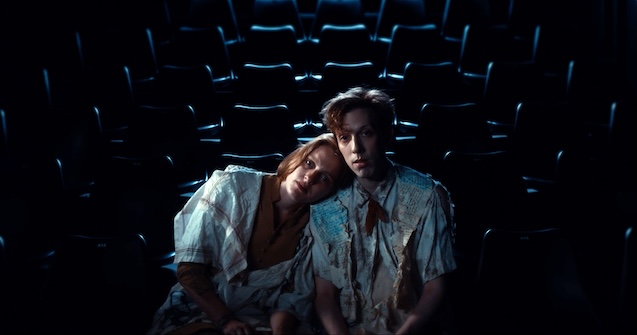
A scene from Fil Ieropoulos’s Uchronia. Photo: courtesy of the Boston Wicked Queer Film Festival.
Unlike Hammer, French poète maudit Arthur Rimbaud would spurn fame, success, and immortality when at 21 he gave it all up and fled to Africa to become a failed gunrunner and possibly a slave trader. As is noted in Fil Ieropoulos’s Uchronia (2026; screens April 7 at 8 p.m. at the Brattle Theatre), Albert Camus described Rimbaud’s abandonment of his calling as a “spiritual suicide.”
Ieropoulo’s new film literally disinters the poet and reappraises his legacy. It revels in the same kooky, chimerical costumes and designs as his Avant-Drag! (2024) while it draws on Foivos Dousos’s barbed and literate narration and screenplay. Its premise is reminiscent of that of Paul B. Preciado’s Orlando My Political Biography (seen in the 2023 Boston Wicked Queer Film Festival) in which the filmmaker transforms the work of a Queer literary giant (Virginia Woolf in Preciado’s opus) into an inventive and challenging personal manifesto.
A newsreel-like voiceover narrator explains how an excavation of Rimbaud’s grave has “uncovered boxes of unknown origin” containing “newsreels from indeterminate eras, psychedelic diagrams, unsent letters, newspaper clippings describing events that never happened, and obscure technological paraphernalia. Is this an elaborate hoax or could it be a case of genuine paranormal activity?”
In fact, along with the chapter headings from Rimbaud’s 1873 poetic cycle A Season in Hell, the allegedly unearthed material provides the framework for Ieropoulo’s dense and ludic palimpsest, a combination of a TED Talk, a trial, Steve Allen’s Meeting of the Minds, and a surrealistic, phantasmagorical pandemonium. Historical figures, LGBTQ icons, and a villain or two converge to discuss the legacy of the enigmatic, revered and reviled Rimbaud, portrayed posthumously with weedy insouciance by Kristof Lamp. The participants, presumably summoned up by Rimbaud, include those with “expertise in failed revolutions” such as Louise Michel, Emma Goldman, David Wojnarowicz, Marsha P. Johnson, Alan Turing, and a few wry composites like “Trotsky 2.0” and “Deleuzian Bodybuilder.”
Those to blame for this failure, in Ieropoulo’s reckoning, include not just patriarchal oppressors but members of the queer community as well, who, either willingly or unwittingly, sold out to the powers that be. Artists like Andy Warhol, for example: in one of the film’s more amusing moments he confesses to Jack Smith of Flaming Creatures (1963) fame that “Pop eats subculture and shits trivia.” Alternately outrageous, hilarious, insightful, and insufferable, Uchronia (like Utopia, but with time) is a tour de force that deserves to be seen, probably more than once.
Peter Keough writes about film and other topics and has contributed to numerous publications. He was the film editor of the Boston Phoenix from 1989 to its demise in 2013 and has edited three books on film, including Kathryn Bigelow: Interviews (University Press of Mississippi, 2013) and For Kids of All Ages: The National Society of Film Critics on Children’s Movies (Rowman & Littlefield, 2019).
Tagged: "A Horse is Not a Metaphor", "Avant-Drag!", "Barbara Forever", "Schizy", "Uchronia", Barbara Hammer, Fil Ieropoulos