
Book Review: Streetwear’s Conquest — Culture Captured, Politics Ignored
By Yulia Pereira
Concentrating on strategies that enabled casualwear to grow worldwide, the book ignores the broader historical and political conditions that encouraged that success in the first place.
Bigger Than Fashion: How “Streetwear” Conquered Culture by Tyler Watamanuk. Simon & Schuster, 340 pages,
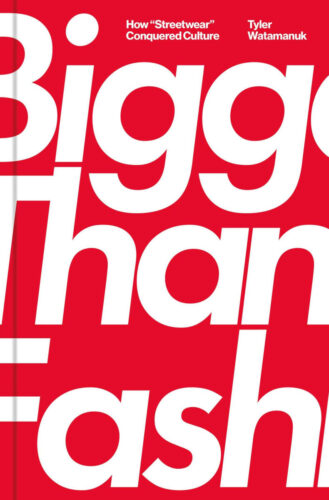
Tyler Watamanuk has attempted a narrative history of the cultural movement that reshaped the global fashion industry. He traces how, over fifty years, an accumulation of underground references, DIY ethos, and youthful provocation challenged traditional definitions of art, design, and commerce. Yet, by focusing on commercialization, globalization, and identity as a symbolic system, he overlooks an examination of the transformation’s broader political/historical context.
Watamanuk structures this history through a series of interconnected origin stories, beginning with Shawn Stüssy in Southern California and then moving through parallel developments in New York’s graffiti and hip-hop scenes. The early chapters emphasize the unplanned nature of streetwear’s emergence: Stüssy’s transition from surfboards to T-shirts is presented less as a strategic pivot than as an improvised response to customer demand. What began as an exercise in self-branding is quickly converted into a scalable product, which underlines one of the book’s central insights — that streetwear’s economic logic precedes its formal recognition as “fashion.”
A similar trajectory unfolds in New York, where graffiti writers such as Futura and Haze move from producing illicit subway art to creating designs for commercial products. Watamanuk treats this transition as a translation rather than a rupture: the visual language developed under conditions of marginality is repurposed, with relative ease, for corporate and institutional contexts. The emphasis throughout his story is on continuity — on how styles, symbols, and practices can migrate across domains without losing any of their subcultural coherence. Streetwear, in this account, is not so much an artistic genre as the center of a network of overlapping cultural scenes (from low to high), each contributing to a shared vocabulary of forms.
Watamanuk is particularly attentive to moments of convergence. One such moment occurs when East Coast hip-hop intersects with West Coast surf and skate culture, producing a hybrid aesthetic that would define and propel streetwear’s early expansion. These encounters are framed as “flash points,” moments when previously distinct cultural systems recognize one another and begin to exchange codes. Music, especially hip-hop, played a central role in this process of fusion, functioning as both a carrier and amplifier of the “new” style. In this sense, artists serve as intermediaries, translating local aesthetics in ways that boost broader circulation.
As the narrative moves into the 1990s and 2000s, Watamanuk charts the gradual consolidation of streetwear into recognizable brands and retail environments. Labels like Stüssy evolve from informal operations into structured businesses; new entrants adopt and refine early models. The rise of boutique retail spaces — part store, part cultural hub — marks a major shift from production to curation. Here, the book underscores the importance of scarcity and controlled distribution: value is generated not only through design but through limitation, timing, and access.
 This capitalist logic reaches a new level of intensity with the emergence of brands such as Supreme, whose model of limited releases and cultivated opacity was embraced by many as paradigmatic. Watamanuk doesn’t present Supreme as an innovator of style so much as a consolidating innovator of structure — a company that formalized principles that had already been established. Nuanced marketing strategies, the careful maintenance of insider status, and the calibration of supply contributed to a system in which “underground” meaning and consumer value are inseparable.
Symbolizing what? A Romanian revolutionary from the 1989 anti-communist uprising, dressed in modern Western-style streetwear, grips Romania’s national tricolor flag that still bears the Communist coat of arms in its center.
The later chapters extend this trajectory into the domain of high fashion, focusing on figures like Virgil Abloh, who was dedicated to collapsing the boundary between streetwear and luxury. Abloh’s work is framed here as a form of conceptual practice, drawing on strategies of appropriation and recombination as a way to challenge established hierarchies. The use of preexisting garments, the elevation of branding, and the deliberate manipulation of price all signal a shift in how fashion is produced and understood. Streetwear — once defined by its distance from luxury — becomes one of its primary engines.
Throughout, Watamanuk centers on the idea that streetwear operates through the recoding of value. Objects are not inherently meaningful; they acquire significance through social context, circulation, and recognition. A T-shirt, a sneaker, or a logo is not desirable because of its material properties, but because of the system of values it represents. This emphasis on the power of symbolic exchange enables the narrative to move fluidly between different scenes and periods — streetwear is presented as a coherent, if evolving, cultural formation.
Yet it is precisely this focus on internal dynamics — on how value is produced and transformed within these networks — that limits the scope of Watamanuk’s analysis. By concentrating on how the appeal of casualwear metamorphosed and grew worldwide, the book ignores the broader historical and political conditions that encouraged that success in the first place.
The book repeatedly addresses how streetwear emerged from working-class subcultures — surfboard shapers, graffiti writers, skaters, hip-hop artists — non-elite and other marginal groups. Shawn Stüssy initially operated out of small rented spaces, producing boards and T-shirts; graffiti writers moved from subway tagging to gallery walls. Class issues are present from the get-go — but they are left unaddressed. Instead, Watamanuk emphasizes streetwear’s rejection of fashion institutions and conventional modes of production and branding.
This leads to some crippling lacunae. For example, in Soviet and Eastern Bloc cities, dissent rarely took the form of uniforms or organized visual codes. Rebellion dressed in denim. Protesters, dissidents, and youth subcultures adopted jeans, sneakers, and T-shirts — clothing that in the United States had long been associated with workers rather than elites. The paradox is obvious: regimes that claimed to represent the proletariat found themselves opposed by citizens dressed in the everyday clothing of another country’s working class. No Soviet gymnastiorka tunics, no Maoist Zhongshan suits.
This omission of realpolitik is especially ironic, given the book’s attention to Dapper Dan, whose work demonstrates how streetwear operates through the recoding of value — transforming elite luxury symbols into markers of subcultural identity. Watamanuk leaves the inverse process unexamined: how countries transformed ordinary American working-class clothing into symbols of freedom, abundance, and political possibility in the face of scarcity.
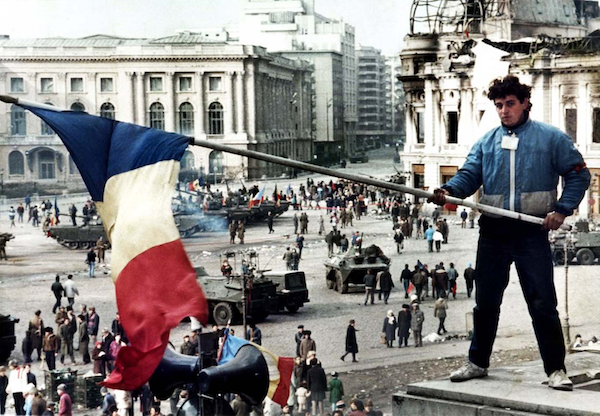
Symbolizing what?: a Romanian revolutionary from the 1989 anti-communist uprising, dressed in modern Western-style streetwear while gripping Romania’s national tricolour flag that still bears the Communist coat of arms in its center.
The truth is, streetwear’s rise was not only a bottom-up challenge to cultural hierarchies within the United States; it was also part of a broader historical moment in which American mass culture — rooted in working-class life — circulated globally as an image of freedom. In this sense, the U.S.’s cultural victory during the Cold War was not instigated through the efforts of elites or institutions, but through the appeal of an aesthetic of the ordinary. How the anti-capitalist world used streetwear as symbolic of rebellion (against authoritarian repression and capitalism itself) is a very important, and perhaps most far-reaching, part of the story. Seen from this perspective, the “American Century” was, to no small extent, the “Working-Class Century.” But we will have to wait for another book to elaborate on streetwear as an instrument of liberation.
Yulia Pereira is a Colombian designer, writer, and educator based in Bogotá.