
Visual Art Review: “Imagined Nation” and the Unfinished Work of American Democracy
By Lauren Kaufmann
In light of our current government, the show provides inspiration from the past, and it serves as an invaluable reminder that democracy has never been static, but ever evolving.
Imagined Nation at the Boston Athenaeum, on view through November 14.
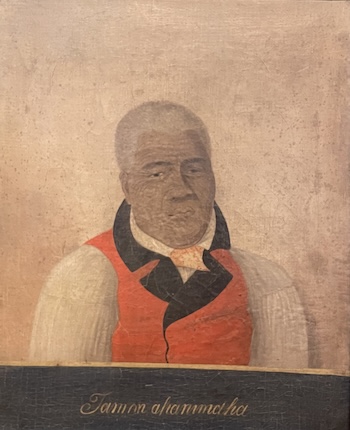
Artist Once Known (likely Chinese). After Louis Choris (Russian 1795-1828), King Kamehameha the Great, c. 1816-1817. Photo: courtesy of Lauren Kaufmann
With all the chaos going on in the world, it feels like a strange time to be celebrating the American experiment. But he we are, on the cusp of the country’s 250th birthday, and despite anxiety over our democracy, Boston cultural institutions are honoring the milestone with special exhibitions and programs. Blessed with a wealth of documents and artwork, our museums are doing a very good job of holding a mirror to the nation and its complicated past.
Imagined Nation at the Boston Athenaeum takes a critical look at our ever-changing democracy. The exhibit focuses on the aspirations of the country’s founders, spotlighting some of the leaders who envisioned its beginning. While there’s heavy emphasis on the nation’s early leaders, there’s also consideration of some modern artists and thinkers, who have reframed the past with a wider lens, expanding ideas about the country’s identity.
There are about 100 objects and works of art on display—paintings, sculpture, original documents, rare books, and maps. Over the course of the next nine months, there will be two rotations, and they will reflect shifts in thematic emphasis, as well as changes in the objects and artwork. The current theme is “History and Memory.” The second rotation, starting in mid‑May, will emphasize “Community and Place”; the third rotation, beginning in late August, will center on “Citizenship and Democracy.”
The objects and artwork on display represent varied viewpoints and interests. Reed Gochberg, who curated Imagined Nation, says that the diverse nature of the Athenaeum’s collection reflects the institution’s wide-ranging interests. Founded in 1807, the Boston Athenaeum is just steps away from the Statehouse, and possesses a large collection of historical documents and artwork—100,000 rare books, maps, and manuscripts, and 100,000 works of art. It plays an important role in the city’s cultural life, organizing exhibitions and lectures that examine the forces that shape the political, social, and intellectual life of Bostonians and New Englanders.
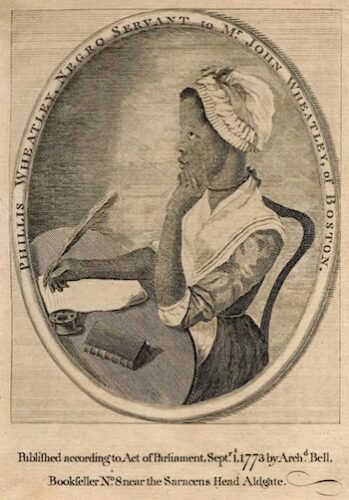
Attributed to Scipio Moorhead. Archibald Bell, printer, “Phillis Wheatley: Negro Servant to Mr. John Wheatley of Boston,” 1773. Photo: courtesy of the Boston Athenaeum.
There are several portraits on display. One of the more intriguing portraits is the first painting that the Athenaeum acquired, and the subject matter is a bit surprising. It’s an 1816 painting of Hawaiian leader King Kamehameha the Great. The portrait presents an older man of color, seen from the chest up, with a weary expression on his face. It’s a flatter, more intimate representation than the nearby, high-gloss portraits of George Washington and John Adams. The label states that King Kamehameha preserved independence from colonial oppressors for most of the 19th century. It also mentions that the painting was never displayed in annual art exhibitions at the Athenaeum, and was likely acquired as a curiosity. This bit of information reveals a telling detail about the Athenaeum’s early curators, who acknowledged the painting’s importance through its purchase, yet felt discomfort, or perhaps disinterest, in displaying it.
In a separate Community Label, an Athenaeum intern addresses the issue surrounding the unidentified painter of King Kamehameha’s portrait. Jamie Rose Valera notes that scholars believe that Chinese artists living in the Philippines made the painting. She comments that it is unusual to see Asian art that includes the greater Pacific region.
There are several Community Labels throughout the exhibit, and they usefully supplement information offered by the curatorial staff. I appreciate this effort, which provides more personal interpretations of the objects and works of art. I’m seeing this practice at more museums: it’s a great way to bring in diverse points of view, involve members of the local community, and demystify the curatorial process.
On the same wall as the portrait of Kamehameha the Great are two depictions of George Washington. In a painting from 1972, George Deem (1932-2008) presents two portraits on one canvas. The effect is of Washington gazing at his own portrait. It’s an inventive, effective way to portray the groundbreaking role that Washington played in our country’s history, and the inevitability of his introspective nature.
The second portrait, by Thomas Sully (1783-1872), is a copy of the famous Gilbert Stuart portrait of Washington. Here Washington is shown in his final year in office, surrounded by the symbols of his power. Wearing a sober expression, this version of Washington exudes the weightiness of the office.
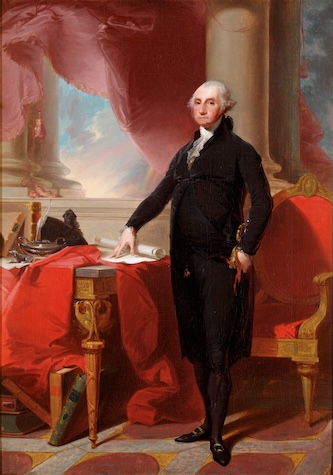
Thomas Sully, After Gilbert Stuart. George Washington, 1800. Image courtesy of the Boston Athenaeum.
The exhibit includes a display case filled with books from Washington’s personal library. The Athenaeum owns about 350 of his books, and several hundred pamphlets. The collection shows Washington’s wide-ranging interests—including agriculture, military strategy, natural history, slavery, Indigenous sovereignty, and the role of government. His signed copy of Thomas Paine’s Common Sense is a prized possession: it is often hailed as the book that helped persuad colonists to leave England and create a government elected by the people.
The topic of slavery in early Boston is a recurrent theme, and the Athenaeum has several documents relating to poet Phillis Wheatley, the first published Black poet in North America. Wheatley was kidnapped from West Africa as a young child and enslaved by the Wheatley family of Boston. Her poetry became well-known here, and eventually, around the world. The exhibit includes several examples of Wheatley’s work, including a poem entitled “Recollection,” which was printed in the Annual Register in London (although she was not identified as the author), and a print of Wheatley made by African American Scipio Moorhead, who had a brief career as an artist before being sold at auction.
A text panel explains that some of the Athenaeum’s early benefactors profited from the trade of enslaved people and the illegal sale of opium. The Perkins family, who were closely associated with the Athenaeum, enslaved an African man named Deyaha in Saint-Domingue, now Haiti. In 1791, they brought him to Boston. Although he was a free man, Deyaha continued to serve the Perkins family. A series of portraits of Deyaha and the Perkins family are on display. Their relationship reveals the tangled legacy of slavery, and the resulting injustice that has plagued people of color for many years.
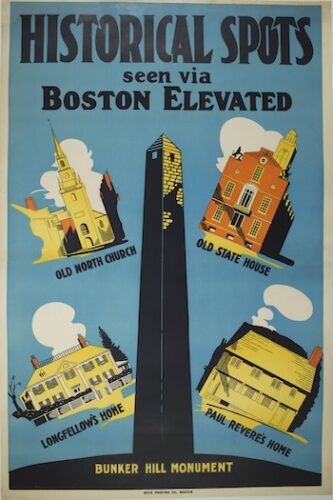
Eastern Advertising Company, Boston Elevated Railway Company. Historical Spots Seen Via Boston Elevated, 1925. Photo: courtesy of the Boston Athenaeum.
In a poster made for the Boston Elevated Railroad, dated circa 1925, several landmark sites—the Old North Church, the Old State House, Longfellow’s Home, Paul Revere’s Home, and the Bunker Hill Monument—are touted as places that are newly accessible by public transit. In a large map of Boston Common made for Boston’s 300th anniversary in 1930, a variety of points of interest are illustrated, but none mention the history of enslaved or Indigenous people. The omissions should not be surprising, considering the era, but we can look back now and broaden our perspective as we take into account the role these people have played in our history.
There are two works by Boston artist Allan Rohan Crite, who was recently honored with an exhibition at the Athenaeum, as well as one at the Gardner Museum. As a longtime resident of the South End, Crite witnessed and documented tremendous change in his neighborhood. The two lithographs on display here, made in the 1970s, feature sites on the Underground Railroad.
Imagined Nation and Revolution! 250 Years of Art + Activism in Boston (reviewed in The Arts Fuse) at the Boston Public Library both offer ways to think about our complicated past, and our still evolving identity. With so many significant works of art and written documents, these exhibits are new opportunities for visitors to view the country’s history, celebrate our progress, and instill hope for change. In light of our current government, the shows provide inspiration from the past, invaluable reminders that democracy has never been static, but ever evolving.
Lauren Kaufmann has worked in the museum field for the past 14 years and has curated a number of exhibitions.