
Visual Arts Review: “Persona” — The Gardner Museum’s Captivating Probe into Photographic Self-Reinvention
By Lauren Kaufmann
Overall, the exhibit offers a fascinating look at photography’s potential to pose challenging questions about who we are, how we are perceived, and how we can alter our self-image to interrogate our own sense of identity.
Persona: Photography and the Re-Imagined Self at the Isabella Stewart Gardner Museum, through May 10
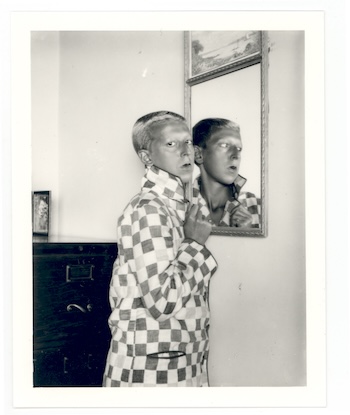
Claude Cahun, Self-portrait (reflected image in mirror, chequered jacket), 1928. Gelatin silver print. Photo: courtesy of the Jersey Heritage Collections
Persona: Photography and the Re-Imagined Self explores how artists use their art to pose complex questions about identity. Through appropriating alternative identities, using masks and mirrors, and staging self-portraits against imaginary and mythical backdrops, they probe and prod at their sense of self, prompting viewers to reconsider preconceived notions about gender and identity. While some of the artists dress up as literary or historical figures, others play with the cult of personality. All are questioning who they are, and how the world perceives them.
Photography and innovation have always gone hand in hand. Pieranna Cavalchini, curator of Contemporary Art at the Gardner, and Melissa Harris, editor-at-large at Aperture Foundation, spent three years putting together this exhibition, and they have produced an impressive show that is expansive, incisive, and global in scope.
The works presented in Persona span more than a century and represent artists from around the world. It is fascinating to see some of the early photos placed in conversation with more contemporary images; you can’t help but think about people’s ongoing quest to come to terms with the problem of identity. This universal search is not new, although artists have expressed it in many different ways over the years.
The earliest images date from the early 1920s. Marcel Duchamp (1887-1968) and Man Ray (1890-1976) used photography playfully. Duchamp adopted a persona — Rrose Sélavy — and posed for Man Ray. In Belle Haleine, 1921, Rrose appears as a model for an invented perfume bottle label. In Rrose Sélavy (Marcel Duchamp), Duchamp is decked out in a furry collar and jaunty hat, sporting dark lips and smoky eyes. These early works poke fun at social norms, pointing out the absurdity of conventional assumptions. At the time, Man Ray was attaining prominence as a pioneering photographer, inventing camera-less photograms that he dubbed “rayographs.” Duchamp was becoming famous for breaking down boundaries between works of art and everyday objects. The two collaborated on many projects over the years.
In other work from the 1920s, several photographs by Claude Cahun (1894-1954) show a young woman who adopted a pseudonym, shaved her head, and took self-portraits that systematically examined her notion of gender. Born Lucy Schwob, Cahun was a photographer, sculptor, and writer who experimented with a variety of disguises, dressing up as an aviator, dandy, doll, body builder, and vampire. Although Cahun’s work was not well known during her lifetime, it has drawn more attention in recent years as we more carefully consider our ideas about gender and beauty.
In a contemporary response to the work of Duchamp and Cahun, British artist Gillian Wearing created a self-portrait in which she dressed up as Cahun, holding a mask of her own face. In another image, Wearing made a locket with images of herself dressed up as Duchamp and his alter ego. If you didn’t know that the artist made these images in 2012 and 2018, you might think that they are from the 1920s.
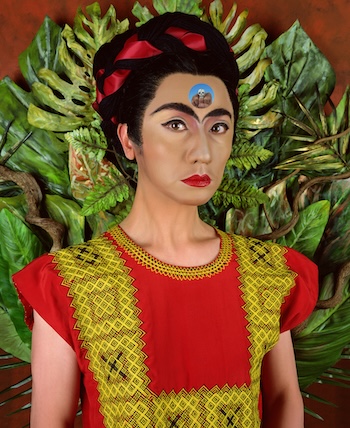
Yasumasa Morimura, An Inner Dialogue with Frida Kahlo (Skull Ring), 2001. Digital chromogenic print mounted on aluminum. Photo: courtesy of the artist
Egyptian photographer Lina Geoushy created a series of black-and-white photographs called “Trailblazers” that highlights Egyptian women whose accomplishments have been overlooked. In one image, she channels Sameera Moussa, an Egyptian nuclear physicist who became the first woman on the faculty of Cairo University. In another image, she morphs into Egyptian feminist Doria Shafik, who participated in a hunger strike in 1956 that resulted in Egyptian women obtaining the vote and the ability to run for elected office. Geoushy says that this project is about “reclaiming erased stories and building a living feminist counter-archive.”
In Not Manet’s Type, Carrie Mae Weems uses a mirror to create self-portraits, wondering why a famous white artist, such as Manet, would not see her as a worthy subject. Five photographs show us Weems in her bedroom, playing the role of an artist’s model. In one image, she writes: “I took a tip from Frida who from her bed painted incessantly — beautifully — while Diego scaled the scaffolds to the tops of the world.”
Frida Kahlo also plays a prominent role in the work of Japanese performance artist and photographer Yasumasa Morimura. Through digital manipulation, he creates an amalgamation of Frida Kahlo and himself. Morimura focuses on the pain that Kahlo suffered as a result of her medical problems and her tempestuous relationship with Diego Rivera. An Inner Dialogue, one of the two images on display, depicts a nude Kahlo/Morimura — there are straps cross her torso, nails inserted into her face and body. The image speaks to Kahlo’s martyrdom; in 1940, she painted a self-portrait with a crown of thorns fashioned into a necklace.
The late David Wojnarowicz (1954-1992) was a photographer and AIDS activist who was enamored with French poet Arthur Rimbaud, known for his transgressive, bawdy verse, which alluded to gay love affairs. In the four photographs on display, Wojnarowicz and his friends wear a mask of Rimbaud while posing in some of Wojnarowicz’s favorite New York City sites. Wojnarowicz made the mask from the only known image of Rimbaud.
In a work inspired by Oscar Wilde’s The Picture of Dorian Gray, Yinka Shonibare CBE RA, a British-Nigerian artist, produced a series of images drawn from the 1945 film adaptation. The lone color image depicts Shonibare — as the title character — at the moment when the portrait of the decayed visage of Gray is revealed. Shonibare says that his focus on Wilde’s protagonist underlines the role of the dandy as “both an insider and an outsider who disrupts such distinctions.”
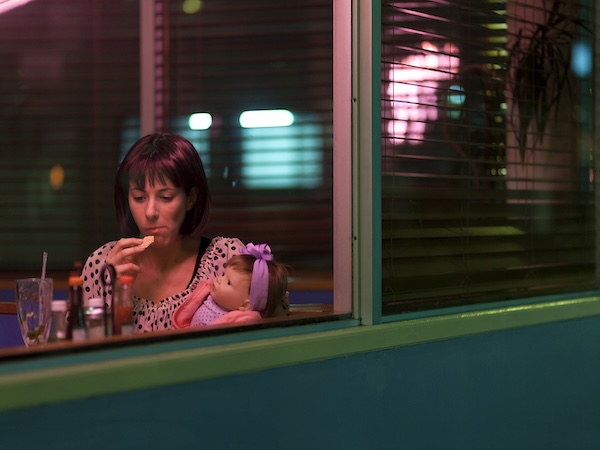
Jamie Diamond, I Promise to Be a Good Mother, 2011. Archival pigment print. Photo: courtesy of the artist and Kewenig Gallery
In a piece inspired by a work from the Gardner’s collection, Mary Reid Kelley and Patrick Kelley produced a video, The Rape of Europa. The Kelleys employed the Gardner’s enormous Titian painting and a re-creation of the museum’s courtyard as the backdrop for their video. Several still shots from their video are included in the exhibition. According to the myth, Europa was kidnapped and raped by Zeus, posing as a bull: the child born from this assault became the foundation of European civilization. Mary Reid Kelley plays an angry Europa, with eyes wide open as she takes in the violence.
Jamie Diamond plays with what she calls “the mask of motherhood.” In a series of self-portraits, the photographer holds a reborn doll — a lifelike baby doll that looks remarkably similar to a real baby. Diamond is also featured on the facade of the museum in a work called Monstra Te Esse Matrem. In this image, the artist stands tall, holding a baby in one arm, while two older children hide behind her. It is an image that many mothers will recognize, seeing themselves reflected in Diamond’s depiction of motherhood, a role that can define and limit women’s identity.
All of the work in Persona brings a tremendous imaginative power to investigating personal, social, and historical perspectives. For some of the photographers, adopting an alternative persona is a way to confront social convention or to express a personal statement. For others, it is a way to draw attention to historical figures whose lives and contributions have not been fully appreciated. Overall, the exhibit offers a fascinating look at photography’s potential to pose challenging questions about who we are, how we are perceived, and how we can alter our self-image to interrogate our own sense of identity.
Lauren Kaufmann has worked in the museum field for the past 14 years and has curated a number of exhibitions.