
Poetry Review: Matt Bialer’s “Time Is, Was, Will Be” — Love and Grief in an Eternal Present
By Michael Londra
Matt Bialer’s long poem doesn’t see time as a clock running to zero, but as an infinite love poem.
Time Is, Was, Will Be by Matt Bialer, Saint Julian Press, 68 pp, $18.
In his recent biography of New York School poet James Schuyler, Nathan Kernan described Schuyler’s “poetic territory” as “free verse put to the service of careful and fluent observation in real time.” Indeed, over the course of his literary career — recognized in 1981 with the Pulitzer Prize — Schuyler (1923-1991) believed lyric utterance should put “the reader in the position of making the same discoveries, at the same time, as the poet.”
Matt Bialer’s new book-length poem Time Is, Was, Will Be takes after Schuyler’s example. Reflecting the ebbs and flows of sensory perception, Bialer poeticizes human consciousness. Riffing on reality, time, and truth, his first lines set the tone: “Today is Sunday / November 5th / Four and one-half years / To the day / After my wife / Lenora / Died of breast cancer.” Illustrating the Freudian process of “working through” — shaping trauma into a narrative that converts suffering into meaning — Bialer’s stanzas give form to his sorrow: “I used to count / How many Sundays / I was out / From her death // It was like swimming / Further and further / Out in the endless ocean… The land / I was leaving behind / Her life.” Grief finds expression in compulsively keeping track of how many haircuts he’s had since he lost her, but even this strategy cannot really assuage despair: “it’s been / 28 haircuts // Even though / I stopped counting // Stopped counting // How many haircuts?”
Such inconsistency, however, amounts to small potatoes compared to the breakdown of identity. Bialer inverts the “personal is political” cliché, revealing how the world’s horrors exacerbate personal torment: “And I keep reading / About the wars / In the Middle East / And Ukraine // So much / Pointless death / And I spend / So much time / Struggling with / This one death.” Loss has “turned me / Into a freak / A mutant…I am / Always in conflict / Like I’m / Trying to withstand / A brutal invasion // A war within myself / A bombed-out hospital / Like I see on the news … The disintegration / Of my own infrastructure.”
Time Is, Was, Will Be desires to be a blueprint, offering ways to rebuild that internal network. Recollecting his wife of over 30 years, Bialer distills complex emotion into accessible details: “Our first date / At Café Dante … She played footsie with me … I had / never had / A woman / Be so bold.” By avoiding the false intimacy of grandiose rhetoric, the poet’s controlled, conversational style eschews sentimental overreach. Pathos emerges from simplicity. For example, at the hospital, the weight of mortality is communicated in four words by a nurse: “I hand fed her … Until a nurse / Told me / Not to … ‘Food doesn’t matter anymore.’” Such moments are akin to Willem de Kooning’s “slipping glimpses,” apertures in reality’s fabric constituting a trapdoor into infinity.
Indeed, Bialer’s title announces as much. Derived from obscure poet, diplomat, and clergyman Henry Van Dyke’s 1904 poem “Time Is,” Bialer quotes five of the lyric’s 11 lines as his epigraph. He’s not well known today, but Van Dyke (1852-1933) received some notice in 1997, when “Time Is” was read at Princess Diana’s funeral. Focusing on how fluctuating thoughts and feelings influence our understanding of time, Van Dyke argues that love’s transcendence suspends temporality: “Time is too slow for those who Wait, / Too swift for those who Fear, / Too long for those who Grieve, / Too short for those who Rejoice; / But for those who Love, Time is not.” For Bialer, it isn’t so much that love negates external reality, but that love and time are synonymous. Thus time suffuses these pages, from complex scientific theories to the humdrum: “This Sunday / Is Daylight Savings Time.” The buildup has a cumulative effect: “We can portray / Our reality / As either / A three-dimensional place / Where stuff happens over time / Or as a four-dimensional place / Where nothing happens.” Bialer believes this “nothing” means “change / Really is / An illusion … there’s nothing / That’s changing // It’s all just there … Time is, was, will be.” This, of course, is another way to describe what poetry is — an eternal present.
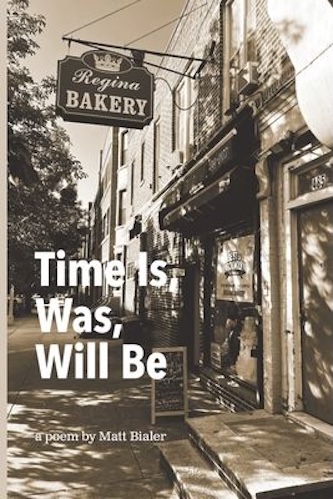
Bialer introduces us to Mary, Bialer’s “girlfriend / Of 3 and ½ years,” and Izzy, his daughter with Lenora, returning home from college to attend Mary’s birthday: “I am tasked / With buying the cake.” Picking the right confection is essential: “I walk into / Regina Bakery / In my neighborhood / In Brooklyn.” Owned by the same family for 50 years, the store represents longevity and happiness: “It’s been the same / For decades.” Its walls covered in “thank you cards / From local kids / Who love / Their desserts,” the old school joint seems to him to be suspended in chronological amber, where “Time is not real.”
Of course, a photograph can be another form of frozen time. It is no surprise that the book’s jacket is a photo of the bakery. Not only a poet, Bialer is also a street photographer. Images of his are housed in the permanent collection of The Brooklyn Museum, among other venues. His snapshot adorns the book’s cover. Apropos for this symbol of community, the birthday cake catalyzes the poem’s healing conclusion: “Mary says to me: / ‘You got me / The cake I wanted.’” Celebrating as a family, Izzy embraces Mary as “an important part / Of her life.” Lenora’s loss is therapeutically repositioned within a synthesized poetic vision.
Joining a diverse tradition of long songs that include Federico Garcia Lorca’s Poet in New York (1940) and A.R. Ammons’s Garbage (1993), Matt Bialer’s Time Is, Was, Will Be unearths universality from the commonplace — what Schuyler baptized “a day like any other.” Looking at time not as a clock running to zero, but as an infinite love poem, these last lines of Bialer’s may speak for all of us: “For the moment / Time is everywhere / And nowhere // I am so happy.”
Michael Londra — poet, fiction writer, critic — will be introducing a poetry reading addressing AI and Surveillance Capitalism at Poets House in New York on April 7. He talks New York writers in YouTube indie doc Only the Dead Know Brooklyn (dir. Barbara Glasser, 2022). His poetry has been translated into Chinese by scholar-poet Yongbo Ma. Two of his Asian Review of Books contributions were named among its Highlights of the Year for 2024 and 2025. “Life in a State of Sparkle—The Writings of David Shapiro” from The Arts Fuse was selected for the Best American Poetry blog. “Time is the Fire,” prologue to his soon-completed Delmore&Lou: A Novel of Delmore Schwartz and Lou Reed appears in DarkWinter Literary Magazine. He can also be found in Restless Messengers, The Fortnightly Review, Cha: An Asian Literary Journal, and The Blue Mountain Review, among others. Born in New York, he lives in Manhattan.