
Book Review: When the Face Disappears, the Painting Speaks — Ewa Juszkiewicz
By Margherita Artoni
Today, Ewa Juszkiewicz stands among the most incisive voices in contemporary art. Each work redefines how women may emerge in painting, charting new territories of meaning.
Ewa Juszkiewicz: Recent Paintings Text by Katy Hessel and Lisa Small, with Ewa Juszkiewicz and Jennifer Higgie. Rizzoli International Publications in collaboration with Gagosian, 176 pages, $120.
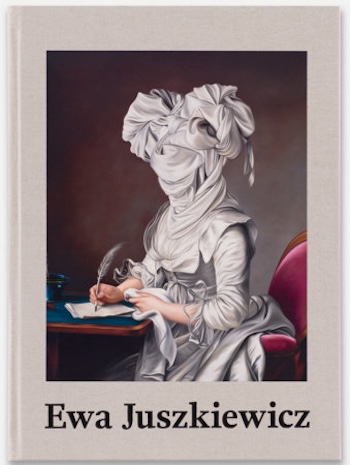
For centuries, in Western painting, the face has embodied self-definition, emotion, and social belonging, becoming the focal point of figurative narrative. In the portraits of Ewa Juszkiewicz, however, physiognomy dissolves, opening a space that invites viewers to read absence itself as expressive power. In her works, facial features give way to drapery, botanical elements, and ornamental details, creating a delicate balance between presence and omission — a device that is both deliberate and charged with meaning.
The volume Ewa Juszkiewicz: Recent Paintings gathers more than 30 works created between 2019 and 2024. Full-page reproductions and close-up details reveal the artist’s extraordinary command of technique, while installation photographs highlight the relationship between the paintings and their display context. Essays by Katy Hessel and Lisa Small offer complementary perspectives: one tracing the historical evolution of the female symbol in continental art, the other analyzing the aesthetic mechanisms that drive her investigations. A conversation with Jennifer Higgie illuminates Juszkiewicz’s innovative process and the ways she transforms historical works.
In her early pieces, such as 2012’s Straw Hat (after Élisabeth Vigée Le Brun), hints of the original remain recognizable, creating an enigmatic aura. In this work, the delicate lace ruffle and the partially obscured face invite interpretation: one might read the figure as shifting from a portrait into an emblem of aesthetic contemplation. In more recent works, like 2023’s The Promenade (after Joseph Wright) and In a Shady Valley, Near a Running Water (after François Gérard), facial features yield to intricate compositional structures, where lush decorative motifs take center stage. In The Promenade, the flowing patterns of the gown could be seen as guiding the eye through movement rather than expression; similarly, in In a Shady Valley, Near a Running Water, botanical motifs replace conventional facial cues, suggesting a dynamic interplay of natural forms and historical reference. These observations reflect one critical reading of Juszkiewicz’s interventions, emphasizing how each fragment carries poetic weight, suspending conventional judgment on female iconography and inviting viewers to perceive figures as open to multiple interpretations.
Juszkiewicz’s technique marries academic rigor with contemporary inventiveness. Oil paint is applied in thin, layered glazes, generating a chromatic rhythm that guides the eye. Light is calibrated to create both tension and shimmer, while tonal layering shapes depth and form. Every detail — from drapery to floral ornamentation — is executed with attention to movement and fall, transforming material into narrative vehicle. The overall effect produces dense, harmonious surfaces that invite immersive, sensory engagement.
Her visual language intertwines with both classical and modern references. From Goya, she inherits the ability to unsettle expectations; from Élisabeth Vigée Le Brun, she absorbs formal grace and reinterprets it critically; from Manet and Velázquez, she learns the interplay of physical presence and psychological ambiguity. Her work also enters a conceptual dialogue with Cindy Sherman, regarding identity construction; with Kehinde Wiley, in relation to portraiture; and with Marlene Dumas and Lynette Yiadom-Boakye, for subjective interpretations of the female figure. This dialectic positions her practice between tradition and innovation, demonstrating that painting can still probe the human condition in diverse ways.
Juszkiewicz reworks historical images, prompting new ways of engaging with European painting, rethinking its principles, and questioning conventions in the visionary realm of women. She carefully studies classical representations, deciphers their structures, gestures, and costumes, and transforms them into compositions charged with energy, texture, and flow. Artistic heritage becomes both a cognitive and theoretical medium: the past converses with the present, inviting viewers to reconsider the familiar and perceive the body and posture in fresh terms. References to the masters serve to explore the female topos and introduce new semiotic possibilities into contemporary painting.
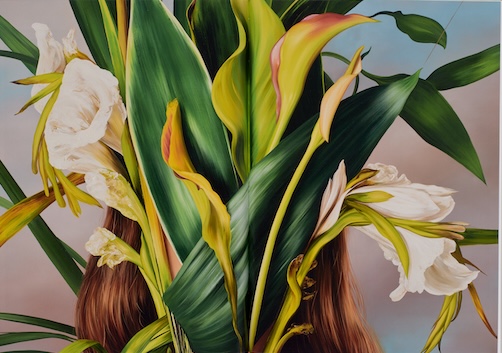
Interior spread of the book Ewa Juszkiewicz: Recent Paintings (Gagosian/Rizzoli)
Philosophically, her work evokes the Kantian concept of the noumenon — the thing-in-itself. The vanishing face elevates the canvas into a space for contemplation, where what eludes immediate perception reveals itself as a locus of thought. Absence creates an interstice, encouraging the mind to fill in what is unseen and to confront layers of reality beyond the sensible. Her approach suggests a metaphysical inquiry into what painting can reveal of the invisible.
Signs that stand in for the face function as suggestive markers, following established patterns without describing a specific individual. Every drape, embroidery, or botanical reference constructs a complex whole open to multiple readings. Juszkiewicz has stated: “My painting comes from a touch of contrariness; a desire to free myself from the rules imposed by our fashion and culture.”
Her study of historical works led her to recognize that many representations portray female archetypes trapped in rigid garments and prescribed poses, often idealized according to established norms. By reconfiguring these figures, she unveils previously unseen structures.
The sequence of works in the book guides the reader from early experiments to the most recent outcomes. The visual environment expands and becomes richer with various components, a balance of ornate patterns, motifs, and substitute forms of the figure.
Figures in her compositions appear as suggested profiles rather than fully realized individuals. Tangible forms oscillate between the contingent and the abstract, with delicate filigree hovering like immaterial imprints vibrating in silence. Juszkiewicz has developed an immediately recognizable iconographic repertoire, lending formal coherence to each work.
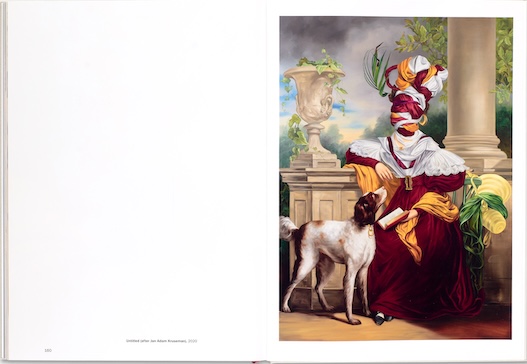
Interior spread of the book Ewa Juszkiewicz: Recent Paintings (Gagosian/Rizzoli)
Her paintings convey a sense of the unresolved, engaging both reflection and imagination. They demonstrate that skill and spirit can still coalesce in contemporary art. The book meticulously documents every stage of her vision, guiding the reader through the layered development of ethereal figurations.
Today, Juszkiewicz stands among the most incisive voices in contemporary art. Each work redefines how women can emerge in painting, charting new territories of meaning.
Ultimately, her practice opens new avenues for figurative painting, with the disappearing face as a point of unavoidable focus. Ewa Juszkiewicz: Recent Paintings marks a pivotal moment in her career, systematically presenting her production over the past five years, and documenting the evolution of her aesthetic and its experiments in form and perception. The book serves as a visual testament to her artistic maturity, offering the public, critics, and collectors a comprehensive overview of her creative journey and solidifying her place in the international discourse.
Margherita Artoni is a contemporary art critic and curator working between Italy and the United States. She began her career collaborating with Flash Art and currently writes for Segno, Juliet, Artribune, Exibart, Inside Art, ArteIN, part of cult(ure), The Arts Fuse, and Whitehot Magazine.
She has directed galleries in Turin — including NEOCHROME and EDGE Art Space — and in New York at TEAM Gallery. Her curatorial work has included exhibition programs with international artists such as Rashid Johnson, Theaster Gates, Ali Banisadr, Angel Otero, Tim Rollins & K.O.S., Laura Owens, and Mika Tajima.