
Book Review: All Scorsese’s Films — An Essential Guide to a Temple Guardian
By Tim Jackson
The hefty volume is consistently engaging and informative — a lively, visually appealing guide to one of cinema’s most formidable careers.
Martin Scorsese: All the Films, The Story Behind Every Movie, Episode, and Short by Olivier Bousquet, Arnaud Devillard, and Nicolas Schaller. Black Dog & Leventhal, $43.99
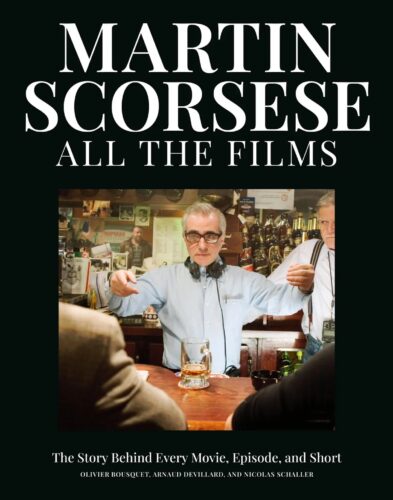 Martin Scorsese: All The Films offers a comprehensive survey of more than six decades of the director’s career. The book combines biographical notes, production histories, critical commentary, background details, anecdotes, and a strong selection of production photos. Coming in at 500 pages, authors Olivier Bousquet, Arnaud Devillard and Nicolas Schaller manage to keep chronology moving, supplying a clear, readable overview that informs and engages. Covering 26 feature films, 17 documentaries, seven shorts, and four television projects, the volume is a smorgasbord filled with behind-the-scenes photos, thematic essays, concise summaries, and insights into casting decisions and performances.
Best of all, there are welcome surprises along the way. Midway through the book arrives an essay entitled “Guardian of the Temple,” the temple being the “seventh art” of cinema. The piece goes into the making of the documentary series A Journey with Martin Scorsese Through American Movies, as well as his concerns with the fading of color film stock. The piece also contextualizes his 2019 comments on Marvel blockbusters: “That’s not cinema. Honestly, the closest I can think of them, as well-made as they are, are theme parks. It isn’t the cinema of human beings trying to convey emotional, psychological experiences to another human being.” He later clarified his position: in a response published in The New York Times, he stated that he believes that film is an art form — not just a business. Here is how he put it: “I’ve always felt visual literacy is just as important as verbal literacy.”
A lifelong infatuation with film and early appetite for B-movies contributed to a style that embraced an encyclopedic knowledge of Hollywood history as well as European art-house cinema. As a student at New York University’s Television, Film and Radio Department, Scorsese became familiar with the everyday workings of moviemaking. A formative directing workshop with Haig P. Manoogian led to a short feature, What’s a Nice Girl Like You Doing in a Place Like This. Intended as a horror film, the piece “actually turned out to be a comedy,” a statement that speaks to Scorsese’s sensibility, which is comfortable with paradox. The book notes that the hero of that film “already bears the hallmarks of the Scorsese antihero: anxious and paranoid.” It is infrequently screened, but can be viewed on YouTube.
Next came The Big Shave, a short film about a man shaving. Blood pours out razor touches flesh. The project has been called “a personal vision of death” (from Scorsese on Scorsese). The authors call this “the first Christ-like image in Scorsese’s cinema.” Next came a trilogy of small films, in which his mentor Manoogian instructed him to “free himself from the Hollywood format and to allow personal experience to express itself.”
Scorsese’s first commercial film was 1967’s Who’s That Knocking at My Door, while he was still at NYU. It was followed by 1972’s Boxcar Bertha, produced with Roger Corman, whose low-budget production methods were of use to many notables to come in film. Bertha was made in 24 days for $600,000 ($4.4 million in 2024 dollars) — it doubled its investment. John Cassavetes advised Scorsese, “You spent a year of your life making a piece of shit. You’re better than that stuff; you don’t do that again.” The warning stuck: 1973’s Mean Streets (originally titled Season of the Witch) established Scorsese as a personal filmmaker. It also introduced Harvey Keitel, whom the book calls “his double,” and cast the young Robert De Niro, who later became a well-known alter ego for Scorsese. The following year, the director also made the 49-minute documentary Italianamerican. Eschewing the tough talk of the streets, the narrative was about the young director’s parents, their roots, heritage, and family stories. It was a return to the stories of the immigrant experience that had initially fed his imagination.
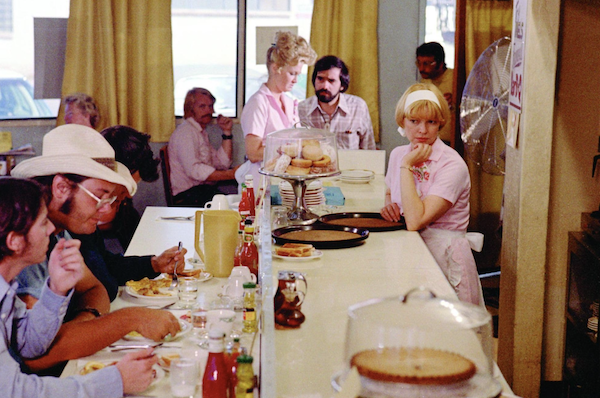
A scene from 1974’s Alice Doesn’t Live Here Anymore featuring Ellen Burstyn, Diane Ladd, and Martin Scorsese
In 1972, Alice Doesn’t Live Here Anymore followed, introducing the kind of strong female characters to which the book devotes an essay, “Blondes, Mothers, and Madonnas.” Amid the flood of films dominated by men with type-A personalities, women like Barbara Hershey in Boxcar Bertha, Sharon Stone in Casino or Lili Gladstone in Killers of the Flower Moon exemplified a response: these are resolute women who confront and/or endure childish men.
With Taxi Driver, which the authors call a “sociological horror film,” Scorsese fully established himself as one of the stars of the New Hollywood. An essay titled “With the Movie Brats” places the director into sociopolitical perspective alongside Coppola, DePalma, Spielberg, Lucas, and several others of this new generation of “friendly individualities with their own agenda.”
A venture into musical genres followed. New York, New York, the De Niro-Minnelli musical, was met with controversy and mixed reception, but The Last Waltz has become a landmark concert film, a star-studded record of The Band’s farewell performance. Before his next major project, Scorsese returned to an examination of his life and times with “American Boy: Profile of Steve Prince,” a 55-minute profile, reminiscent of the earlier Italianamerican. It was a quick experiment, an effort to “tell the story of America.” Prince was a sort of all-purpose worker for the director, best known for his small role as Easy Andy, the gun salesman in Taxi Driver. Prince is set up as the voice of his generation, representing its “disillusionment and excess.” This jittery film was never released, though it, too, is available online and at the Criterion Channel.
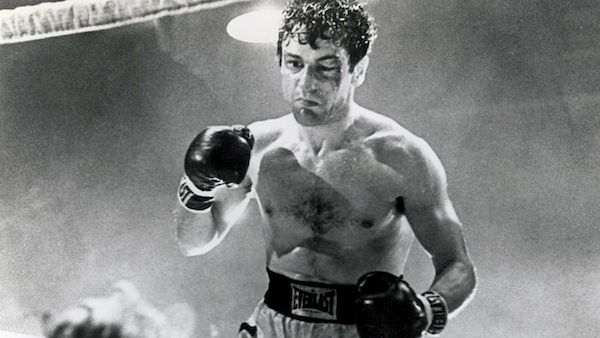
Robert De Niro in a scene from 1980’s Raging Bull.
While filming The Last Waltz, the director had become close with Robbie Robertson. In his 2016 memoir, Insomnia, the musician writes about what he calls the “outer limits of excess and experience” that the two experienced. American Boy and the production of Raging Bull (1980) came at a time when Scorsese was also sliding into serious cocaine addiction. This book, however, largely sidesteps that chaotic period. Instead, it devotes a detailed chapter to Jake LaMotta, Robert De Niro, and the film’s long, difficult path to production. Raging Bull is now acknowledged as a masterpiece.
In the 1980s, Scorsese continued his winning streak with King of Comedy, The Color of Money, New York Stories, and The Last Temptation of Christ. Each one furthers his experiment with genres. In 1990, he returned to the gangster picture with Goodfellas, based on Nicholas Pileggi’s book Wiseguy: Life in a Mafia Family. His editor, Thelma Schoonmaker, handed him the script, and his friend, 80 year-old British director Michael Powell (The Red Shoes), encouraged him to take it on to “revitalize the genre.”
The 1990s saw Scorsese expanding his narrative reach: remakes of Cape Fear and The Age of Innocence, a return to the gangster epic with Casino, the spiritual biography Kundun, and the urban drama Bringing Out the Dead. In the midst of this flurry came the three-part documentary A Personal Journey with Martin Scorsese Through American Movies (1995), first broadcast in the UK and later shown on PBS. The series was divided into three parts: “The Storyteller,” “The Illusionist,” and “The Smuggler.” The director speaks directly to the camera about the filmmakers who shaped him. He continued that cinematic reflection with My Voyage to Italy (1999), which traces Italian cinema from the silent era through De Sica, Antonioni, and Fellini. Together, the two documentaries form an aesthetic self-portrait: Hollywood and Italian neorealism, spectacle and moral inquiry, the twin traditions that define Scorsese’s paradoxical vision.
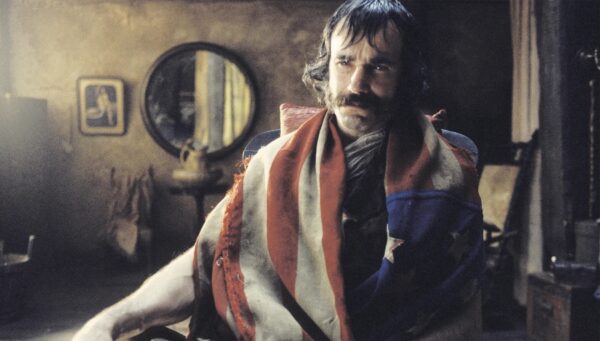
Daniel Day-Lewis in 2002’s Gangs of New York.
Following an essay titled “Blood on the Pavement: The Spectacle of Violence,” Martin Scorsese: All the Films dives into Gangs of New York, the first of the director’s many collaborations with Leonardo DiCaprio. That film was anchored by the bravura performance of Daniel Day-Lewis; it was also supported by a $77 million budget, with Robbie Robertson composing the score and Michael Ballhaus as cinematographer (he had shot five previous Scorsese films). Set in 1863 in the vicious Five Points section of New York, the director intended it to be a mythic film about democracy’s primal growing pains. He told writer Jay Cocks (who penned the script with Kenneth Lonergan and Steve Zaillian) that the film should emphasize archetype over historical reality, or, as Scorsese put it, “Think of it like a Western in Outer Space.”
This first two-thirds of the volume offers valuable insights into Scorsese’s artistic evolution across 18 features, several personal documentaries, shorts, and accompanying essays. The remaining third still has a lot of ground to cover, including eight more features and eight remarkable documentaries that Scorsese has directed since 2005. At age 83, he is still experimenting with genre while maintaining a commitment to examining the American cultural landscape. These investigations include No Direction Home, a series on Bob Dylan (2005); Shine a Light (2008), a Rolling Stones concert film; A Letter to Elia (Kazan) (2010); Rolling Thunder Review (2019); George Harrison: Living in the Material World (2021); and two television documentaries with Fran Lebowitz, Public Speaking and Pretend It’s a City.
Wisely, the authors do not attempt a definitive analysis of the director’s style and substance. Instead, Martin Scorsese: All the Films succeeds as a brisk, thoughtful survey of a large and significant body of work consolidated into a thick, coffee-table-style book that includes a generous array of photographs. The volume is consistently engaging and informative — a lively, visually appealing guide to one of cinema’s most formidable careers.
Tim Jackson was an assistant professor of Digital Film and Video for 20 years. His music career in Boston began in the 1970s and includes some 20 groups, recordings, national and international tours, and contributions to film soundtracks. He studied theater and English as an undergraduate, and has also worked helter-skelter as an actor and member of SAG and AFTRA since the 1980s. He has directed four feature documentaries: Chaos and Order: Making American Theater, which is about the American Repertory Theater; Radical Jesters, which profiles the practices of 11 interventionist artists and agit-prop performance groups; When Things Go Wrong: The Robin Lane Story, and Marblehead Morning: Daring & Stahl: 50 Years in Harmony. He has made two short films as well: Joan Walsh Anglund: Life in Story and Poem and The American Gurner. He is a member of the Boston Society of Film Critics. You can read more of his work on his substack.
Tagged: "Martin Scorsese: All the Films", Arnaud Devillard, Martin Scorsese, Nicolas Schaller