
Book Review: Will Self’s Moral Reckoning — Satire for a Decadent Age
By Ed Meek
As is the case with effective satirists, Will Self is nothing if not provocative.
The Quantity Theory of Morality by Will Self. Grove Press, 368 pages, $27.
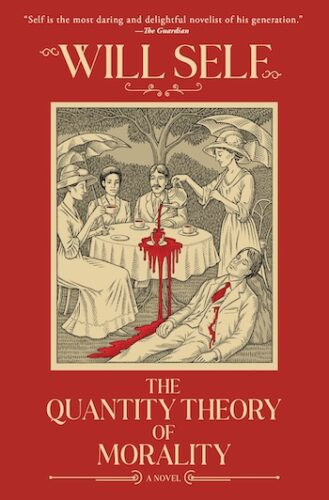 I’m late to reading Will Self, author of 22 works of fiction and nine works of nonfiction, shortlisted for the Booker Prize once, and the Whitbread Novel of the Year, as well as the Bollinger Everyman Wodehouse Prize. The Quantity Theory of Morality is a bookend to The Quantity Theory of Insanity, written 35 years ago. The former claims there’s a surfeit of insanity; his current novel brings back a character to argue there isn’t enough morality in our age to keep us on track.
The novel focuses on a group of upper-middle-class British friends who gather together over the course of a period of years. Self includes a character named after himself. Each chapter is written from the perspective of one of the characters. Self plays with their identities, depicting them as straight, gay, or trans in different chapters. Throughout the novel, he lampoons middle-class professionals, psychiatrists, government workers, spies, lawyers, financiers, Jews, AI, funerals, and mortality, among others. It is clear they’re floundering in a decadent era after the fall of the British Empire — a fate that awaits the United States as its empire wanes.
Self is a writer’s writer, partly because he’s constantly pushing the limits of fiction. He knows several languages and employs an astonishing word hoard. The novel is packed with references. He knows his Bible. Above all, Self is laugh-out-loud funny, to the point that if someone else is in the room when you are reading this book, you’ll want to read passages aloud.
Regarding the title: “The quantity theory of morality, Bettina, concerns the human propensity to do things they hold to be either right or wrong — to commit themselves to this exercise of justice, or injustice; and to allow either evil, or righteousness to enter into their being.” This brings up a question many of us find ourselves asking these days: How can the people running our country live with themselves? Self seems to think they are aware of all the harm they are doing. One of the characters, Dr. Busner, explains that if a group at the top is immoral, their actions cause others down the chain of command to go bad. Thus, in a corrupt, immoral administration, the tone is set by the President and his close associates, for horrific behavior among hangers-on like Noem, Patel, and Witkoff (and the entire Trump family). For Self, moral laxity among the higher-ups results in direct, harmful consequences throughout society (as in the sociopathic Epstein debacle).
Self’s writing is a pleasure to read: “I remember it was dark out as I walked towards the Barbican through the sepulchral emptiness of Smithfield on a Sunday.” The novel is replete with such vivid sentences.
Consider the humor: “After all, we’ve all known each other for years, and we don’t have any real secrets, do we?” “No, I thought to myself sardonically, except for what we do for a living, how much we earn, how much we have overall, who we’re sleeping with, what we truly, in our innermost hearts, believe, together with whatever we really think about someone … and everyone.”
For satire to really bite, it has to be true. I have no idea how much any of my friends are worth, and I’ve known them for 60 years! Who knows what we really think in our heart of hearts? Or consider this: “On and on she went: I suppose Joanie was attractive once, but I think she must have sampled her own breakfast pots too much, so that now she’s just another big, solid, pear-shaped Englishwoman of uncertain age, draped unsuitably in flower-patterned cotton and with a face as red as a poppy.”
Finally, each chapter is written in a different, yet fully developed voice. This is not a linear yarn for readers hooked on detective novels or page-turning thrillers. But if you love good writing and enjoy raucous invention and scathing lampooning, you will thoroughly enjoy The Quantity Theory of Morality. As is the case with effective satirists, Self is nothing if not provocative.
Ed Meek is the author of High Tide (poems) and Luck (short stories).
Terrific review that encourages me to read the novel. Thanks, Ed.