
Television Review: “Imperfect Women” — Apple TV’s Nuanced Soap Opera Explores Female Friendships and Class Strains
By Sarah Osman
While each female protagonist makes some rough decisions, the series never pigeonholes them as villains or saints.
Generally speaking, most of the shows on Apple TV fall into one of four categories:
- Sci-fi mysteries
- Charming comedies that, unfortunately, tend to be canceled
- Soap operas that verge on the trashy
- F1
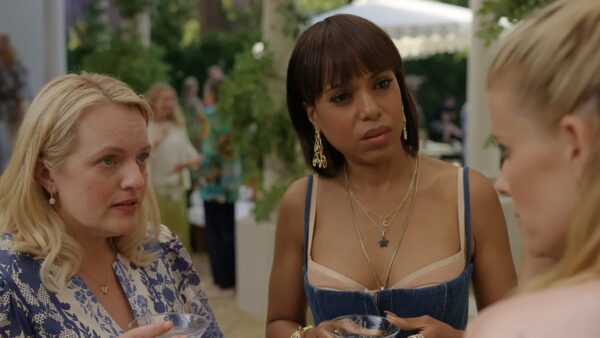
Elisabeth Moss, Kerry Washington, and Kate Mara in Imperfect Women. Photo: Apple TV
Apple TV’s latest addition, Imperfect Women, falls into the borderline trashy soap opera category. The series follows the questionable decisions made during the difficult lives of friends Eleanor (Kerry Washington), Nancy (Kate Mara), and Mary (Elisabeth Moss). What makes Imperfect Women different from other TV soaps is that it’s not focused on an overarching mystery but on the complex nature of female friendships, particularly the overwhelming pressure society puts on women to be perfect.
The proceedings begin with a bang: Nancy is murdered. Her two besties are understandably disturbed. Over the course of Imperfect Women‘s narrative, individual episodes spotlight specific women. We learn that Nancy is a former ballet dancer from Bakersfield who married into wealth. Her husband, Robert (Joel Kinnaman), turned out to be an alcoholic hot mess with an even more wayward family. Eleanor comes from an equally chaotic and controlling clan, and that only exacerbates her various griefs, leading to some bad decision Fridays. Mary is the eternal optimist who begins to realize that her perfectly curated domestic life may not be so paradisiacal.
Imperfect Women doesn’t start off with a bang — it’s a slow burn. It took a few episodes for me to become invested in its characters. But, once I was, I was hooked. The series plays with time; the storyline begins in the immediate aftermath of Nancy’s murder and proceeds to rewind back. Sometimes shows miscalculate when they choose a nonlinear narrative strategy — they’re a disaster. But Imperfect Women has been carefully thought out. Instead of indulging in arbitrary leaps into the past, it’s clear that we are receiving information at the right time for the right reason.
The lead actresses give powerhouse performances (not surprising, given the track records of Washington, Mara, and Moss). The male performers aren’t quite as strong (partly because they aren’t given as much to work with). Both Kinnaman and Corey Stoll (who plays Mary’s husband) do the best they can with playing frustrating spouses who are there to supply motives for their wives’ decisions and actions. Even the side characters, like Eleanor’s brother (played by Leslie Odom Jr.), are fully fleshed out.
It’s impossible for me to say which lead actress is the star, because the trio maintains an admirable balance. None of the women fall into the dreaded “antiheroine” trap, where their behavior can be chalked up to “oh, she’s the appointed rebel, that’s why she behaves so badly.” Eleanor, Nancy, and Mary are complicated characters who express real emotions, which are generated as they grapple with sorrow, envy, the demands of domestic life (particularly for Nancy and Mary), and the impossible standards to which women are held. While each protagonist makes some rough decisions, the series never pigeonholes them as villains or saints. Imperfect Women is a series that settles, effectively, into the soap opera gray.
Since I am from, and currently live in, Los Angeles, I enjoyed how the series tackles class distinctions. To a nonnative, the term “Pasadena socialite” may be baffling, but Imperfect Women fleshes out the term as it tosses in subtle nods to realities that only Angelenos would get. Los Angeles is often thought of as either a) pure glamour or b) pure squalor. In truth, most people live somewhere in between. Yet swimming in that “in between” are endless classes and sub-classes: the interactions among them can wreak havoc on families and friendships. The class distinctions among the story’s protagonists is one of the crucial conflicts in Imperfect Women. The tensions arising from social stratification are carefully explored, and that is refreshing. Few shows set in Los Angeles acknowledge these divides, let alone delve into them.
Sarah Mina Osman is based in Los Angeles. In addition to The Arts Fuse, her writing can be found in The Huffington Post, Success Magazine, Matador Network, HelloGiggles, Business Insider, and WatchMojo. She has an MFA in Creative Writing from the University of North Carolina Wilmington and is working on her first novel. She has a deep appreciation for sloths and tacos. You can keep up with her on Instagram @SarahMinaOsman and at Bluesky @sarahminaosman.bsky.social.
I am r enjoying the show – into episode 2 – not sure why the ratings are so low on IMDB (5.4) & Rotten Tomatoes (43%). It’s definitely at least an 8 in my view.
Starting off with your third paragraph would have been a good choice.
Apple TV consistently has the best series on television. I haven’t seen a trashy soap opera there yet.