
Theater Review: “The Antiquities” — An Alarming Futuristic Time Capsule Undone by Lifeless Design
By David Greenham
In his speculative play The Antiquities, dramatist Jordan Harrison has no trouble envisioning earthlings in the posthuman age.
The Antiquities by Jordan Harrison. Directed by Alex Lonati. Scenic design by Christopher & Justin Swader. Lighting design by Amanda E. Fallon. Costume design by Lila B. West. Sound design by Anna Drummond. Staged by SpeakEasy Stage Company in the Roberts Studio, Calderwood Pavilion, Tremont Street, Boston through March 28.
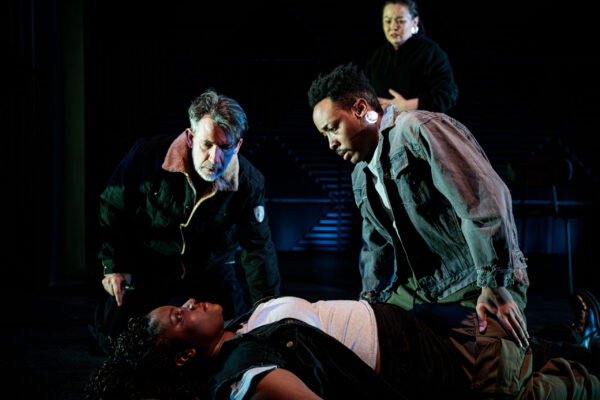
A scene in the SpeakEasy Stage production of The Antiquities. Foreground: Catia and Anderson Stinson III; background: John Kuntz and Helen Hy-Yuen Swanson. Photo: Benjamin Rose Photography
In his playwriting career, Pulitzer Prize finalist Jordan Harrison has been interested in exploring the delusions encouraged by human hubris. From the beginning, it has been commonly accepted that we are superior to everything around us. Save for the possibility that there are other intelligent forms of life in our universe — a concept we only take seriously in science fiction — we believe humans are more important than … anything else. Even the most ardent climate crisis advocates, perhaps in order to garner attention for the cause, tend to focus their fears about the future in terms of how the disintegrating environment will affect the fate of human beings. And even that argument has not shaken the comfortable assumption that the human race is too resourceful, too smart, and too entrepreneurial, to destroy itself.
Harrison, in his speculative play The Antiquities, has no trouble envisioning earthlings in the posthuman age. Set some time after 2240, the audience is welcomed by two robotic hosts, Woman 1 (Alison Russo), and Woman 2 (Kelsey Fonise). These AIs (in human form) ask audience members to imagine that we are taking a tour of the late-human age: we have been given bodies that somehow arrived at the auditorium. We can sense and feel as humans purportedly once did. We are walking through a permanent collection in the museum of late human antiquities. Drawing on detritus from when humans roamed the earth, the museum creators have cobbled together an instructive look at a time when people ruled.
Suddenly, we are brought to the 1816 exhibit. It’s that summer of literary legend at Villa Diodati at Lake Geneva, Switzerland, when Mary Shelley (also Russo), is huddled around a campfire with her husband Percy Bysshe Shelley (Jesse Hinson), their friend Dr. Briggs (John Kuntz), George Gordon Lord Byron (Tobias Wilson), and Mary’s stepsister and Byron’s mistress, Claire Clairmont (Fonise). It’s here where Mary Shelley first conceived the story of Frankenstein, the scientist who explored the notion of regenerating life from dead tissue.
The next exhibit, set in 1910, provides a glimpse of the dawn of the industrial revolution. Here Dinah (Helen Hy-Yuen Swanson) sits in her factory barracks in an American city, mourning the loss of her finger, which was chopped off in a machine. Rose (Catia) sits with her, book in hand, trying to learn to read. They are visited by a father (Hinson) and his son Tom (Harry Baker). The father admits that he and his wife can’t take care of all of their children, so he wants to have Tom – a boy of 10 or so – be taken in by the women so he can work at the factory.
The next time-hop is to a Menlo Park dive bar in 1978 where Stuart (Anderson Stinson III) is celebrating his creation of a self-learning robot. He’s sharing his joy with a skeptical bartender (Fonise), and a regular customer (Kuntz) who’s already half in the bag. “This is like baby’s first step,” Stuart says, “one day your car is gonna drive you around, and you’ll think it’s nothing,” he adds, concluding, “a non-organic being will raise your kids for you.”
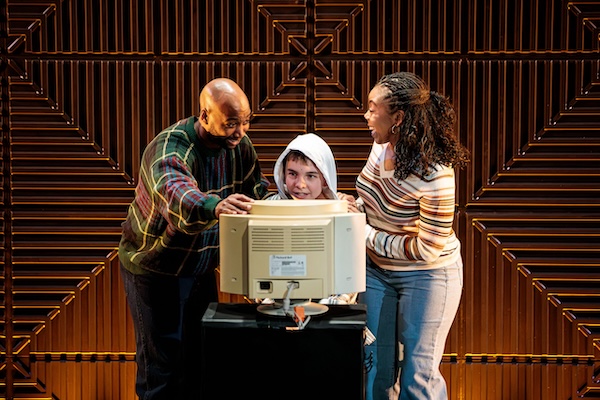
A scene in the SpeakEasy Stage production of The Antiquities. From left to right: Tobias Wilson, Harry Baker, and Kelsey Fonise. Photo: Benjamin Rose Photography
The glimpses of times past continue. 1987 arrives. Stuart’s sister Joslyn (Russo) struggles to comfort her son Noah (Baker) in the days before Stuart’s death, from AIDS, to 1994. A family (Wilson, Fonise, and Baker) plugs in its first personal computer and we hear the familiar dial-up internet sounds. Then it is 2023, and we see a recently fired employee (Catia) confronting a couple of lawyers (Hy-Yuen Swanson and Kutz) to determine the cash settlement she’ll receive for keeping quiet about the dangers of the AI system that their company has devised.
By the time we arrive at the scenes set in 2076 and 2240, it’s clear that we’ve created a dystopian world controlled by machines — humans are considered a subspecies.
Harrison has created a time machine that cranks out images that are both foreign and familiar. The ensemble of nine actors is asked to bounce around, from place to place and time to time, in a script that dramatizes scenes that reflect the power of our curiosity, tinged with intimations that our actions might eventually lead to dark places that lead to self-destructive places.
The ensemble cast seamlessly manages the many character changes they are called on to make, helping to make the short scenes engaging. The parade of scenes and time periods are unrelated — aside from the theme — but our brief encounter with Stuart (Stinson III), the gay robotics/artificial intelligence designer, and his grieving sister Joslyn (Russo), is poignant. They never meet up in the play, but a lovely link is established between them. The scenes in which she shares her grief with her son Noah (Baker) supply some of the most emotional moments in the production.
The message of The Antiquities is clear — our choices matter. Yet a choice that the SpeakEasy Stage production makes undermines the script’s theatrical power. Director Alex Lonati and the design team made the decision to lean heavily into Harrison’s image of a lifeless world to come.
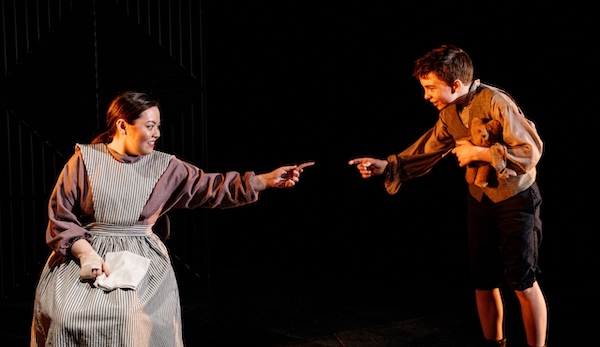
A scene in the SpeakEasy Stage production of The Antiquities. From left to right: Helen Hy-Yyen Swanson and Harry Baker. Photo: Benjamin Rose Photography
The setting by Christopher and Justin Swader features a dark wall filled with repeated textured tiles that could have been created by a 3D printer. Amanda E. Fallon’s sepia-toned lighting is often too dim and flat. Costume designer Lila B. West dresses the play’s characters in predictable period costumes, rather than making use of a more inspired approach that would better reflect the historical context. Anna Drummond’s soundscape is at its best when it uses recognizable sounds from the past to establish place. All too often it relies on electronic droning sounds to signify the futuristic nightmare.
The 100-minute production is performed without an intermission, and the director’s approach to the numerous transitions from scene to scene was off-putting. As each episode ends, the actors drop their human characteristics and move robotically — they become part of some futuristic army charged with adjusting the locations of the chairs and tables that make up the pieces on the set. This choice robs the production of any forward dramatic momentum. Each scene has to build its energy and movement from the get-go, and this is a tall order because most episodes are quite short.
The result is that this intriguing script, which encourages us to reflect on our behaviors as human beings, feels strangely dated, a throwback to the old “futuristic” sci-fi films of the 1950s. The design choices undermine the immediacy of the play’s warning about where we are headed. (Check current headlines about the worldwide rush, with billions invested and billions more to come, to create artificial sentience.)
Why is Harrison’s wake-up call so necessary? Woman 1 (Russo) notes at play’s end, “What seems clear is that humans thought of themselves as the endpoint. The final step of evolution. When the truth was, they were a transitional species. A blip on the timeline.” Libertarian high tech billionaires and their paid-for authoritarian-friendly supporters in government believe that being a “blip” is a good thing, and they are doing their infernal best to help push humankind to the exit. Time to throw a monkey wrench in that evolutionary scheme.
David Greenham is an arts and culture consultant, adjunct lecturer on Drama at the University of Maine at Augusta, and is the former executive director of the Maine Arts Commission. He can be found at https://davidgreenham.com/