
Book Review: Unquiet Graves and Uneasy Truths in “Centroeuropa”
By Peter Keough
An engaging and entertaining mystery, told in an evocative period setting, that deconstructs narrative conventions, analyzes the artifice of identity, and critiques the capitalist patriarchal system.
Centroeuropa by Vicente Luis Mora. Translated from the Spanish by Rahul Bery. Bellevue Literary Press, 192 pages. $17.99.
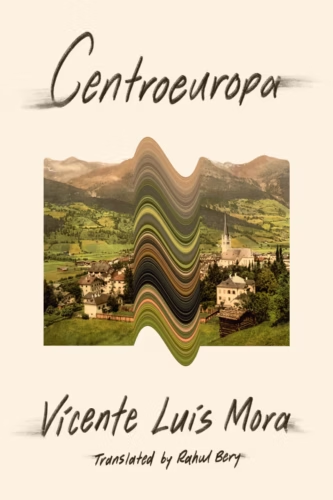 What if the soldiers killed in wars over the past two thousand years began to emerge from their graves to reproach those who have ignored them or have profited from their sacrifice? These days you’d have to include murdered civilians too, like the thousands of dead children killed in Gaza or the 150 or more obliterated by an apparent US strike in Iran.
The disinterment takes place on a much smaller scale in Spanish author Vicente Luis Mora’s playfully uncanny novel Centroeuropa, when a freeholding farmer digs into the frozen soil to bury a beloved wife and unearths the perfectly preserved corpses of two hussars killed in the recently concluded wars with Napoleon. These will be followed by four more casualties from a different war, and then more and more, the number doubling with each macabre discovery. Centroeuropa not only provides a timely reminder of the death toll mounted by profiteering warmongering leaders, but at the same time also deconstructs narrative conventions, analyzes the artifice of identity, and critiques the capitalist patriarchal system, all while succeeding as an engaging and entertaining mystery told in an evocative period setting.
The circumstances resemble those of the young pioneer in John Ehle’s saga of the 18th century Appalachian frontier, The Land Breakers (1964), whose wife has also died just as the two have set out to shape their future in their new homestead. But, instead of creating a new civilization by excavating the wilderness, in this case the settler inadvertently excavates layers of civilization and uncovers the wilderness beneath. Like Ehle’s tragic couple, Redo and the late Odra Hauptshammer had hoped to restart their lives by moving from Vienna to the Prussian town of Szunden in the early 19th century, where they would be among the country’s first private, non-aristocratic landowners. To fit into the new community, which is transitioning from a feudal society to a more bourgeois capitalist structure, the couple had decided they must be cagey about their background and their identity, not the least about their connection with a Vienna brothel.
“If I was going to have friends in Szunden,” Redo notes not for the first time in his manuscript, “I was going to invent for myself a past full of coherent details.” In other words, become a fiction writer, an artfully artless and admittedly unreliable first-person narrator of the tale we are reading. “I ask the potential reader to forgive me for faltering as I expound,” the amateur memoirist apologizes, “for these memories constitute the first long text I have ever put to paper, and the past is so wide, long, and deep, that choosing any single part as a starting point constitutes, in a way, an imposture.”
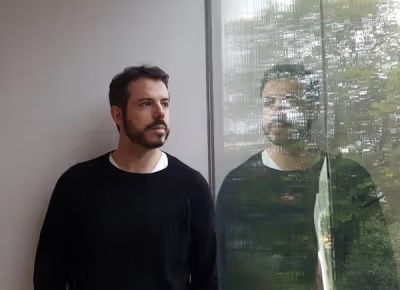
Spanish novelist, poet, essayist, and literary critic Vicente Luis Mora. Photo: Virginia Aguilar
An imposture Redo pulls off with aplomb if with ambivalence, writing, “I laughed between tears, thinking of the play I was staging against my will, at once dramaturg and tortured protagonist.” Nonetheless, the task of reinvention and integration at first goes smoothly: the locals are sympathetic to the recently bereaved stranger with an admirably luxuriant, well-tended beard. Among these is Jakob, a well-off, well-read bourgeois, a fan of Enlightenment thinkers, and a history buff. Another is the albino witch Ilse, who has the gift of prophecy. Between the two, Redo is offered guides to an equally baleful past and future.
Meanwhile, the faltering farmer is stuck in the present with the accumulating corpses preventing him from burying Odra or planting a crop of sugar beets. The local authorities are unwilling to commit themselves to finding a solution to such an unprecedented challenge to rationality, morality, religion, and the status quo. Redo is forced to bury and unbury and bury again the mounting crop of cadavers. It’s a version of Hitchcock’s The Trouble with Harry (1955) except the lone, inconvenient corpse is multiplied exponentially, and the trouble is not just with Harry but with history itself.
Jakob offers a pre-Marxist vision into how the interdepartmental conflict about the disposal of the bodies is not just bureaucratic but systemic. The problem: society is transitioning into a more advanced means of production, moving from the feudal to the bourgeois. “There are always objections whenever two administrations join,” he explains to Redo. “And in this case, two eras: the past one, represented by Geoffman [the local land-owning baron], and the new one, symbolized by you, Szunden’s first free farmer.”
But the real quandary, Jakob tells him, is that the dead are a reproach to the living, a rebuke to the powers that be that owe their existence to the incalculable toll of those killed in their service. “A nation cannot survive with the truth exposed,” Jakob informs Redo. Or can it? If that were so, then the mortal revelations in Redo’s field would put an end to the slaughter. But, when soldiers from the future begin to emerge, it is horrific proof that, even when the truth is exposed, it will make no difference.
Peter Keough writes about film and other topics and has contributed to numerous publications. He was the film editor of the Boston Phoenix from 1989 to its demise in 2013 and has edited three books on film, including Kathryn Bigelow: Interviews (University Press of Mississippi, 2013) and For Kids of All Ages: The National Society of Film Critics on Children’s Movies (Rowman & Littlefield, 2019).