
Book Review: Dead but Dealing — Alain Mabanckou’s Pointe-Noire Necropolis
By Kai Maristed
Dealing With the Dead achieves something else no outsider, however gifted or knowledgeable, could pull off: showing how magic, superstition, religious faith and credulity (as in, a hunger to believe) play into the everyday lives of most Pointe-Noireans.
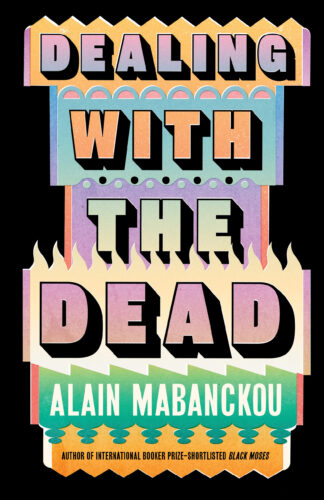
Dealing with the Dead by Alain Mabanckou. Translated from the French by Helen Stevenson, The New Press, 208 pages, $24.99
 “You tell yourself over and over till you come to believe it: your new life started an hour ago, when a shock ripped through the earth around you, and you felt yourself being sucked up by a cyclone then flung down where you’re lying right now, on a heap of earth topped with a brand-new wooden cross.”
This, the opening sentence of Dealing with the Dead, conveys the novel’s fantastical substance and down-to-earth (sic) tone far better than any distanced description could. Yes indeed, the central character, Liwa— ‘you,’ because the book is narrated throughout in the second person—is dead. And no, he hasn’t yet come to grips with that fact, especially because he’s only twenty-four years old, a working-class orphan raised by his beloved granny. A hotel kitchen helper who only seven days earlier was partying along with all of Pointe-Noire, Congo, to celebrate Independence Day.
Ever since his earliest poetry publications, on through a Booker nomination and two Goncourts, ditto, to this, his fourteenth novel, the French-Congolese writer Alain Mabanckou has enlivened the sometimes air-starved French literary scene with fresh and original fiction and poetry. On the surface, he likes to present as a good-natured iconoclast, not averse to visual slapstick and verbal clowning—his social media posts often feature boldly colorful costumes and a pair of jolie-laide little bulldogs. All the while, he has crafted a body of work that does what some consider the only job of fiction worth doing: leading readers inside the lives of people utterly unlike themselves. His fellow novelist George Saunders puts it this way: “Fiction is a kind of compassion-generating machine that saves us from sloth. Is life kind or cruel? Yes, Literature answers.” Saunders and Mabanckou… two recent chroniclers of graveyard tales. And both descendants of Nathaniel Hawthorne, perhaps?
But let’s get back to our hero, Liwa, stranded on his hummock of fresh earth in the cemetery of Frère-Lachaise. No, that’s not a typo, but a typically deadpan Mabanckouean play on the name of the famous Paris cemetery, Père Lachaise. The difference being that here in Pointe-Noire, it’s the graveyard for the poor, who are not allowed into La Cimetière des Riches. Kept out by whom? Well, the living, naturally, but above all by the jealous dead, who have a chronic real estate crisis to manage, space having become awfully tight underground, which is one reason why many of the dead make ‘deals’ with fetishists (witch-doctors, if you will) who in turn cut deals with the living to harbor spirits in their bodies—not usually a comfortable arrangement—in exchange for fortune or revenge or love or any of the usual prizes. For the least scrupulous above ground, such goodies can be had simply for a major blood sacrifice. (Children are prized. Premium on relations. Super premiums for albinos and twins).
The novel is classically divided in three parts, starting with ‘The Longest Dream of Your Life.’ Of Liwa’s life, though not in his life, for after getting to his feet — “supporting yourself on that wooden cross… you’re wearing an orange crepe jacket with wide lapels, a fluorescent green shirt with a large collar…purple flares… and your shiny red white-laced Salamanders” — Liwa falls into a sort of dizzy trance. Vignettes of his past unspool, in no fixed order. Providentially, they fill in his relatively short history as a happy, mischievous kid with a passion for soccer, pier-fishing, and the book Tom Sawyer. However, they give no hint of how or why he died. That will remain the central mystery until near the end. His longest dream guides us into the complex social structure of Pointe-Noire, notably the solidarity among market women, an informal mutual insurance system that gave his young, beautiful mother a fine burial. Liwa dreams back through the four days of his own funeral, his corpse lying in state in his beloved grandmother’s shack, the singing, feasting, dancing, and consoling of old Mà Lembé. It’s often touching, a mix of laughter and tears, but one is eager to return to Liwa’s present predicament.
In part two, ‘At Frères-Lachaise,’ Liwa, back on his feet, is greeted by a parade of hair-raising, well-moldered denizens of the cemetery. Each has her or his story to tell (and all the time in creation to tell it.) These are tales of the often murderous rancor between various tribes, especially those of northern versus southern Congo. About who the principled fetichists are versus the quasi-devils. About the gross excesses of the clergy. About political treachery and corruption, with President Papa Mokonzi Ayé alias Zarathustra (quite an anecdote behind that moniker) stirring the pot and offing his opponents. He’s brought up short only when a general strike by the dead “currently rocking Pointe-Noire, and threatening to spread across the country,” according to one minister, looks likely to topple his reign. Wrongs galore, precious few rights. And yet Liwa is warned more than once not to return to the city, the land of the living, if it be in search of revenge. Only to do good. Are you listening, Liwa?
Part three, ‘At the Ceremonial,’ starts with Liwa about to breach the high walls of Frère Lachaise with surprising ease, and set off for town. “It’s up to you now to steer the direction of your life, or rather, your death.
“You tighten your bowtie. You check that the musketeer cuffs are showing … you’re past caring if some people find your outfit ridiculous. It’s not what you wear, it’s how you wear it, you tell yourself.
“You imagine the other deceased spying on your movements, saying to themselves that they’d always known you’d go back for revenge. You can almost hear Black Mamba quoting to them the proverb he claims, baselessly, originated with his tribe:
‘Only a fool measures the depth of the water with both feet.’
You’re not a fool, you know what you’re doing… there’s no way anyone is going to stop you…”
From this point on, headlong determination, action and various plot elements quietly inserted throughout the novel run an increasingly breathtaking relay race, leaping obstacles up to the final, unforeseeable finish.

Author Alain Mabanckou. Photo: Caroline Blache
The quote above typifies the flawless translation by Helen Stevenson. In an end note, she mentions having benefited for the first time (this was their sixth collaboration) from an audio version as read by ‘Alain’ himself. “To hear… his genial, trenchant, ironic voice…is extraordinary, like hearing a composer perform their own work.” After listening to Le commerce des allongés myself for this review, I agree, and enthusiastically recommend it to anyone with enough French to follow along.
Like the cemetery it portrays (there is in fact a Frères-Lachaise) Dealing with the Dead proffers a surface appearance—unhurried, even meandering, picaresque and picturesque by turns—a string of beguiling tales something like The Arabian Nights, except with a contemporary wink and bite. Often amusing, with a disarming touch of the folkloric.
Below that surface is where Mabanckou works his own brand of magic. For one thing, he is a teacher. Rendering Pointe-Noire as recognizable and familiar as, say, Paris, has long been his project. Many of his novels paint the region’s geography, open ‘Western’ eyes and ears to its beauties, ravages, and cadences. Faulkner’s monumental creation of Yoknapatawpha County comes to mind, a signal difference being that Pointe-Noire is real, albeit a place most ‘Westerners’ are unlikely ever to set foot in. But thanks to Dealing With the Dead and other tales set in Mabanckou’s hometown, we walk its waterfront and dance in its bars and duck the police and share family meals, and start to grasp the Congo’s power politics and complicated, deeply buried past. Who has heard of the 17th century Christian prophetess Kimpa Vita, for example, a legend in her time, who fought for the unity of her native country?
Hometown. Certainly Mabanckou’s books draw heavily on his personal history. His other major theme, alongside Pointe-Noire, is the life of Congolese ex-pats in Paris. (Black Bazaar was my first Mabanckou, and remains one of my favorites. I rolled off the sofa laughing.) Here he veers again from slapstick to caustic, from tenderness toward his characters to treating them with surprising roughness. His newest novel, Ramses of Paris, is a prime case and another walk on the wild side for readers to look forward to, once translated. These novels are as far in mood and substance from the French-led wave of self-regarding, repetitive autofiction (Annie Ernaux in the lead) as the lively African quartiers of Paris are from the monotonic Champs-Elysees.
Dealing With the Dead achieves something else no outsider, however gifted or knowledgeable, could pull off: showing how magic, superstition, religious faith and credulity (as in, a hunger to believe) play into the everyday lives of most Pointe-Noireans. It’s startling, even risible at first. One expects the authorial superego to barge in at any moment, waving the flag of empirical rationality, affirming that he and we are above such stuff. But no. The story rules. This is reality. This is how life is here. No judgment.
Plot is one thing and story another. Plot requires some engineering; story wants vision, pure imagination, a will to wander. Mabanckou can set a plot as well as the next novelist, but it’s in the stories, the layering of his people’s wildly divergent experiences whether in this world or the next, that his wit, tenderness and sometime flares of righteous outrage shine the brightest.
Kai Maristed’s work has been published in Agni, Ploughshares, Five Points, and elsewhere. Her books include Broken Ground, praised by John Coetzee, and Belong to Me, starred by PW. This fall saw standing ovations for her full-length play, Paul and Émile. Her new, prize-winning story collection, The Age of Migration, will be out in July.