
Book Review: “Eating Ashes” — A Haunting Tale of Migration and Mourning
By Brooks Geiken
Sliding back and forth between the past and the present, Eating Ashes paints a gritty, emotional, and forceful vision of a family traumatized by disconnection.
Eating Ashes by Brenda Navarro. Translated from the Spanish by Megan McDowell. W.W. Norton, 240 pages, $24.99
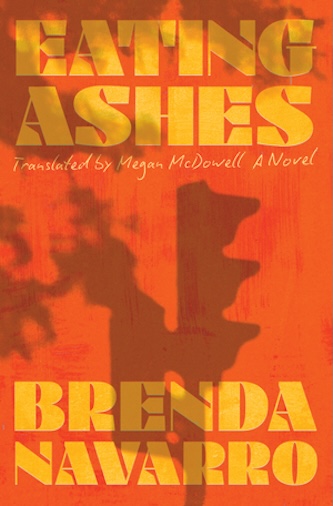 Mexican author Brenda Navarro, now residing in Spain, fuses forceful prose and intimate loss in the first paragraph of her novel Ceniza en la Boca (translated as Eating Ashes). The nameless female narrator lays out a hard truth: her brother Diego is dead. Once that reality is stated, the backstory begins. What led up to Diego’s demise? Navarro plunges into the relationships among the narrator, her mother, and Diego. Navarro pulls no punches when detailing the harsh facts of life for the trio in Mexico; existence in the country for the underclass is brutish, short, and untenable. Important, painful, and life-changing decisions must be made.
The violence of everyday life, compounded by limited opportunities for employment, force the mother to make a gut-wrenching decision — she must move to Madrid, Spain. While she is starting a life there, Diego and his sister are left with their grandparents in Mexico. Sister and brother are paralyzed by feelings of abandonment and longing. Eventually, the siblings are reunited with their mother in Spain, but the reunion is only a momentary improvement. The sister faces difficulties when she obtains employment in Barcelona, while Diego is ostracized at school.
Immigration is a horrific issue in America today: masked ICE agents are terrorizing immigrants (legal and non-legal), harassing or detaining people without legal warrants, placing many in detention centers. Two protestors in Minneapolis were killed. In Eating Ashes, immigration is viewed from a somewhat different angle — that of a family attempting to establish a secure foothold in a new country. Displacement leads to alienation in this narrative — local prejudices reject immigrants. Both of the children were made to leave their homeland at too young an age — the separation deepens their feelings of isolation. Diego can only find solace when he is listening to Vampire Weekend or getting high on weed; the narrator escapes her unhappiness by embracing a sexual relationship with Tom-Tomás. The mother becomes absorbed by her job and grows distant from her kids. In response to this domestic disruption, the narrator and Diego are constantly fighting and bickering with each other.
That said, the narrator seems to adjust somewhat to life in Spain, while her brother has an extremely difficult time, especially in school. Diego is constantly bullied verbally by his classmates and ends up fighting with one of the boys. Diego is from Mexico, so he is treated with hostility because he is stigmatized as an outsider. Diego becomes more withdrawn and depressed as the narrative progresses — culminating in the tragedy mentioned early in the novel.
After she returns to Mexico with Diego’s ashes, the narrator discovers that some of her friends have died. Navarro implies that a few of these school friends died at the hands of the narcotraficante, members of a drug cartel. In an attempt to renew her connection with her past, the narrator hooks up with one of her old friends from school — but that relationship quickly fizzles out.
Sliding back and forth between the past and the present, the novel paints a gritty, emotional, and forceful vision of a family traumatized by disconnection. Navarro has a gift for convincing dialogue, for capturing Mexican speech patterns. Diego, his sister, and their mother are vivid, realistic presences in Eating Ashes, a powerful novel about a family that fares — unsuccessfully — in survival mode.
Note: Actor, producer and director Diego Luna is directing a film adaptation of Eating Ashes. It may be released this fall
Brooks Geiken is a retired Spanish teacher with a lifelong interest in music, specifically Afro-Cuban, Brazilian, and Black American music. His wife thinks he should write a book titled The White Dude’s Guide to Afro-Cuban and Jazz Music. Brooks lives in the San Francisco Bay Area.