
Book Review: “The Alibi of Capital” — Accept No Excuses
By Ed Meek
Stealing the future and concealing the theft — capitalism’s method, which, according to this well-argued book, is incompatible with sustaining the global climate and democracy.
The Alibi of Capital: How We Broke the Earth to Steal the Future on the Promise of a Better Tomorrow by Timothy Mitchell. Verso Books, 400 pages, $34.95.
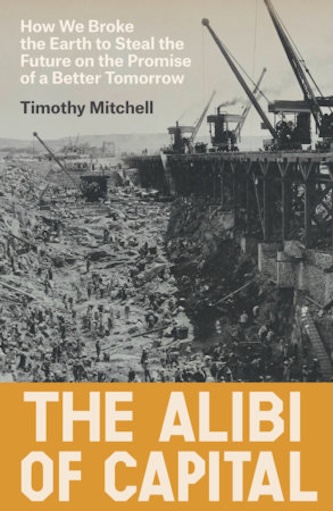 Timothy Mitchell is a political theorist and historian and the author of Carbon Democracy. In The Alibi of Capital, he argues that capitalism provides us with a convenient alibi for our theft of the future and destruction of the planet: “extraordinary wealth is claimed from the future, then repaid from the livelihoods of those who come later.” In other words, we create debt that has to be paid for in the years to come. “Meanwhile, the earnings of most people in the present carry the burden of repaying the cost of previous claims.” Those in the present are paying off debts from the past.
We run into this phenomenon locally all the time. We have to pay off the debt accrued by the newly built school or loans that the town took out during the pandemic. Nationally, we owe money for the ever-escalating deficit we create each year and for the companies that dominate the casino that is the Dow Jones (Nvidia is going to make a fortune, right?). Because we are so monomaniacally focused on maintaining an overheated economy, the destructive effects of burning fossil fuels are papered over. Climate change becomes a secondary concern. This is especially true under Trump, who has decided to pump up short-term profits from fossil fuels at the expense of the environment, essentially ceding the market for green energy to the Chinese.
It’s a very strange world in which a company like Uber can be worth $166 billion on the New York Stock Exchange — and not actually produce anything. It provides a service: drivers are paid to give people rides and to deliver food made by restaurants. The drivers own and maintain their own vehicles. Because they are considered independent contractors, Uber doesn’t provide them with health insurance. When Uber first started operating, it charged less than conventional taxi services. Of course, that was to take over the market and lower competition. Since then, Uber has raised prices, and it has now introduced “surge pricing,” which often charges more than taxis. Currently, the service’s drivers also deliver groceries and household goods. Uber’s plan is to eventually replace their workers with robotaxis. That vision — of the enormous value of the company sans human beings — establishes Uber’s future wealth.
An Uber I took recently in Brooklyn was driven by Juan ____, who told me he drove for both Lyft and Uber seven days a week, 12 hours a day. He commuted each morning from Jersey City. He’d been driving for Uber for ten years. He took pride in his work ethic, emphasizing that it was a part of his Dominican background. He claimed that he took two vacations a year; he went home to the Dominican Republic to be with his extended family. A recent study referenced in the New York Times says three-quarters of restaurant meals are now take-out, delivered by “independent contractors.” The delivery business is a service, a convenience for diners often provided by immigrants, many of them undocumented, according to reporting in the New Republic. Their time and energy are being stolen from them now to pave the way for a time in which they will not be needed.
There are two major groups in the climate change camp. One group insists that we can work within capitalism to address climate change. Saul Griffith is an example. He insists that if we electrify everything, we can solve the problem of climate change, and he claims we have the capability. The Biden administration took this point of view. Mitchell, however, is in the contrary camp. He writes that we must rethink capitalism in order to deal with climate change. Although “economic growth without end became the very measure of political well-being and progress,” Mitchell argues that we need to rethink this obsession with growth. He shares some affinity with the degrowth movement, promoted by Kohei Saito, Naomi Klein, and others who argue we need to put the brakes on the crazily optimistic assumption that growth has no limits. The problem, politically, is that drawing boundaries is a hard sell. Neither party in the U.S. is willing to adopt it. Particularly given the manipulative role that money plays in politics.
Mitchell traces the development of capital as alibi all the way back to Egypt, when farming along the Nile was taken over by capitalists. He then brings readers up to the present, examining the dominance of the stock market and the financial industry. “Capital as alibi” is a default position, particularly when conservatives argue that the transition to green energy will hurt the economy and the consumer. Trump has gone all out for this anti-environmental mantra; he is a fossil fuels booster, even insisting, in the face of scientific reality, that coal is cleaner and more efficient than solar energy or wind turbines.
Mitchell is a big-picture thinker who, in this deeply researched book, takes a well-reasoned stance against the status quo. And he makes a strong case that there is a viable alternative to the unsustainable path we are on. If we don’t choose to evade it for a faux future.
Ed Meek is the author of High Tide (poems) and Luck (short stories).
Tagged: "The Alibi of Capital", Capitalism, Climate Change, Climate Crisis, degrowth
“It is no crime to be ignorant of economics, which is, after all, a specialized discipline and one that most people consider to be a ‘dismal science.’ But it is totally irresponsible to have a loud and vociferous opinion on economic subjects while remaining in this state of ignorance.” – Murray Rothbard
“Beware of false knowledge; it is more dangerous than ignorance.” — George Bernard Shaw, Man and Superman: Maxims for Revolutionists.
That applies to this article just as well. Back in 2022, when oil was expensive, Senator Warren and others tried to introduce a Big Oil Windfall Profits Tax because “We need to curb profiteering by Big Oil and provide relief to Americans at the gas pump — that starts with ensuring these corporations pay a price when they price gouge, and using the revenue to help American families.” Now Trump, under whom oil has been comparatively cheap, supposedly “has decided to pump up short-term profits from fossil fuels at the expense of the environment, essentially ceding the market for green energy to the Chinese.” As if the Chinese have a legitimate, unmanipulated economy of green energy that has no environmental costs. I’ve been watching for years as baseless, self-contradictory nonsense like this gets passed off with dead-certain umbrage. If you read the article linked to “degrowth” overhead all the way through the criticisms, you’ll learn that one of the reasons that it’s politically implausible is that it threatens to immiserate and kill millions of poor people while failing to achieve environmental goals. If the reviewer doesn’t feel like dealing with that and other realities, the editor should have obliged him to.
As an editor and critic, I don’t like anti-intellectualism—from left, right, or center. I wasn’t sure if you were calling the author of the book or the reviewer ignorant, but that kind of dismissal won’t fly, particularly in the age of systematic”de-braining” heralded by Trump. I have not read Alibi—but I have the galley and have read the intro. It is a serious work of scholarship … the writer is polemical, but not a dunce.
If you disagree, deal with his argument—evidence and analysis. Bring in counterpoints. Of course, your “realities” may be “fantasies” to many. For example, in my reference to “false knowledge” I was thinking of the fossil fuel industry, which for decades, until the present, has been lying about the enormous damage its product is doing to the environment.
There is an argument to be made that “degrowth” is politically implausible—so are all sorts of things, good and bad. Criticism generated by alternatives to capitalism—let it come from all sides, reasonable and pointed. Let the most fact-based and persuasive of the ideas triumph. Or let capitalism reign supreme!
For the sake of pointing out intellectual inconsistency, your claim that degrowth will “immiserate and kill millions of poor people while failing to achieve environmental goals” must be based on conclusions reached via models—projections. Yet regarding the deaths that have (and those that will) follow the end of USAID you sarcastically ask “Won’t somebody think of the statistical children!” For you, apparently, some models projecting the death of the poor are “real” … others are not. It appears to be a calculation of the value of human life based on ideological dogma. Regarding the shutdown of USAID, there are children’s dead bodies on the ground—we are just not sure of the number. Degrowth may or may not be a good idea but, unlike the Trump administration, it has not directly killed anyone yet.