
Film Review: “The Bride!” — Maggie Gyllenhaal’s Feminist Monster Mash
By Tim Jackson
The film’s intellectual friskiness is everywhere, and at times it takes centerstage at the expense of the story.
The Bride!, written and directed by Maggie Gyllenhaal. Screening throughout New England
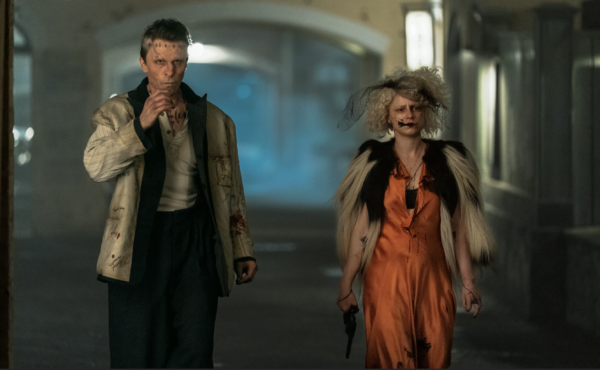
Christian Bale and Jessie Buckley in The Bride! Photo: courtesy of Warner Bros.
Talking about her new film, The Bride!, Maggie Gyllenhaal has suggested that its central idea is that we all harbor monsters within. That notion of a shadow self flows throughout her work. At twenty-four, playing Lee Holloway in Secretary, she portrayed a young woman who willingly submits to spankings from her boss (played by James Spader). The character chooses to acknowledge, not repress, her desires. In the HBO series The Deuce, Gyllenhaal was cast as a sex worker who gradually claims creative authority, moving up to become a director in the burgeoning porn industry of 1970s New York. Her 2021 directorial debut, The Lost Daughter, adapted from Elena Ferrante’s novel, dramatizes a woman’s ambivalence about motherhood; it is the story of a woman who abandoned her children in order to pursue love and a career. As writer and director of The Bride!, Gyllenhaal has created a lively, hybrid vehicle for using this notion of a “shadow self” to challenge patriarchy and assert female agency. The film is a dense pastiche of postmodern references — at the service of a feminist diatribe — that draws on elements of horror and broad comedy.
Mary Wollstonecraft Shelley wrote “Frankenstein; or, The Modern Prometheus” in 1817. It was part of a challenge, with Lord Byron and Percy Bysshe Shelley, to see who could come up with the best ghost story. The prologue in James Whale’s 1935 film, Bride of Frankenstein, has Lord Byron (Gavin Gordon) floridly recounting Mary Shelley’s horrific tale of Romantic ambition and male hubris. “It was these fragile white fingers penned the nightmare,” says Byron. Percy adds, “I do think it a shame, Mary, to end your tale quite so suddenly.” Mary (Elsa Lanchester) answers: “That wasn’t the end at all. Would you like to hear what happened next? I feel like telling it.” The film that follows features the Bride (Lanchester again) in the finale — she is immediately repulsed by the monster (Boris Karloff), hisses and howls, and pulls a lever that explodes the laboratory.
Gyllenhaal saw an opening in the skimpy screen time given to the monster’s mate. Her retelling is set in 1935 in Chicago. In this prologue, Mary Shelley, filmed in black and white and highlighted in chiaroscuro, laughs madly as she explains the wicked intent of her new story. Jessie Buckley plays Shelley as well as the bride, echoing Elsa Lanchester’s double performance. Christian Bale is the creature; he goes by the name of Frankenstein, though he prefers Frank. No heavy prosthetics have been utilized but, with a stapled forehead, facial scars, a crooked nose, a flattened skull, and some very bad teeth, the actor bears a passing resemblance to Karloff’s version of the monster.
“Reinvigorating” is the film’s term for restoring bodies to life, a specialty of Dr. Euphronious, played by Annette Bening. Frank drops by her office, which also is a laboratory. Learning of the scientist’s reputation as a “reinvigorator,” Frank hopes she can dig up a mate for him — so to speak. She eyes him skeptically and asks “You mean you want to get laid?” Frank insists that, after a century of bachelorhood, he is lonely and needs romantic companionship. The doctor refuses; Frank explodes in anger and yells, “I thought you were a mad scientist!” Soon the pair are off to fetch a body from a graveyard in a black-and-white scene that nearly duplicates the graveyard opening in Bride of Frankenstein.
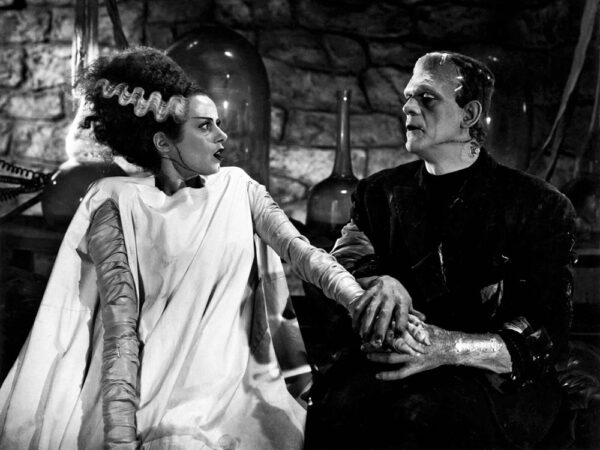
Elsa Lanchester and Boris Karloff meet in The Bride of Frankenstein.
The fresh corpse, in the form of Jessie Buckley, is laid out on the lab table. In an earlier scene we learned that the woman is Ida, a party girl who was murdered because of the secrets she held about certain wealthy men. This scenario will later return via a film noir subplot. “She’s too beautiful,” says Frank as we hear a sinister maid knock curiously at the lab door. Jeanie Berlin makes her cameo as the doctor’s assistant, a role previously played in the ’30s by Dwight Fry. Shooing her away, Dr. Euphronious turns to Frank and explains that she has neither the time nor the inclination to hunt for another, less attractive, corpse
Ida’s broken body lies ready for the requisite electric jolts that will bring her back to life, and that happens in quick order. Embodied with mad glee by Buckley, the bride has no memory of who she once was. Unlike the ’30s bride, who was repulsed by her hideous groom, she finds her groom to be perfectly useful. Frank is a little dull, but he knows how to party. As Mae West once cooed, “You’re not too bright, but I like that in a man,” a sentiment echoed by Kathleen Turner in Body Heat.
Pissed off at having wasted time and ready to celebrate, the bride heads straight to a local nightclub with her new hubby. It turns out that Ida and Frank are movie fans. He has a special reverence for a matinee idol named Ronnie Reed, played by Gyllenhaal’s brother, Jake. When he awkwardly introduces himself to Ronnie at the nightclub, the meeting leads to the first of several elaborate dance sequences that are brimming with references to Mel Brooks’ Young Frankenstein.
Ida’s unabashed sexual behavior leads to an attempted rape. The perpetrators are quickly dispatched by Frank, but the murders are caught on a nearby camera. Suddenly, Ida and Frank are killers on the run, pursued by the police and a detective named Jake Wiles, played by Gyllenhaal’s husband, Peter Sarsgaard. Penélope Cruz plays his canny secretary, Myrna Mallow.
That plot development brings on a slew of scenes that allude to Bonnie and Clyde. As the bride attempts to figure herself out, the references to film history pile up. Frank says at one point, “Are we in a movie?” Part of Gyllenhaal’s intent with The Bride! is to satirize America’s obsession with popular culture as source material for self-development: flashy images as an inspiration for a personality do-over. These days, even the fashion industry is remodeling the human figure, creating a warped notion of beauty that sets the bar impossibly higher.
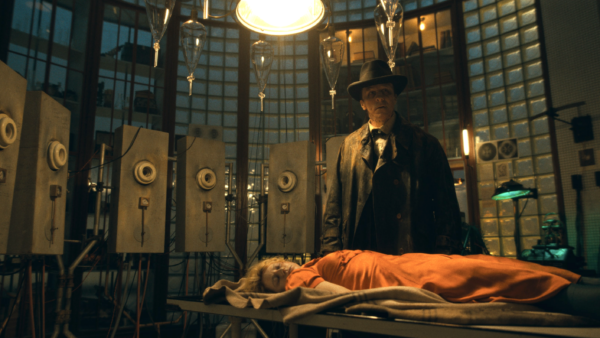
Christian Bale and Jessie Buckley in The Bride! Photo: courtesy of Warner Bros.
Along with references to cinema, The Bride! is dense with literary references and feminist-theorist asides. Herman Melville’s line in his short story “Bartleby, the Scrivener,” “I would prefer not to,” recurs throughout the narrative, becoming a quiet mantra in the service of female resistance. Other moments address women’s liberation more directly, as when Ida, desperate to escape the laboratory for the wider world, cries out, “Let me out,” a howl for freedom that reverberates beyond the scene itself. Later, hammering the message home, Ida answers a question by shouting, “Me too. Me too.” Jake is constantly badgering his secretary to stop smoking, which may allude to the campaign of ad-guru Edward Bernays, “the father of public relations.’ As a strategy to make women smoke more, in 1929 he staged a protest called Torches of Freedom — lighting up as liberation. Bernays also promoted cigarettes as an after-dinner treat; it was healthier (and more slimming) to ditch sugary sweets and pick up a cigarette at the end of a meal.
Gyllenhaal’s interest in the “shadow self” leads to doubling throughout the story. Ida, is a name associated with women who were part of the social reform and suffragette movements (think of Ida B. Wells, Ida Tarbell). Because Ida has lost her memory, she renames herself Penelope, the name of the actress who is playing Jake’s secretary. Jake, played by Gyllenhaal’s husband, is, of course, Gyllenhaal’s brother’s name. The maid, Jeanie Berlin, is the 76-year-old daughter of Elaine May, who, if not an avowed feminist, is an exemplary embodiment of independent womanhood. Perhaps I am taking my scrutiny a step too far, but feminist icon Gloria Steinem was once Christian Bale’s stepmother when she married Bale’s father (now deceased) in 2000.
The film’s intellectual friskiness is omnipresent, and at times this antic meta-structure plays out at the expense of the story itself. The proceedings feel overdetermined, like an argument dressed in comic-gothic drag, a camp-ish essay sending up varieties of repression. Still, The Bride!‘s performances and elegant set designs keep the two-ton enterprise aloft. Bale has the actorly skill and subtlety to stitch together a role that demands carefully measured doses of humility, insecurity, and monstrosity. Buckley is a magnificent actress, and she attacks this role by pulling out all the stops. She supplies the gravitational pull necessary to hold things together, even when the filmmaker’s ideas threaten to scatter the narrative apart. Gyllenhaal obviously loves film, has done her research, and is unabashedly out front about her feminist agenda — she deserves considerable credit for pulling off this ambitious, cerebral monster mash.
Tim Jackson was an assistant professor of Digital Film and Video for 20 years. His music career in Boston began in the 1970s and includes some 20 groups, recordings, national and international tours, and contributions to film soundtracks. He studied theater and English as an undergraduate, and has also worked helter-skelter as an actor and member of SAG and AFTRA since the 1980s. He has directed four feature documentaries: Chaos and Order: Making American Theater, which is about the American Repertory Theater; Radical Jesters, which profiles the practices of 11 interventionist artists and agit-prop performance groups; When Things Go Wrong: The Robin Lane Story, and Marblehead Morning: Daring & Stahl: 50 Years in Harmony. He has made two short films as well: Joan Walsh Anglund: Life in Story and Poem and The American Gurner. He is a member of the Boston Society of Film Critics. You can read more of his work on his substack.
Tagged: Annette Bening, Christian Bale, Jake Gyllenhaal, Maggie Gyllenhaal, Penelope Cruz, essie Buckley
Wow what great reference unpacking! And for one additional flip, the officiant for the Bale-Steinem wedding was Native leader Wilma Mankiller, no murder subtext otherwise implied.
Great find. Debra.
Our esteemed editor removed my oyster references (which is fine; it was maybe too much and broke the flow)
To wit: (though not witty enough)
“In addition to the many filmic allusions, there are nods to other gender-specific elements. Oysters are a significant plot device. Those sperm-like mollusks are attributed to increasing male sexual desire and testosterone production.”
Terrific review, Tim. Maggie certainly called all her friends and family members to her table for this one.