
Film Review: “Deepfaking Sam Altman” – the “Roger and Me” of the AI Age
By Preston Gralla
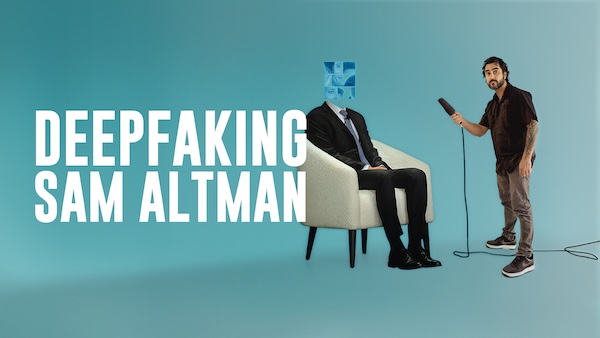
Deepfaking Sam Altman is an entertaining, off-beat deep dive into the hands-on tech needed to generate deepfakes. It also sounds the alarm about the growing imitative power of AI.
Deepfaking Sam Altman, directed by Adam Bhala Lough. Screenings around the country, including a couple showings in Baltimore in March and Washington, DC, in April.
Nearly 40 years ago, Michael Moore’s documentary Roger and Me traced the filmmaker’s travails while trying to set up an interview with General Motors CEO Roger Smith as the corporate giant slashed, burned, and gutted Flint, Michigan, closing its auto plants and laying off tens of thousands of workers. Moore drew on his bitter sense of humor as he attempted to track down Smith in an effort to highlight the effects of deindustrialization on the economy and the people who lived in America’s heartland.
Today, the United States faces an economic tsunami whose potential consequences are as dire as — or even more dire than — that earlier crisis: the widespread deployment of AI. To dramatize what we might be up against, filmmaker Adam Bhala Lough set out to make the Roger and Me of the AI age — Deepfaking Sam Altman. He set out to interview Sam Altman, co-founder and CEO of OpenAI, because, he explains in the film, Altman is “the person who knows whether my kids, my job, and humanity itself is totally screwed” thanks to AI.
So armed with a camera crew, a sense of mission, and his own considerable wits, Lough tried to get Altman to sit with him for a filmed interview. It seemed a simple enough task. After all, what could go wrong?
Plenty, as you might imagine, just as it did for Moore nearly 40 years ago. And like Moore, Lough makes an excellent movie out of the snafu, the first documentary that delves with considerable acumen into the human consequences of AI.
Lough starts off by making countless phone calls and doing much badgering and guilting, trying any way he can to get his pitch to Altman for an interview. It doesn’t take long for him to realize that a callback from Altman, much less an interview, is not going to happen.
He’s torn. What to do next? Should he give up on the film?
Then comes his epiphany. Why even try to interview Altman? Why not use AI to build a deepfake of Altman — a virtual being who looks, acts, thinks, and talks like Altman — and interview him instead?
After all, what could go wrong? You already know the answer to that, as you did the last time I asked a similar question: plenty. And that’s where the fun — and the truth — in this movie begins. The troubles start when Lough looks for a company to create an Altman deepfake. No US company will touch it. No one explains to Lough directly why they won’t. But the answer is obvious: Altman wields such power that they fear being crushed by him if they do it.
He eventually finds an AI company in India, where his family is from, to create one. The rest of the movie is spent on his trials and tribulations in creating the deepfake and then interviewing and filming what he affectionately calls the SamBot.
At this point, the movie becomes an entertaining, offbeat deep dive into the hands-on tech needed to generate deepfakes, with plenty of comic antics along the way. Eventually, Lough hands over the directing of the movie to SamBot, whose auteur suggestions combine what you would expect from Fellini on acid, accented by the sophistication you’d expect from a Three Stooges short.
Driving it all is Lough’s screen presence: pissed off, irascible, and darkly ironic, yet continually fueled by an energy and optimism that won’t let up. Ultimately, despite the setbacks and antics, he pulls off the interview and afterwards faces a dilemma: should he pull the plug on SamBot or let it live because it appears to be an intelligent being?
Keep in mind the movie was filmed in 2024, which means the deepfake-creating tech in it is several generations behind what can be done today. A SamBot built today would be much eerier than the one Lough helped create because it would be so much more realistic and convincing.
The movie doesn’t wrestle with many of AI’s larger issues: the economic deluge that may put countless people out of work, the AI slop that’s enshittifying our culture, the theft of artists’ and writers’ work to train AI, the way authoritarians can use AI to cement their power, and what our children’s and children’s-children’s lives will be like in an AI-centric world.
But that’s far more than a single film can do. That doesn’t make Deepfaking Sam Altman any less alarming, though. Yes, it’s amusing, but it’s also a warning. If someone as incisive and sharp as Lough struggles to decide whether SamBot is a sentient being, the technology is a lot more insidious than we ever imagined.
Preston Gralla has won a Massachusetts Arts Council Fiction Fellowship and had his short stories published in a number of literary magazines, including Michigan Quarterly Review and Pangyrus. His journalism has appeared in the Los Angeles Times, Dallas Morning News, USA Today, and Boston Globe Sunday Magazine, among others, and he’s published nearly 50 books of nonfiction which have been translated into 20 languages.