
Film Review: “Queen Kelly” Restored — Erich Von Stroheim’s Mad Genius Resurrected
By Betsy Sherman
Cinema lovers with a taste for the exotic and a tolerance for narrative loose ends should take advantage of the re-emergence, via 4k digital makeover, of Queen Kelly.
Queen Kelly – Directed and written by Erich von Stroheim. A 2025 restoration of the 1929 film. At the Somerville Theatre March 1 at 2 p.m. and March 2 at 7:30 p.m. At the Brattle Theatre, Cambridge, March 6-8.
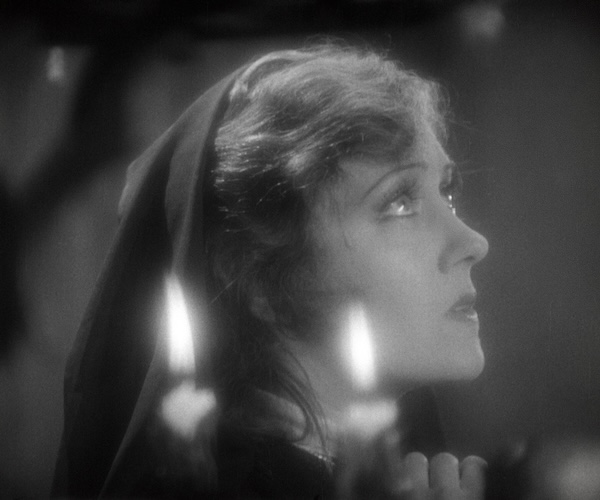
Gloria Swanson (playing Patricia “Kitty” Kelly) in Erich von Stroheim’s unfinished masterpiece Queen Kelly. This scene later appeared in Sunset Boulevard. Photo: Kino Lorber
Gloria Swanson, a genuine silent movie superstar, is now best known for playing a fictional, delusional silent movie superstar, Norma Desmond, in Billy Wilder’s 1950 Sunset Boulevard. Among the film’s deliciously meta touches is the pairing of the actress with Erich von Stroheim, who plays the stoic Max von Mayerling, Norma’s ex-husband and one-time director, now her butler.
When Norma and the character played by William Holden watch a movie in Desmond’s mansion, projected by Max, it’s a scene from Queen Kelly, starring Swanson, directed by von Stroheim. On screen, a much younger Swanson is shown in profile as she prays, illuminated by candles. The intimate portrait is truly sublime. Who wouldn’t agree with Norma’s famous credo, “We didn’t need dialogue. We had faces!”
This clip was a revelation in more ways than one. Queen Kelly was shot during 1928-1929 but never finished and, essentially, never released. Even the most die-hard Swanson fan wouldn’t have seen it before. A 1985 reconstruction of the incomplete Queen Kelly—with onscreen text and photos giving a feel for what would have constituted the latter part of the story—was released in theaters and on home video, to the delight of silent-movie fans. And now a 2025 “re-imagining” of the project, with some story expansion and enhancement of its atmosphere, a 4K digital makeover, and an outstanding new score by Eli Denson, is making the art-house rounds. Cinema lovers with a taste for the exotic and a tolerance for narrative loose ends should take advantage of its re-emergence. Dennis Doros (who oversaw the 1985 release of the film) and Amy Heller of Milestone Films are responsible for this new release, with Kino Lorber as the distributor.
Anytime is a good time to revisit the career of Queen Kelly’s director-writer, Erich von Stroheim (1885-1957), an artist who ruffled feathers within Hollywood’s corridors of power but nonetheless shaped the language of cinema. Driven by an artistic vision intent on X-raying civilization to expose the barbarism within, von Stroheim ignored the usual constraints of budget and the amount of film shot (he also included adult material that many deemed vulgar). This obsession made his works less likely to have a smooth path into theaters. His 1924 Greed stands as a masterpiece in spite of a truncation by M-G-M that stripped it of hours of footage (its negative was destroyed).
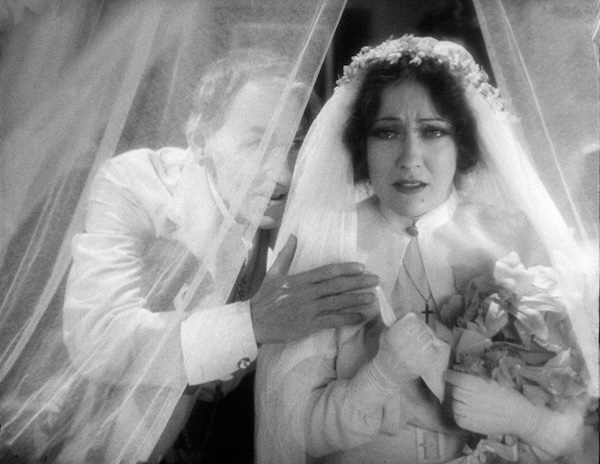
Gloria Swanson (playing Patricia “Kitty” Kelly) as the Madame of Poto-Poto in Erich von Stroheim’s unfinished masterpiece Queen Kelly. Photo: Kino Lorber
Von Stroheim was his own greatest creation. He invented a persona in which he was a distinguished member of the nobility and former military officer. However, he was actually born Erich Oswald Stroheim in Vienna, the son of Jewish parents, his father a hatmaker. His time in the Austria-Hungarian army was brief and of no distinction. Dissatisfaction and ambition led him to emigrate to the U.S. in 1909. He identified himself as Erich Oswald Hans Carl Maria von Stroheim, and while in the U.S. converted to Catholicism.
The maverick director began and ended his career as an actor. In the early days of Hollywood production, von Stroheim, with no training in theater or film, found his way into D.W. Griffith’s orbit. During World War I, he bluffed his way into work as a military advisor on films. In front of the camera, he incarnated the stiff-spined Prussian officer; his sadistic, sneering version of the enemy earned him the moniker “the man you love to hate.” Behind the camera, he created the icon of the authoritarian, temperamental movie director. His firing from Queen Kelly effectively ended his career as a filmmaker; he later found work as a character actor. His standout roles were Captain von Rauffenstein in Jean Renoir’s 1937 Grand Illusion and Max in Sunset Boulevard. He spent his later years in France, where he and his films were revered.
Flashing back to 1928, von Stroheim was on the outs with major studios and had had a major disappointment when independent producer Pat Powers pulled the plug on the wildly over-budget The Wedding March (a version of the first half of the story survives, and it’s marvelous). The director had a family to support and needed work. Swanson, one of the top stars of the day, had newly signed with United Artists, which believed in self-determination for its stars. She had already formed Gloria Swanson Productions and produced Sadie Thompson, which would soon be released. She wrote in her 1980 memoir Swanson on Swanson that she wanted “freedom from the hassle of business worries.” The third famous name behind Queen Kelly is Joseph P. Kennedy, Sr. Yes, the political family patriarch, not much remembered for his significant involvement in the film business. The restoration project for Queen Kelly found pertinent materials among Kennedy’s papers at Boston’s John F. Kennedy Presidential Library and Museum.
Kennedy became Swanson’s business manager and lover. The pair canoodled in Los Angeles, New York, and Palm Beach, so it wasn’t much of a secret. Not only was Joe married to Rose Kennedy, Gloria was hitched to French aristocrat Henri, Marquis de la Falaise de la Coudraye. Kennedy dissolved Swanson’s previous corporation and established Gloria Productions, replacing her cronies with his cronies.
Kennedy sought out von Stroheim for the pair’s first collaboration. He had to have known about the director’s reputation for excess, but he was looking for the best. Von Stroheim maintained he had written the perfect vehicle for Swanson: called The Swamp, it was about a convent girl whose love for a carousing prince redeems him. He moved the story’s European setting to Africa, where the girl’s dream romance becomes a nightmare. She is given the choice between living with a corrupt rich man or taking over a brothel. It probably seemed like an adventurous acting challenge for Swanson.
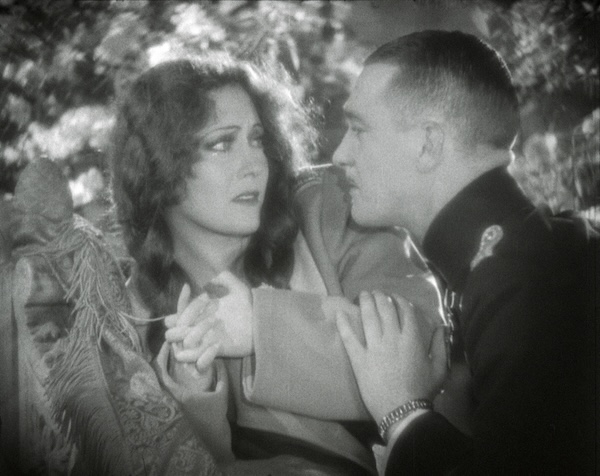
Gloria Swanson (playing Patricia “Kitty” Kelly) with Walter Byron (Prince Wolfram) in Erich von Stroheim’s unfinished masterpiece Queen Kelly. Photo: Kino Lorber
The title was changed to Queen Kelly, and production never got far into the African part of the story. About an hour and a quarter of the 105-minute version available takes place in Central Europe, pre-World War I. Patricia “Kitty” Kelly (Swanson), who lives and receives her education at a convent in the fictional European principality of Cobourg-Nassau, doesn’t appear in the opening scenes. Instead, there’s a spotlight on the decadent goings-on in the palace, with which Patricia’s wholesome qualities will be contrasted. We’re plopped into the bedchamber of “mad queen” Regina the Fifth, last of her royal line. Actress Seena Owen’s ticking-time-bomb performance is worth the price of admission. She prowls nude through the halls of the palace looking for her lover, Captain of the Guard Prince Wolfram (Walter Byron). At one point, Owen airs herself on the balcony, covering her breasts with the white Persian cat she’s holding under one arm.
“Wild” Wolfram, whose engagement to the queen will be announced any minute, is astride a horse drawing a carriage of high-spirited prostitutes home to the palace with him. The queen flips at his disrespect, but he remains smug. Come morning, the hungover officer takes his cavalry squad out for a drill. They encounter a single-file line of convent girls and nuns. Among them is the 31-year-old Swanson playing 17-year-old Patricia. As the soldiers stop for a formal greeting, the two main characters meet cute. Or is that meet-creepy? Patricia curtsies and her bloomers fall to her ankles. Wolfram, the other soldiers, the girls, and maybe even the nuns laugh at her. Patricia, whom we’re told inherited her father’s Irish temper, extracts the panties and angrily throws them at Wolfram. He then sniffs them. They banter. Each make a wish on a handful of hay, and they commence fantasizing about each other.
Mother Superior hears about Patricia’s flirtation and says she must forgo supper and pray. In the prayer scene—edited into Sunset Boulevard—she doesn’t beg the Virgin Mary for forgiveness — but to see the prince again. Wolfram, at a palace banquet, learns he’ll be joined in matrimony to the foul-tempered Queen sooner than he thought: tomorrow. He wants Patricia for dessert before the wedding day.
Wolfram and his adjutant start a fire in the convent and grab Patricia in the confusion. What follows, in Wolfram’s rooms at the palace, is a lengthy, occasionally charming seduction scene leading up to their moonlit kiss. The prince gives her a long military coat to put over her nightgown. He plies her with champagne, oysters, and caviar. After the kiss, the Queen appears, wearing a feathered négligée. She grabs a black snake whip from the wall, informs Patricia that this man is “MINE” and drives our heroine out of the palace, to the amusement of the guards. Patricia is taken back to the convent, where a telegram has arrived saying her aunt in German East Africa, who financially supports her, is dying. Her boat fare has been paid — she must go there at once.
The queendom part of the story has its pluses and minuses. The ol’ Cinderella template served Swanson and her peers well. It’s corny, but capable of being reinvented through the application of style, which von Stroheim accomplished. As always in his work, the production design is impeccable; there’s a rich integration of décor, characterization and themes. Queen Kelly had two cinematographers; Paul Ivano was the one favored by Swanson, so he’s considered responsible for the beautiful shots of the leading lady. The director and star-producer got along well (true to his persona, he called her “Madame la Marquise”). Swanson blossoms under von Stroheim’s direction, expressing the restlessness and yearning of youth. The bland Walter Byron is in his co-star’s shadow; reportedly, this was generally Swanson’s m.o.
Before continuing to the Africa passages, here’s an interesting quote on von Stroheim from Swanson’s autobiography:
The experience of working with him was unlike any I had had in more than 50 pictures. He was so painstaking and slow that I would lose all sense of time, hypnotized by the man’s relentless perfectionism. A scene that Allan Dwan or Raoul Walsh would have wrapped up in an hour might take von Stroheim all day, fondling and dawdling over the tiniest minutiae, only to announce late in the afternoon that he would like to try it once more the following day. But his exactitude always paid off in the rushes, and it was a course in the art of filmmaking to hear him defend his choices and explain his reasons—rare occasions, to be sure, for in general he considered himself to be his own best audience and only critic.
The rest of the re-imagining is about 30 minutes and includes clips of surviving footage shot by von Stroheim, still photographs that help tell the story and new intertitles by Milestone Films that fill in exposition. For atmosphere, it adds vintage footage of the port city of Dar Es Salaam (in what is now Tanzania) shot by Martin and Osa Johnson for their documentary African Paradise.
The production moved from Kennedy’s Film Booking Offices (FBO) studio to Pathé, where the mogul built a luxury bungalow for Gloria. Von Stroheim planned for these scenes to make up at least two-thirds of Queen Kelly. It will be obvious that his artistic vision—which included a gritty realism inspired by novelists such as Émile Zola—clouded any caution about censorship.
The screenplay, with its emphasis on vice and violence, undoubtedly taps into white mythology about the “dark continent.” Swanson claimed she was told her aunt ran a dance hall, not a bordello. But Patricia, presumably still reeling from her trauma at the palace, enters what is indisputably a whorehouse. Patricia’s aunt (Florence Gibson), on her deathbed, tearfully reveals that it was her friend, plantation owner Jan Vryheid, who has been paying for her school. She implores her niece to marry Jan, so she will have security and the aunt can die a peaceful death. Jan arrives to meet his virginal prize. Actor Tully Marshall reprises his turn in von Stroheim’s The Merry Widow, in which he was also a hideous, reprehensible (but fun to watch) groom to a younger woman coerced into marriage.
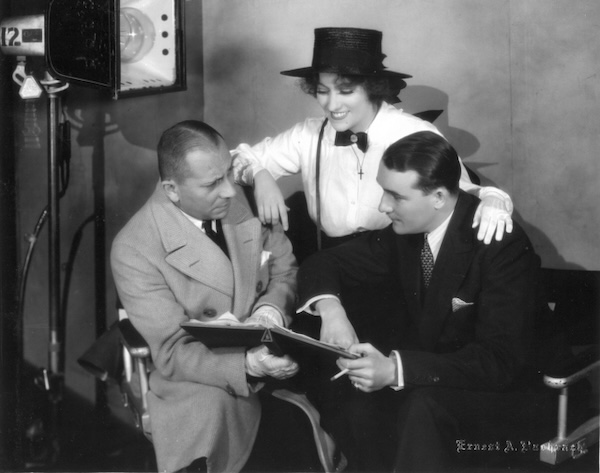
Erich von Stroheim, Walter Byron, and Gloria Swanson discussing a scene in Queen Kelly. Photo: IMDB
Von Stroheim’s unique way of telling a story is at full strength. Patricia’s fate is powerfully encapsulated in a composition that contains a triangle—the dying aunt’s bed as the base, mosquito netting forming the peak. To the right of the triangle is the quaking, tearful teenager, to the left the impatient lecher. The aunt reaches for a hand from each, and has them clasp over her diseased body. Chilling. Not long after, a bespectacled Black priest performs both the last rites for the aunt and the marriage, almost simultaneously. Patricia hallucinates the cleric as Prince Wolfram, who tells her to wait for him (he’s not out of the picture yet).
The clips contain vivid characterizations by two supporting actresses. Madame Sul-Te-Wan, a.k.a. Nellie Crawford Conley (an African-American actress who had, like von Stroheim, worked on Birth of a Nation and Intolerance) as the stylishly dressed cook Kali, and Rae Daggett as Coughdrops, a lady of the horizontal profession with tubercular lungs under the anchor tattooed on her chest.
The script had Patricia refuse to go to Jan’s estate and consummate the marriage. Instead, she chooses to run the brothel. Her style earns her the nickname Queen Kelly. There are costume-test photos of Patricia as a madam, in a black dress, hat, and orchids. It’s too bad we never got to see how Swanson would have handled that phase of the performance. But production never got that far. As the wedding was being filmed, Marshall, as directed by von Stroheim, drooled tobacco juice on Swanson’s hand as he was putting on the ring. The freaked-out star walked off the set and phoned Kennedy, telling him, “Our director is a madman.” Shooting ceased.
In hindsight, we consider 1929 the beginning of the sound revolution, so it seems foolish to have begun a film in the older style. But, given all of the changes going on in the industry, it couldn’t have been easy to see the big picture. According to von Stroheim biographer Richard Koszarski, Queen Kelly didn’t fail because it was silent. Silent movies were still being made and released at the time. The director’s excesses were the reason that this film, like others before it, was snatched away from him.
Swanson asked a few of her director friends to help reshoot Queen Kelly. Her efforts only succeeded in getting footage for an (unconvincing) ending to tack onto the Cobourg-Nassau footage. Her version was shown outside the U.S. in the early ‘30s. Von Stroheim couldn’t let go the film go either — he wanted his story to be realized. The closest he came was writing a French novelization, Poto-Poto, published in 1956. Kennedy, who had put $800,000 of Gloria Productions’ money into the picture, told Swanson, “I’ve never had a failure in my life.” He never wanted to hear about this one again.
Queen Kelly, with its Hollywood royalty on-screen and off, does not disappoint.
Betsy Sherman has written about movies, old and new, for The Boston Globe, The Boston Phoenix, and The Improper Bostonian, among others. She holds a degree in archives management from Simmons Graduate School of Library and Information Science. When she grows up, she wants to be Barbara Stanwyck.