
Book Review: Losing the Flavor — Allegra Goodman and the New Jewish-American Family
By Robert Israel
What Allegra Goodman’s stories serve up could be called a vision of Jewish American Life Lite.
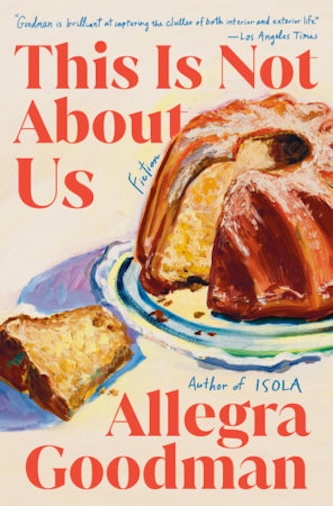
This is Not About Us by Allegra Goodman. The Dial Press, 336 Pages, $29
 Some years ago, as an instructor teaching a college-level course in American Jewish stories in my hometown of Providence, I chose as a text for the class Jewish-American Stories, a collection of short fiction edited by Irving Howe — literary and social critic, democratic socialist, and co-founder of Dissent magazine. His anthology brought together two dozen writers who probed a common theme: what he called the “post-immigrant Jewish experience.”
These representative authors — Bernard Malamud, Philip Roth, Isaac Bashevis Singer, and others — wrote remarkable and vivid pieces, sparkling with humor and pathos. Taken individually and collectively, the stories encapsulated what Jewish Americans—like those in my family—faced when they left Eastern Europe and Russia and settled, in many cases, for what amounted to a painful repatriation in the United States. Many of the stories — like Malamud’s “The Magic Barrel,” for example — have since become part of the canon. Rereading them today, the tales stand the test of time — they still shine with passion, wit, and wisdom.
But the passage of time puts pressure on immigrant cultures, which must grapple with new hurdles and fresh challenges. Yes, immigrants arriving in America today face some of the same perils Jews did when they arrived in the 19th and 20th centuries. Inevitably, though, old solutions fall short of new quandaries. It is fitting, then, that contemporary writers working in this vein often exhibit an ambiguous, even dismissive, view of tradition. Howe, in his introduction, anticipated this trend, yet nonetheless felt compelled to give a nod of encouragement to younger Jewish writers, asking: “Do they not have a right, also, to make of their involvements and confusions with Jewishness the foundation for stories and novels?”
I thought of Howe’s prescient comment while reading the latest book by Allegra Goodman — a Cambridge-based writer who has published eleven books and regularly contributes fiction to The New Yorker. Her new book, This Is Not About Us, focuses on a fictional Jewish-American family, the Rubinsteins, who reside in Boston, Providence, and other northeastern locales. In short, they are our neighbors. And, perhaps predictably, their struggles are markedly different from those of their forebears.
This disjunction has much to do with how many of today’s Jewish Americans pursue “Jewish continuity,” a term widely promoted in the religious community. It encourages a strong Jewish connection through education, group identity, and an engaged Jewish life. One might think that this concept would resonate in the lives of the characters in Goodman’s collection of stories — it is not a novel, although it aspires to be. The narrative features a multigenerational cast of characters, but it appears that many have left the quest for Jewish continuity behind. That’s because they are focused on securing a leg up in the American middle and upper classes.
In “Apple Cake” — one of the best stories in this collection, originally published in The New Yorker — Goodman’s characters banter about the disposition of one’s final remains: cremation is discussed, though it is prohibited in the Jewish faith. This topic would never have come up in the writings of the authors in Howe’s book — one simply followed the dictates of Jewish law. Yet this alternative is widely discussed today.
Goodman gives us a reportorial taste of contemporary Jewish life — the quarrels between siblings, the minutiae of family life — described through tightly controlled, at times colorless prose. Her dialogue is terse and emotionless. When descriptive passages of the external world appear, they seem used as fillers. This hollowness might have served as a literary device to reveal what lies beneath the unruffled existences of the characters. But Goodman does not draw on the hard-earned tradition of the authors in Howe’s collection, where readers are given the smells and tastes of Jewish life. For example, when Goodman refers to the apple cake in the aforementioned story, we are told it is craved by many and gorged on by those who eat it — yet we aren’t given a concrete sense of how it tastes.
I suspect that if Howe were to update his 1977 collection to include talented younger writers, he’d most certainly include Goodman. She demonstrates verve and ambition, and understands the tenets of her faith. But what is missing in her work is a vision of bringing the past forward, endowing her characters with the complex riches of the ongoing American Jewish experience. What her narratives serve up could be called a vision of Jewish American Life Lite. Reading Goodman’s efficient but thin look at “how we live now” suggests that American homogenization has become pervasive.
Robert Israel, an Arts Fuse contributor since 2013, can be reached at risrael_97@yahoo.com.
Tagged: "This Is Not About Us", Allegra Goodman, Jewish-American fiction