
Film Review: Beautifully Empty – The Vacant Glamour of “Marty Supreme” and “Wuthering Heights”
By Erica Abeel
Both films are intermittently entertaining and display a high level of craft. They’re also blithely mediocre: mainly flash and filigree, vacuous at their center.
It’s no surprise that Josh Safdie’s Marty Supreme and Emerald Fennell’s “Wuthering Heights”—two of the season’s most high-profile films—are doing big box office. (Marty is also in the conversation for awards season.) Both films are intermittently entertaining and display a high level of craft. They’re also blithely mediocre: mainly flash and filigree, vacuous at their center. Critics have mainly treated the two films kindly, perhaps because Hollywood is facing multi-level crises—including looming conglomeration and theaters mostly sitting empty—and reviewers are understandably eager to deliver a bit of good news. But the success of such work is less about films that resonate than products designed for a dumbed-down age: titillating and super forgettable.
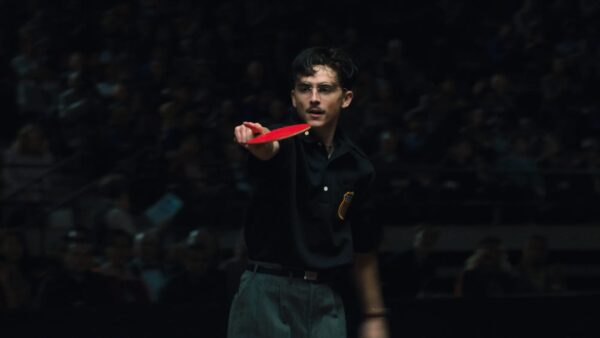
Timothée Chalamet in Marty Supreme. Photo: A24
Marty Supreme follows the time-honored trope of a young man on the make—the ’50s Jewish American version, that is. The ambitious hero, determined to rise in society, famously figures in novels by such 19th-century French giants as Balzac and Stendhal. But these novelists created indelible characters—think Rastignac and Julien Sorel—along with a pointed, wide-ranging critique of the period.
Marty, in contrast, offers whippy displays of virtuosic ping-pong (though not enough of them), drawing on editing techniques (omitting balls) that are hands-down brilliant. But the show-offy cross-talking among the narrative’s characters adds up to nothing but noise. And the overexposed Timothée Chalamet, as the pimply young dynamo on the make, supplies a whirlwind of manic energy and not a whole lot more (despite the fact that Chalamet went all out to get the table tennis right and has called his performance “top-level shit”).
If the hero’s journey included a critique of the jungle-y culture that surrounds him, I missed it. Marty plays as an exercise in pumped-up energy larded with tiresome tangents. Especially puzzling is the turn by Odessa A’zion as the girl from the ’hood our boy (knocked up) and left behind, her face chronically schmeared with eye makeup. As for a semblance of a character arc, Marty’s abrupt transformation into a mensch seems purloined from a different movie. And that repellent crack he makes about Auschwitz? I’m sorry, Josh Safdie, but not even a Jew, as Marty claims, can say that.
I signed off on Emerald Fennell’s “Wuthering Heights” in the opening scene. A crowd that includes young Catherine Earnshaw (Charlotte Melling, and later played by Margot Robbie) is getting off on the public hanging of a man who appears to be ejaculating. Okay, I’m guessing that the scene was set up to presage the sex-and-violence link that runs through the Gothic masterwork that furnished the template for Fennell’s movie. And the director produced, as films require, a visual equivalent. That said, the ugly opening plays more like the device of a shock jock than a portal into the tormented affairs of Cathy/Heathcliff.

Margo Robbie and Jacob Elordi in “Wuthering Heights.” Photo: Warner Bros. Pictures
Still, much of Fennell’s “Wuthering Heights” is a visual treat for the armchair traveler. You get to viscerally wander those wild, craggy Yorkshire moors (or wherever the film was shot). Cue the cheesy but irresistible image of Heathcliff (Jacob Elordi) riding off on a rearing steed against a flaming sunset after hearing of Cathy’s engagement to wealthy neighbor Edgar Linton (Shazad Latif). Fennell’s version of Thrushcross Grange, Linton’s estate, as a scarlet-and-gold candy box—with Cathy’s bedroom walls patterned after her skin—is preposterous but fun to gape at. As is Cathy’s elaborate, far-too-modern wardrobe, which features flounces, tinsel, and décolletage—call it Barbie Victorian. Gape is the operative word; this movie dumbs you down.
Theoretically, the money shots focus on the fated love/lust of Cathy and Heathcliff. Whenever Elordi’s glowering Heathcliff came within an inch of Cathy, my neighbor at the AMC 84th Street theater squeaked in anticipation. But guess what? Fennell’s signature may be raunch—think the bathtub scene in Saltburn and her interest in bodily fluids—but her “Wuthering” isn’t hot. Any chemistry between the two leads was MIA. Fennell fluffs up expectations with a BDSM scene of a groom and a maid that Cathy witnesses through the floor boards; an eggy mess left on young Heathcliff’s bed; fingers penetrating jellied fish mouths. Cathy and Heathcliff exchange torrid looks, cavort on the moors, and deliver a tame bedroom scene that appears choreographed every inch of the way. Fennell promises soft porn, but her film doesn’t deliver—it’s not porny enough. She might have had a transgressive vision in mind, but she didn’t run with it. Maybe she was fearful of the movie ratings overseer.
In a similar spirit, Fennell nods at diversity and inclusion by casting Hong Chau as Cathy’s servant Nellie and the South Asian actor Shazad Latif as Edgar Linton, Cathy’s unloved husband. The problem is that the original Linton was the epitome of the white, bloodless aristocrat.
In the key role, Margot Robbie struck me as all wrong for Cathy—far too wholesome and robust for a heroine conjured up by the imagination of a writer who was claimed by tuberculosis when she was 30, tipped over the edge by a cold she caught at her brother Branwell’s funeral in September 1848. Fennell has dreamed up a Cathy who can wander the windy Yorkshire moors with bosom bared and bodice ripe for ripping and never catch cold. Elordi glowers well, but that’s all he gets to do. For me, the most grievous miscasting was the delicious Martin Clunes as Cathy’s alcoholic, gambler mess of a dad. Every time Clunes appeared onscreen, I pictured him once again as the endearing but on-the-spectrum doctor from the beloved series Doc Martin.
There’s been much verbiage about Fennell’s in-quotes version of “Wuthering Heights” and whether it violates the spirit of the original, blah blah. There’s no reason a film adaptation can’t create a parallel version of its primary source. I’ve always thought the film of The English Patient was perhaps better than the novel, thanks to Ralph Fiennes and Kristin Scott Thomas—particularly the way the film clarified certain scenes that were illegible in the novel. Fennell’s “Wuthering Heights” is notable for its ambition, production values, and the sheer chutzpah of attempting to bring such a cherished masterwork of English literature to the screen. But none of that has resulted in a good film.
Erica Abeel is a novelist, critic, and former professor at CUNY. Among her novels are Wild Girls, named a Notable Book by Oprah Magazine and now available on Audible; and The Commune, a comic satire on the launch of Second Wave Feminism that Kirkus called “a joyous literary romp with hidden depth.” Her novel The Solstice Summer is forthcoming from She Writes Press.
Tagged: "Marty Supreme", Emerald Fennel, Josh Safdie, Margot Robbie
I haven’t seen Wuthering Heights, but I’ve seen all the other “biggies” and Marty Supreme is consistent with those in having little interest in character development. They’re all predicated on car chases, vampires, aliens, malfeasance on a grand scale or various forms of deux ex machina. Blue Moon is an exception, but the love sub-plot in that film is very flawed.
I call it “Withering Heights”