
Film Review: Men Ruin Everything in “The Love That Remains”
By Peter Keough
Director Hlynur Pálmason’s latest is an ambitious, artful, but half-baked bagatelle.
The Love That Remains. Directed by Hlynur Pálmason. At the Brattle Theatre, February 20-26.
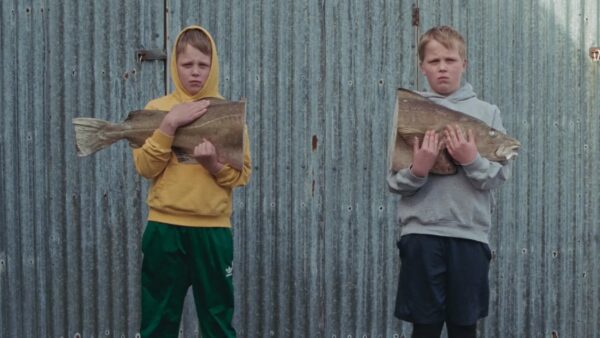
Grímur and Porgils Hlynsson in The Love That Remains. Photo: Pálmason
Hlynur Pálmason’s four-film oeuvre covers a wide range of genres, from the sublimely sweeping historical tragedy of his last film Godland (2022) to the whimsically weepy domestic tragicomedy of his latest, The Love That Remains, but it remains true to certain characteristics. They include the staggering beauty of his native Iceland’s landscape (Pálmason does his own cinematography and is here backed by a restrained piano score by Harry Hunt), the sad, destructive fecklessness of the men who inhabit it and the director’s not always successful efforts to meld the two.
It’s something like a wedding of opposites, which is what the latest film is about. Magnús (Sverrir Guðnason), unlike the errant priest who is an erstwhile fisher of men in Godland, is a mere fisherman, a hard-hat operating the heavy machinery that wreaks havoc on the ocean in scenes that evoke the abstract inhuman grandeur of the SEL’s Leviathan (2012) from Harvard’s Sensory Ethnography Lab. Anna (Saga Garðarsdóttir), on the other hand, is an artist, a sculptor of sorts who renders Louise Bourgeois-like spirals into media of metal, cloth, and rust to create artworks that seem to be unsellable — despite their resemblance to drab Marimekko and tie-dyed T-shirts. How the pair met as teenagers and formed a bond strong enough to endure into middle age is a mystery much discussed by their daughter and two boys (played by gamely genuine child actors Ída Mekkín Hlynsdóttir, Grímur Hlynsson, and Þorgils Hlynsson, the latter the director’s own sons), as well as other cutely precocious kid topics like sex, sexism, and the void of the future.
Also on the docket: the disappointing failure of the men who, in return for their privileged social status, are expected to provide some kind of security and emotional and material stability (a rant on the topic by one of Magnús’s coworkers goes unheeded). But the crop on view are either arrogant, close-minded assholes, like the Swedish gallery owner who visits Anna’s rustic studio and spends all his time avoiding talking about the artworks, or pitiful, self-pitying assholes like her husband. True, both in one way or another get their comeuppance, but in exchange, Anna doesn’t get her due. Just a few sympathizing female friends — rather than the lecherous men sniffing about her — might have been enough. Or maybe better art.
To deal with this not especially fresh material, Pálmason indulges in chronological chaos and metaphorical mishigas. When that isn’t sufficiently obfuscatory, there arrives a little bit of magical realism, a style that combines the oblique with the obvious. The narrative is scattered over four seasons and there is little narrative cohesion, beginning with the spectacle of seeing a roof ripped off a building, a prefiguration of the exposure, analysis, and destruction of the household to come. Recurrent motifs include the knight-like dummy tied to a pillar by the kids, which serves as archery target practice (Saint Sebastian stand-in for the hapless patriarchy under fire); a rooster with a nasty attitude that Magnus is tasked with dealing with; and recurrent scenes from the 1954 horror film The Creature from the Black Lagoon of the titular beast stalking the statuesque Julie Adams.
But such transparent metaphors drawn from the world do not seem to satisfy this director, who tries to transcend realism and perhaps good taste by adding dollops of the fantastic. Thus, the creature morphs with the rooster and the dummy comes to life and changes genders, all to torment poor Magnús, who really doesn’t deserve all that much attention. Unlike the family’s indefatigable border collie Panda — who won the Palme Dog award at Cannes and almost single-handedly rescues this ambitious, artful, but half-baked bagatelle.
Peter Keough writes about film and other topics and has contributed to numerous publications. He had been the film editor of the Boston Phoenix from 1989 to its demise in 2013 and has edited three books on film, including Kathryn Bigelow: Interviews (University Press of Mississippi, 2013) and For Kids of All Ages: The National Society of Film Critics on Children’s Movies (Rowman & Littlefield, 2019).