
Theater Review: “We Had a World” — Joshua Harmon’s Family Saga Revels in Wit and Wounds
By Robert Israel
Joshua Harmon’s play offers numerous instances of familial turbulence, moments of rhapsodic relief, and — to avoid spoilers — revelations of how guilt and hostility fuse to create irreparable fissures in the family dynamic.
We Had a World, by Joshua Harmon. Directed by Keira Fromm. Staged by Huntington Theatre Company, Calderwood Pavilion, Boston Center for the Arts, 527 Tremont St., Boston, through March 15.
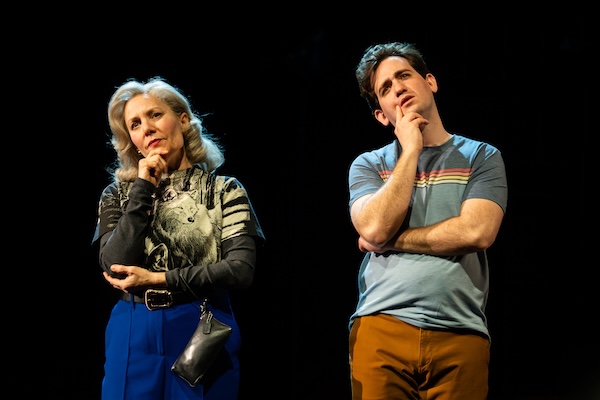
Eva Kaminsky and Will Conard in the Huntington Theatre Company production of We Had a World. Photo: Annielly Camargo
There is a moment early in this long one-act when Joshua (Will Conard), now a grown man, delivers a decade-by-decade recounting of his family life. He relives being five years old again and leaps into the air, unburdened by the weight of his family’s entanglements. It is a liberating moment that is not repeated in the scenes that follow in what can, at best, be described as a dark comedy.
This is the third Harmon play — the second to be staged by Huntington Theatre Company — in Boston that I have reviewed (Arts Fuse reviews Prayer for the French Republic and Bad Jews). In many ways, this script is Harmon’s most successful to date. Like the (autobiographical) character Joshua, who jumps with abandon into the air, the dramatist felt free enough to put less emphasis on grappling/dissecting his Jewish identity/inherited history. Instead, he breathes theatrical life into his grandmother Renee (Amy Resnick) and mother Ellen (Eva Kaminsky), and that detailed attention deepens our understanding of the family’s (often acrimonious) codependencies. Yet, despite the 100-minute running time (see the note on length at the close of this review), the piece is still in need of editing. A careful pruning back of some snippets of dialogue — specifically the banter by one character and the overexplaining by another as to what we’ve just heard — would make those interchanges much more effective.
We Had a World is told via fractured memories because, as Joshua explains, “There is no straight line to tell this story … it’s confusing.” But then why turn around and inject that confusion into the narrative? This miscalculation includes adding specifics that give the impression that the playwright is busily patching holes in the narrative, such as info about a love seat that has its own back story, a yarn that includes references to the family’s visits to, and roots in, France.
The play begins with Renee’s request to her grandson. She has just shared that she is struggling with a fatal cancer diagnosis, and asks that he write a play about their family. She even has a title to suggest: “Battle of the Titans.” She adds: “I want you to promise me something.… make it as bitter and vitriolic as possible. It ought to be a real humdinger.”
We learn the backstories that will form this yet-to-be-penned contentious drama soon enough, and they will feature numerous instances of familial turbulence, moments of rhapsodic relief and — to avoid spoilers — revelations of how guilt and hostility fuse to create irreparable fissures in the family dynamic. There are comic moments aplenty throughout the talk that offer a salve for these painful disruptions. The audience — inevitably craving comic relief — will not leave the auditorium hungry.
The performances are first-rate throughout. As the matriarch, Amy Resnick shines, appearing as a younger, sprightlier version of herself and then, when older, adding a shuffling gait that reflects the ravages of her illness; it is painful to watch. As Ellen, Eva Kaminsky takes full command, embracing her good fortune to be given some of the harshest — and most comical — lines in the play. As the dutiful son/grandson, Will Conard contends with the joys and sorrows of his life with valiant radiance, and we sense the tenderness he craves (and often indulgently receives) and how that search — that longing — ends up molding his life. Courtney O’Neill’s set allows the players to move fluidly between scenes and between decades. Tyler Micholeau’s lighting accentuates the sometimes jarring shifts in time.
This critic has noted before that Harmon, like his autobiographical double in the play, has received more laudatory praise than many other contemporary playwrights, many of whom have had fewer beams of the limelight cast upon them. As I have noted in the past, it is well past time to move on from this mawkish adoration.
A closing note on the value of a play’s running time.
We often read, printed in the playbill, how long a production will run. But we need to remember that the play’s the thing, not the length of time it takes to experience that play.
Arifa Akbar, theater critic for The Guardian, has informed her readers that she enjoys “short attention span” plays. She recently lauded a production of a Shakespeare play in London. Its normal run time would have been around three hours; it had been reduced to 80 minutes. She called the approach, with admiration, “bite-size Shakespeare.”
I wonder what Akbar would think of a play if it ended after 15 minutes, the amount of time the late Pulitzer Prize-winning American playwright Moss Hart said audiences should allot a play before they give it a thumbs up or a thumbs down.
Hart once pithily noted: “An audience will give any play 15 minutes of their time. At the 16th minute, they’ll decide if they want to go on that journey or not.”
With more reflective editing by the playwright — in collaboration with the director — we might not have to worry about the length of productions at all.
Robert Israel, an Arts Fuse contributor since 2013, can be reached at risrael_97@yahoo.com.