
Book Review: “The Copywriter” — Of Proust, Pandas, and Poetic Inertia
By Clea Simon
What stands out for this reader is the humor Daniel Poppick mines from the quotidian.
The Copywriter by Daniel Poppick. Scribners, $26, 225 pp.
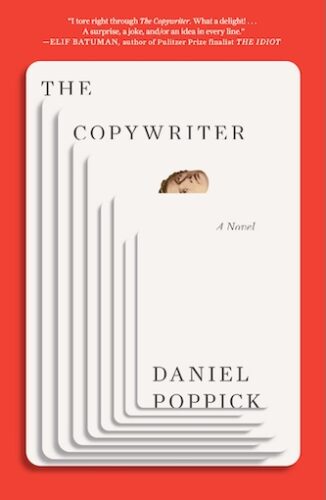 Nothing much happens in poet Daniel Poppick’s first novel, The Copywriter, and that’s okay. This short book moves at the pace of everyday life: friends gather, relationships develop and falter. Work is dull. But while much has been made of Poppick’s poetic sensibility — the author’s collection Fear of Description won a National Poetry Series award in 2018 — what stands out for this reader is the humor the author mines from the quotidian.
Much of that humor is at the expense of Poppick’s narrator, a poet referred to simply as D_. D_ is blocked when we meet him in the summer of 2017. Six years after finishing his MFA, he works as a copywriter tasked with coming up with marketing descriptions for such idiotic items as “a designer sandcastle-building kit for adults” or an “eggplant emoji drone.” It’s a job that requires him to coexist with the ridiculous, and Poppick uses his tasks to skewer contemporary life — and what passes as our search for meaning — in sometimes broad satire, as when he has D_ “trying to imagine what people who are in the market for a coat hook shaped like a panda want to believe about themselves.”
This deadpan humor is larded with literary references (“all happy commutes are alike; each unhappy commute is unhappy in its own way”) as well as the names of poets and literary movements. These are the lingua franca of his cohort: “I’m only dating people who … respect my art like they would respect anyone else’s career,” states one friend. “They should have a good job, they should at least read Creeley, they should be willing to put me on their health insurance if we’re having unprotected sex.” But familiarity with such poets as Robert Creeley, Louise Glück, or John Ashbery (whose death occurs early on in the book) isn’t necessary to understand the zeitgeist of this insular crew.
D_ still writes sporadically — in addition to his brief journal entries, the book is structured around poetic fragments, parables, and dreams — but he spends more time thinking about poetry than composing it. (“This isn’t necessarily a bad thing,” he rationalizes. “You only write the poem when you’re ready for it.”) To the reader it is clear that he is drifting. In truth, his life revolves around his dead-end job, socializing with other poets, and rather listlessly cohabiting with his girlfriend Lucy and their two cats, all of whom seem to have a little more of a sense of purpose, even if it is a ludicrous one. (“We’re poets,” his friend Will says. “But my real passion is delivering office furniture.”)
D_ is vaguely aware of his inertia: “Everyone around us is evolving in their lives and we’re staying the same,” he notes. But although D_ has a sharp eye for the absurdity of modern life, particularly as viewed through the lens of his job, he is blind to what is happening (or not) within himself.
Which, frankly, isn’t much. Over the book’s two-year span, jobs and relationships change. D_ embarks on a cross-country trip, gaining and losing people along the way. With glacial slowness, these changes in his external circumstances force our protagonist out of his passive stance, though his first steps are barely recognizable as movement, even to himself. When his job finally ends, for example, he decides to read Proust, telling Lucy, “No one has ever read Proust and been employed at the same time.” Later he will note that In Search of Lost Time “takes so long to read, you cannot help but be changed in the interval.”
“When I’m done reading Proust, will you tell me how I’ve changed?” He asks Lucy. “I’m worried I won’t notice it happening.”
He may not, but we do, as D_ finally begins first to react and then, finally, act, making one small, but meaningful decision that subtly channels a beloved, lost relative. It’s that small change, as much as the humor and poetry along the way, that makes this coming-of-age story satisfying despite its lack of drama. “When in Rome, burn,” D_ comments at one point, not long before he takes that final step. Even the inconclusive ending works: we may never know what happens next, but at least D_ gets a poem out of it.
Clea Simon is a Somerville resident whose latest novel is The Cat’s Eye Charm (Level Best Books).