
Poetry Review: The Art of Letting Go — Gail Mazur’s “World on a String”
By Ann Leamon
The poems in World on a String set an example for us all of how to live, to love, to release, and to remember.
World on a String by Gail Mazur. Arrowsmith, 64 pages, $20
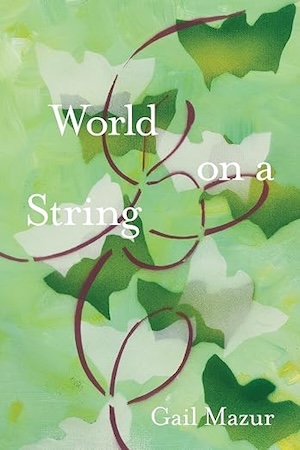
Gail Mazur’s latest book, World on a String, is a collage of images, a whirlwind of photographs and memories. There’s a sense of gathering up, of revisiting favorites, and of making peace with difficult people and things. I was not surprised to learn she’s in her late 80s, nor that she lost her artist husband a few years ago.
That said, one cannot judge this book by its cover. Given its spring-green cover and effervescent image and title, I jumped into the first poem, “Three Trees,” expecting buds and tulips. Around midway, I learned that we were not tripping through the season of rebirth:
“[…]
you even liked ekphrastic poems (I hated them).
You’d love me writing this. […]”
It struck me that this “you” is a sign of absence, in some way an acknowledgment of the departed. The next poem, “Couplets,” also addresses an absent “you,” and with it dawns the realization that the poems are part of a series of heartfelt reflections on the losses that accumulate over a life well-lived.
At the same time, a lovely strand of humor runs throughout this collection. The title poem, “World on a String,” intersperses fragments of the Sinatra standard (music by Harold Arlen, lyrics by Ted Koehler) with recollections of the author’s beloved aunt, who lived and died on her own fierce terms.
“[…] thinking of you waking yesterday how strange the change
in your body of ghost bones,
from major to minor, from what you’d hoped would be
your last sleep, disgusted,
grousing, ‘Oh no! Am I still here?’
[…]”
Mazur’s verse interweaves passions and meanings. “Poems” captures her uncertainty about the nature of her art — her own poetry — and it is leavened with welcome humor.
“I’ve made them but like children
they’ve stopped being mine—
[…]
although they live here in me
even after I’ve sent them away.
[…]
Always near me, mine—
yet for how long?
[…]
How will they do? Where do they think
they’re going without me?”
The poem’s closing lines juxtapose the notion that an artist’s creations are their “children” with that oft-repeated parental lament, darkened by its intimation of Mazur’s mortality.
Death is a central theme throughout a book that is about losses. “Unveiling in Snow” regrets a sisterhood that was never close, listing many of the things that the sisters didn’t do together. It hints at a cause for the distance — “[…] because together we weathered the tempests/of our mother’s house.” It concludes with a burden of guilt that many of us bear for siblings ignored:
“[…] I,
the sister, this Gail who tried to exonerate herself then,
still tries to forgive herself now.”
Two poems deal with Mazur’s mother’s aging and then death. “Her Stairs” amusingly notes her mother’s (mistaken) conviction that someone had snuck into the cluttered house at night to rob her. Mazur attempts to soothe her by agreeing:
“[…]
that weasel, bottom-
feeder, trickster hiding somewhere
in her house of afflictions, stealing beets
and string cheese from the refrigerator, thaw-
ing her favorite TV dinners, […]”
The stairs of the title appear in the last section of the poem, where the speaker speaks of climbing them:
“[…]
on a rescue mission to find some
purloined item—a hairpin, a dresser scarf,
a small hooked rug, one bronze Shakespeare bookend.
[…]”
But the stairs open into memory and mystery:
“[…]
I know these old steps, […]
I know what they lead to. I walk in my sleep to their bedroom
door where I saw my father square his gallant shoulders one last time,
take one last look before he descended for good.
[…]”
On her old nightstand, the poet finds “a crystal chimera” — a rendition of a hideous monster of Greek antiquity — but “I never see what it is I came / for, so I turn back to the stairs and go down empty-handed.” She never finds what she came for, but she did recover memories and partially forgotten losses, including the image of her father squaring his gallant shoulders (against what, did he know he would die?). The speaker’s hands may be empty, but she has left her readers with a multitude of questions.
“October 2001” describes the circumstances of Mazur’s mother’s death — sudden, her body found by a neighbor the next morning. This, like “Her Stairs,” is a prose poem, a form I often find problematic. But it works in this case because the prosaic topics are surveyed chronologically, though in words that are infused with memory and emotion. Here, the poet concludes with the losses of the immigrant and of the daughter:
“[…] in my hollow
ear I heard her voice, speaking clear and firm, saying definitely to me, You did
as well as you could—all I could ask for, considering our story. And what
went with you, Mother—all the cutting, the stirring and the broiling, the
pinches added, the straining, the spicy goulash, the meatloaves, the blintzes,
the pies, the forgiving and also the unforgiving, the sweet and bitter peppery
stew of your life, and I’d partaken of it all along, my mother, and I was fed—”
For all its bereavements, Mazur still delights in her life. The last poem, “Koren,” captures this duality of despair and enchantment. Dedicated to her late husband and his friend, the artist/writer/cartoonist Ed Koren, the title can also mean “shining” or “radiant,” a word used to describe a divine presence. The poem — both love song and obituary — starts:
“Today in The New Yorker
a “new” cartoon
by your old friend Ed,
gone now over a year. […]
Oh Ed,
oh Mike, alone here
at our kitchen table
I’m eating a turkey
(a Thanksgiving leftover)
sandwich, not wanting
to turn the page
on The New Yorker
cartoon. […]”
The poem describes the cartoon — a poetry reading by the Grim Reaper — and repeats the punch line “His poetry is good/but a little dark” along with details about the poet’s act of eating a sandwich at the kitchen table. She recalls the lifelong friendship of the two men — we understand her grief when she refuses to turn the page of the magazine.
This is the way to wind up one’s life. Pick up memories, admire them, capture them in words, the way tree sap captures unwary insects and hardens into amber around them. World on a String sets an example for us all of how to live, to love, to release, and to remember. None of us, after all, gets out of here alive.
Ann Leamon’s writing spans the genres and has appeared in Harvard Review, Tupelo Quarterly, MicroLit Almanac, North Dakota Quarterly, and River Teeth, among others. She holds a BA (Honors) in German from Dalhousie University/University of King’s College, an MA in Economics from the University of Montana, and an MFA in Poetry from the Bennington Writing Seminars. She has attended residencies at the Prospect Street Writing House, Blackfly Writing Program at the Haystack School, Stonecoast Writers Program, and Dorland Mountain Artists Colony. She lives on the coast of Maine with her husband and a Corgi-Lab mix.