
Theater Review: Penelope’s Patient Power — Aimee Doherty Shines in Lyric’s Intimate Odyssey
By Martin B. Copenhaver
The true star of the Lyric Stage production is Aimee Doherty, who is marvelous in the role of Penelope.
Penelope, based on writings in The Odyssey by Homer. Book, music, lyrics, and arrangements by Alex Bechtel. Book by Grace McLean and Eva Steinmetz. Directed by Courtney O’Connor. Staged by Lyric Stage Company at 140 Clarendon Street, Boston, through March 1.
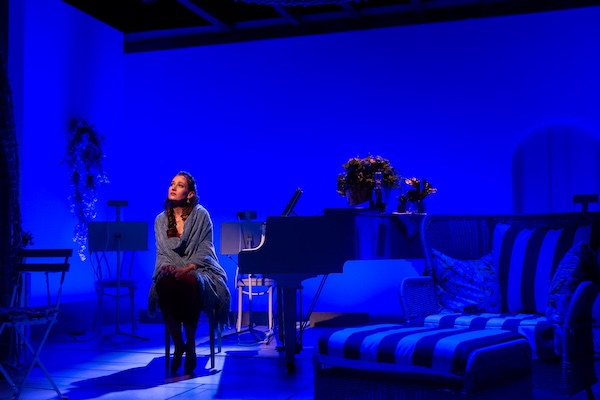
Aimee Doherty in the Lyric Stage production of Penelope. Photos: Nile Hawver/Nile Scott
The chamber musical Penelope tells the story of Odysseus’s wife during her 20 years of waiting for him to return from the Trojan War. It is an intimate piece on a small scale — one actor, one set, one act, five musicians.
As the gods would have it, these days screens great and small are showing trailers for director Christopher Nolan’s soon-to-be released film, The Odyssey. It is clear from the trailers that the film is of epic proportions, a spectacle in the tradition of Cecil B. DeMille, who advised, “The way to make a film is to begin with an earthquake and work up to a climax.”
The contrast between the two treatments of this iconic story could not be more pronounced. In the film (as in Homer’s poem), Odysseus gets to live his life on a grand scale, claim victory in war, encounter various mythical creatures, triumph over monsters, be hailed as a hero. Meanwhile, in her small musical, Penelope gets to… wait for Odysseus. Just wait.
At first, the theme of waiting does not seem capable of carrying an entire play. (Well, there is Waiting for Godot, of course, but that may be more the exception that proves the rule.) Most of us hate to wait. We associate waiting with passivity. We want action, or at least movement, in our lives and in our theater. But waiting is not a single activity. It has many moods. A girl who stands on a street corner waiting for the school bus to arrive will experience one kind of waiting, a passive waiting. That same girl on the same street corner waiting for a parade that is just out of sight will also wait, but it will be a different kind of waiting, an active waiting, infused with longing and anticipation.
In Penelope, Alex Bechtel, who wrote the music, lyrics, and co-wrote the book, traverses the diverse landscape of waiting. At times, Penelope’s waiting is drenched with resentment, at other times it is laced with longing. Her response to the demands of waiting can be pleading for an end, followed by sudden defiance. The various moods of waiting are reflected in the variety of musical styles in the score. There are poetic ballads, comic banter numbers, folk-rock songs, some jazz, and even something gospel-y.
Bechtel has shared that he was drawn to the character of Penelope from painful personal experience. During the pandemic, he was holed up in Philadelphia while his longtime partner was in Boston. The separation proved too much for them to maintain the relationship.
Bechtel was devastated by the break-up. He says there was something about the character of Penelope that spoke to him in his own agonizing experience of isolation and sorrow. He began writing songs for Penelope to sing, which turned into a concept album, then a cabaret version, which developed into the play.

Ethan Wood, Dan Rodriguez, Aimee Doherty, and Kett Lee in the Lyric Stage production of Penelope. Photos: Nile Hawver/Nile Scott
The songs are not particularly remarkable, but the variety helps. The band, which at times plays something of the role of a Greek chorus, features strings. It is excellent. In fact, I found the instrumental pieces, rather than the songs, to be the most moving.
The set (designed by Janie E. Howland) is a contemporary sun-washed Greek villa. Not only is it beautiful (can I get a reservation for my next vacation?), the thrust stage helps create the intimacy that is key to this production.
Also noteworthy is the lighting design (by Karen Perlow). At times it evokes the ocean, other times lightning and rain. By turns, the lighting supports the intimacy of the production, while other times it seems to expand the scope of the set to include a larger world.
The true star of the production, however, is the star of the show. Aimee Doherty is marvelous in the role of Penelope. At various times she literally engages the audience (at one point, she even hands an audience member a glass so they can drink together), but even when she is not explicitly engaging the audience she is always… well, engaging. She addresses the audience as if, collectively, it was another character in the story. As a result, her portrait of waiting never becomes dull. Her performance is poignant, at times heartbreaking. Doherty’s body, and particularly her face, traces such a range of emotions that her words can seem almost redundant. In fact, the most moving scene of the show is without words. Penelope imagines what it would be like to welcome Odysseus home. She imagines sitting with him, holding his hand, dancing with him — all without a word. Every gesture and expression seemed just right, as if there were no other way to tell Penelope’s story. The audience was brought to the kind of hushed silence that only a compelling performance can elicit.
It can be difficult to describe what makes an actor exceptional without resorting to a mere list of superlatives. It is much easier to describe why a particular performance is lacking or simply fails to ring true. Great performers have an ineffable quality, which means that what makes them great is also what makes their performance difficult to capture in words. It is why the French came up with the phrase je ne sais quoi (literally, “I don’t know what”) to describe the indescribable. John Lahr, in the introduction to his new collection of New Yorker portraits of great actors, comes close to tracking down the elusive when he writes of great actors: “In the characters they inhabit, these actors incarnate the longings, the loss, the confusions with which the culture contends and which it often can’t name.” To me, Doherty has that je ne sais quoi that characterizes great actors.
Gratefully, Doherty has appeared frequently on various Boston stages since her first show for Lyric Stage in 2007. In fact, her curriculum vitae is now so impressive in its breadth and depth that it seems time to declare that Doherty is a true treasure of Boston theater. Please, don’t let anyone give her a ticket to New York or Los Angeles. Or, at the very least, make it a round-trip ticket.
Martin B. Copenhaver is a retired pastor and seminary president who lives in Woodstock, Vermont and Cambridge. Once upon a time, he studied theatre criticism with Stanley Kauffmann.
Tagged: Aimee Doherty, Alex Bechtel, Courtney O’Connor, Eva Steinmetz, Grace McLean, Janie E. Howland, Odysseus, Penelope