
Visual Art Review: The Sacred Act of Making — Boston Artists Explore Ritual and Space
By Lauren Kaufmann
In this exhibit, curator Robin Hauck celebrates 10 Boston-area artists who resist the relentless distractions that contemporary life imposes on all of us.
Ritual Practice/Sacred Space at The Beehive, Boston. On view through March 15.
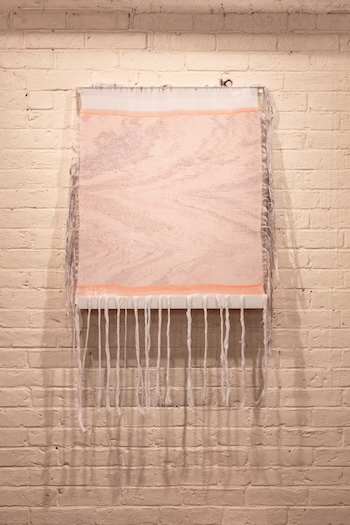
Sam Fields, unwoven-rewoven in orange, 2016. Courtesy of the artist. Photo: Olivia Moon Photography
Regular routines and personal spaces foster artistic creativity. The exhibit Ritual Practice/Sacred Space honors Boston-area artists whose work flourishes because of their embrace of the value of personal rituals and private workspaces.
Creativity depends on focus, and focus requires undivided attention. However, artists, like the rest of us, are bombarded by content — emails, text messages, and social media alerts — that demand their time and attention. In this exhibit, curator Robin Hauck celebrates 10 Boston-area artists who resist the relentless distractions that contemporary life imposes on all of us.
The Beehive is a popular South End restaurant known for live music. Because the restaurant doesn’t have a dedicated gallery space, Hauck has adapted much of the available wall area for the exhibit. While the pieces have a label identifying the artist, title, and sale price, there are no descriptive captions to supply context. A booklet is available upon request: it contains images of the artwork, along with a QR code that leads you to Hauck’s website, Misstropolis.com, which provides valuable information about the artists and their creative processes.
There is a lively debate in the museum world about the use of interpretive labels. Some curators believe that labels offer critical background information about the art; others maintain that they can be too directive, denying viewers an opportunity to experience their own spontaneous responses. There is an art to writing good interpretive labels; when done well, labels supply museum visitors with a deeper understanding of the artist and the artwork, while still leaving room for personal connection and emotional response.
In the case of this exhibition, some interpretive information would help viewers to better grasp the intent of the work on display. Hauck’s website offers some wonderful quotations; including them in the exhibit would provide helpful insights into the art. For example, Daniela Rivera, who has two etchings in the show, says, “Making is my ritual. Ritual does not inform my practice but it is my practice. Making is when time disappears and connection takes over.”
This statement represents one artist’s view of ritual, but it is a meaningful expression that could apply to other artists included in the exhibit. Given the limited space Hauck had to work with, she had difficult decisions to make, but a brief quotation or two might have served as a way to unify the works on view while also explaining the overall theme. Interpretive text can be an effective connective tissue that bonds disparate works.
There are recurrent themes in the exhibition: the value of repetition and the regard for deliberate, unhurried practice. Samantha Fields, who is represented by two woven works, describes it this way:
Handwork keeps me steady in hard seasons: it’s grounding, regulating, and honest. The repetition of making — the threading, knotting, mending — creates a rhythm that steadies my body and focuses my attention. Over time, these repeated gestures become a kind of ritual, marking the passage of hours and helping me find order inside uncertainty.
Fields’s pieces, like much of the work in the exhibition, require exquisite attention to detail, achievable only through intense focus. Her woven pieces feature subtle patterns and pleasing pastels. When you step closer, you can appreciate the steady, repetitive labor that distinguishes her craft.
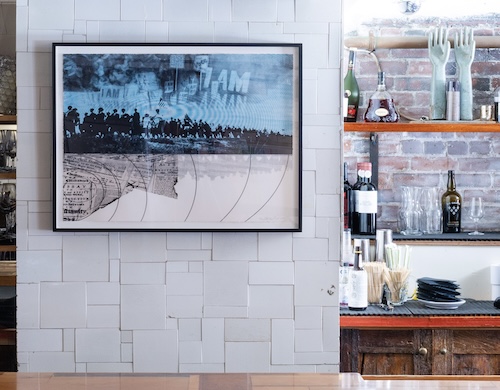
L’Merchie Frazier, We Just Keep on Coming: 1706, 1965, 1968, 2020, 2025. Screenprint in colors, signed in pencil and dated, numbered, edition of 30. Photo: Olivia Moon Photography
L’Merchie Frazier is a nationally recognized artist and educator whose work addresses racial inequity and the history of slavery. In We Just Keep on Coming: 1706, 1965, 1968, 2020, 2025, she layers images to create a stirring statement about the progression of the Civil Rights Movement. The central image is a silhouette of an archival image of a march. While the foreground contains snippets from old newspaper articles about the sale of enslaved people, the background features posters with contemporary slogans: “Black Lives Matter” and “I Am a Man.” It’s a powerful piece that speaks to the current moment.
There are two works by Crystalle Lacouture. Her, a photographic print, resembles a patchwork quilt. It is made up of scraps of clothing worn by the artist’s daughter, full of bright colors and floral prints. In contrast, Blue Mask is a lesson in symmetry, comprising several sets of orange eyes peering out from a canvas filled with dark blue tones.
Rachel Perry’s Chiral Lines is a diptych, composed of two large panels filled with vibrating vertical lines of varied colors. Chiral is a scientific term that means “not superimposable on its mirror image.” In Perry’s piece, the arrangement of vertical lines on the facing panels are inexact mirrors of each other. Perry is a well-known conceptual artist who works in photography, drawing, and sculpture. For this piece, she set out to use all the drawing implements that she could find in her home and car — graphite, marker, ballpoint, and colored pencil. She also used both her right and left hands to draw.
On her website, Perry says, “Each set of drawings is an imperfect mirror image, and a suggestion of the impossibility of making the same thing twice.”
Perry’s observation gets at the essence of making art and is relevant to this exhibition. Every work of art is distinctive and, although artists develop discernible styles that make their work identifiable, each piece they create is different in some ways from every other piece. That reminds me of a comment that Joni Mitchell once made at a concert. After an audience member yells out a request, Joni responds by noting the difference between the performing arts and being a painter. She says, “Nobody ever said to Van Gogh, ‘Paint a Starry Night again, man.’”
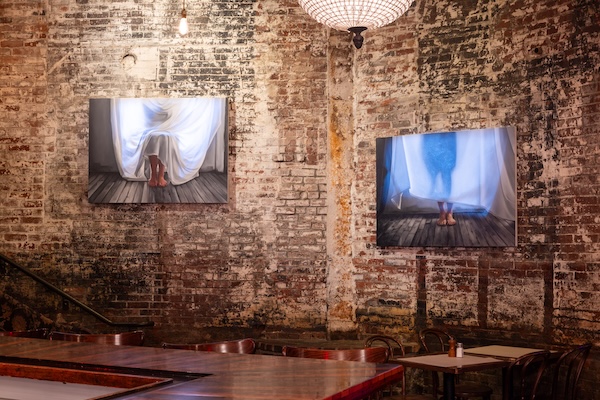
The Safarani Sisters, Untold Tale I, 2024 and Untold Tale II, 2024. Oil on canvas and video projection. Photo: Olivia Moon Photography.
In three mesmerizing pieces by the Safarani Sisters, the Iranian-born twin sisters merge painting with video to create moving images that are projected onto painted canvas. These eye-catching works depict women in domestic scenes, and there’s something truly spellbinding about their innovations.
There are five works by Zainab Sumu — two watercolors and three sculptural works. Having grown up in Sierra Leone and Paris, Sumu integrates traditional African crafts into her work, using natural and synthetic materials to create three-dimensional objects marked by intricate twisting and knotting. Sumu’s watercolors depict scenes of pastoral life in Wansan Village in Guinea. In Wansan Village, 2022, earthenware pots mingle with plants and animals to produce an impression of everyday life in the small village.
Although not explicitly stated, the work featured here is all done by women. Having the space and time to make art has always been a challenge for women, whose childrearing and domestic responsibilities have been obstacles to their creative life. For the 10 artists featured here, their steady focus and avoidance of distraction is paying off. Their work is thoughtful, inventive, and altogether worthy of our attention.
Lauren Kaufmann has worked in the museum field for the past 14 years and has curated a number of exhibitions.
Tagged: "Ritual Practice/Sacred Space", Crystalle Lacouture, L'Merchie Frazier, Rachel Perry, Robin Hauck, Sam Fields, The Safarani Sisters