
Dance Review: “circlusion” Turns the Mattress into a Stage for Reimagined Femininity
By Debra Cash
As this duet unfolds, it opens the way to musings about how a bed is a human-sized rectangle on which are projected dreams and nightmares, sexuality and erotic boundaries.

A scene from circlusion. Photo: Cameron Kincheloe
circlusion Co-created by choreographer Lilach Orenstein and set designer Sara Brown. Artistic collaborator and dramaturg: Zoe Scofield. Lighting design by Jacob Zedek, music composed by Evan Anderson, sound by Christian Frederickson, and costumes by Karen Boyer. Presented by MIT Music & Theater Arts at the Theater in W97, Cambridge, through February 7.
The most famous — or at least controversial — work of performance art featuring a mattress has to be Columbia student Emma Sulkowicz’s 2014-2015 “Mattress Performance (Carry That Weight),” a senior thesis in visual arts that protested what she claimed was the negligence of the university administration for failing to expel a fellow student she accused of rape. (That fellow student called it an act of bullying, was found not responsible by a university investigation, and a legal settlement ensued.)
The mattress that engenders Israeli-American choreographer Lilach Orenstein and MIT-based set designer Sara Brown’s “circlusion,” which they describe as “re-visioning womanhood and sexuality,” is not so freighted, but as this duet unfolds, it opens the way to musings about how a bed is a human-sized rectangle on which are projected dreams and nightmares, sexuality and erotic boundaries. It can be deployed as a wedge against ordinary action and a respite from it; alternately, a raft and a door. Blank as a blotter, it is never neutral.
Sara Brown has crafted a setting that places the performers and audiences in an otherworldly, circular tent that curves like the inside of a sea urchin shell or Noguchi paper lantern. Small groups of audience members are asked to take off their shoes, or cover them with paper booties, and are invited into a small alcove that feels like a spacecraft airlock or a funicular cabin, and — seemingly privately — are given the usual instructions about exits in case of emergency and keeping cell phones off.
The performance space itself is ringed with plush white sofas; I had a seat reserved but most of the student-age folks in attendance sat on the floor. There’s an ambient electronic hum, and pink light glowing close to the floor. You barely notice the yellow sneakers that are starting to poke out from under the tent’s bottom edge, but there they are, followed by pink socks and flowered pants. And then someone else’s dark hair. The two dancers — Chanel Stone and Kat Sotelo — are dragging a mattress into the space, its fitted white cover making the floor into a kind of ice floe.
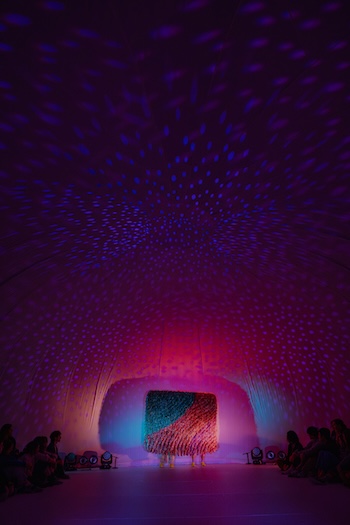
A scene from circlusion. Photo: Cameron Kincheloe
Then, for the next hour or so they explore their relationship(s) and the mattress’s materiality in a kind of retro Grand Union playground. They notice their own shadows; they twitch against the floor; they pretend to make snow angels. Their emotional connection comes and goes in strobed impulses, sometimes angry and rejecting, other times tender and connected.
Stone, who is visibly pregnant, has a serene vibe, like Beyoncé as an Orisha, while Sotelo is more scrappy and urgent. When — voila! — the white mattress cover is pulled off, it reveals a snazzy tinsel fringe cover that, at first, is used as shimmying curtain the dancers can stomp their feet beneath in cartoonish mincing. Later, it cloaks each dancer’s shoulders like regalia. When Sotelo crawls with the mattress across her back she seems a beast of burden, but when both women lie on their backs with the mattress balanced on their feet, it becomes a swaying parasol, unexpectedly light.
These simple vignettes have a kind of purity, but Stone’s pregnancy gives everything a subtext: when she lies on her back she looks like she might be giving birth. Embraces read as maternal. As it happens, choreographer Lilach Orenstein is pregnant right now, too — her child due a few weeks ahead of Stone’s — and after the performance she mentioned to me that Stone was cast before Orenstein knew she was pregnant. In the studio, Orenstein would try everything herself to make sure it was safe for Stone to perform. From the looks of it, Stone was game to do just about anything.
Throughout the action, the ambient music ebbs and flows. Over and around the movement phrases, the light keeps changing, polka-dotted as a Yayoi Kusama installation, shading to dusk, going harsh white.
It’s not clear what this all adds up to, but if anyone still has questions about the value of experiencing a live performance instead of settling in to watch a screen in the comfort of one’s own home, Brown’s enveloping set and Jacob Zedek’s inventive lighting could be introduced as Exhibit A in live art’s defense.
Debra Cash is a Founding Contributing Writer to the Arts Fuse and a member of its Board.
Tagged: "circulsion", Chanel Stone, Kat Sotelo, Lilach Orenstein, circlusion