
Book Review: “The Hadacol Boogie” –James Lee Burke’s Bayou Ballad of Blood and Redemption
By Clea Simon
The point of a novel like this: Life is messy, but glorious. Kind of like The Hadacol Boogie.
The Hadacol Boogie by James Lee Burke. Atlantic Crime, 480 pp., $30
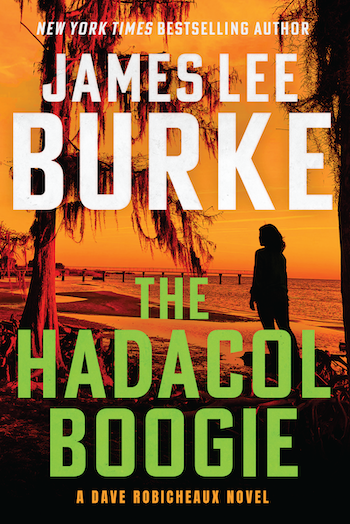 The beauty of James Lee Burke’s books isn’t in their plotting. Yes, the Mystery Writers of America Grand Master knows how to craft crime fiction well, as the return of his series protagonist Dave Robicheaux in his 25th outing decidedly shows. But the crime at the heart of The Hadacol Boogie — the murder and dismemberment of a young Black woman whose body has been dumped on Robicheaux’s property — is merely the catalyst for the Iberia Parish (Louisiana) detective and his sidekick Clete Purcell to pursue larger-scale issues of justice and for Burke to indulge in the metaphor- and allusion-filled prose.
At times shambolic, this rich, rambling novel hits on many themes that will be familiar to fans of the 89-year-old author, from the environmental devastation humans are wreaking on South Louisiana to the racial sins of our nation. That blood-drenched legacy is everywhere: “In a live oak on the bayou were iron spikes and lengths of chain left from the auctions conducted by James Bowie and Jean Lafitte in violation of the 1808 ban on slave importation from the West Indies,” Burke writes before introducing the 1947 murder conviction of Willie Francis, a Black 14-year-old, and his subsequent sentence to death in the electric chair. “The trial was a mockery, At least one of the executioners was drunk and botched the execution.” The young man ended up being electrocuted twice to fulfill his sentence, and his fate becomes one of the touchstones of the book.
Such historical allusions, along with references to everything from the Bible to Chaucer, are given full range in this sprawling novel. Throughout, Burke also lets Robicheaux rhapsodize about his homeland in evocative passages: “On the horizon, lightning was striking the water, but without sound, like gold wires in the bottom of the clouds,” he observes at one point. At another, “the last of the sunlight [was] like a cool fire burning brightly inside the clouds.” These phrases, both elegiac and melancholy, often set up the many moral soliloquies delivered by the troubled detective, whom readers can easily picture as the author’s stand-in.
Speaking of himself and Clete, Robicheaux muses that, in the book’s early 2000s setting, “he and I shared a sense we would be among the last to see what was called traditional America.” He continues, “We also shared a feeling that the new century did not bode well for us. The indifference to the melting of the Arctic, the rising of the oceans, the sands of war blowing in the Mideast, the possible return of an evil man in the Kremlin.” Climate change is a looming presence in the bayou country of South Louisiana, but the other threats simply contribute to the philosophical foreboding in the book, illuminating its protagonist’s grim outlook.
Of course, as a former New Orleans homicide detective, Robicheaux can be expected to view the world darkly. The murder of Clemmy Benoit, “a young Creole woman with blue eyes and roses tattooed on her breasts,” wakes many emotions in the battle-scared vet. Among these are his protective but often confused feelings about his own daughter, Alafair. (In real life, Alafair Burke, the author’s daughter, is a writer of best-selling suspense novels.) “As you might know, a daughter-father relationship is a strange one.… Fear and covetousness are involved. In other words,” he tries to explain, “it’s not a rational state of mind.” This relationship is echoed in Robicheaux’s relationship with the newly fledged detective Valerie Benoit, whose crush-like advances he rejects, saying simply, “I’m old, Valerie. And I mean old.”
That flirtation is one of the easier tests Robicheaux faces. In the course of the book he also confronts his multiple personal demons, from his alcoholism to his bloodthirsty desire for revenge. Still, though the murder leads the detective into a wider scheme involving the Mafia, Vietnam War atrocities, and racist land grabbing, both our protagonist and its author manage to hold it together to an earth-scorching final face-off with an M60 in a Huey helicopter and villains who say things like, “Why go to a war if you don’t kill people?”
In a way, calling that face-off “final” might be a mistake. Despite a conclusion that satisfies on many levels, it would be misleading to say any James Lee Burke book ends with all its plotting tied up neatly. But that’s the point of a book like this: Life is messy, but glorious. Kind of like The Hadacol Boogie.
Note: The title refers to the boogie-woogie blues better known as “Hadacol Bounce” or “Hadacol Stomp.” But although the rollicking tune, which references a high-alcohol patent medicine, was popularized by rhythm and blues pianist Professor Longhair (Henry Roeland Byrd), most of the musical references in this deeply Southern book belong to country music pioneer Jimmie Rodgers, whose music mined a more melancholy vein. One more appropriate to Dave Robicheaux, it would seem.
Full disclosure: I have been a fan and reader of James Lee Burke’s work for many, many years. However, I am now also represented by the agency that represents Burke, the Philip Spitzer Literary Agency. Our shared agency had no input into (and as far as I know is unaware of) this review.
Clea Simon is a Somerville resident whose latest novel is The Cat’s Eye Charm (Level Best Books).