
Musician Interview: George Steel on Launching a New Thursday-night Series at the Gardner Museum with Steve Reich’s landmark “Music for 18 Musicians”
By Larry Hardesty
“I would say Music for 18 Musicians was probably the most influential piece of American concert music of the last quarter of the 20th century. You could conceivably stretch that to the most influential piece of American concert music since it was written.”
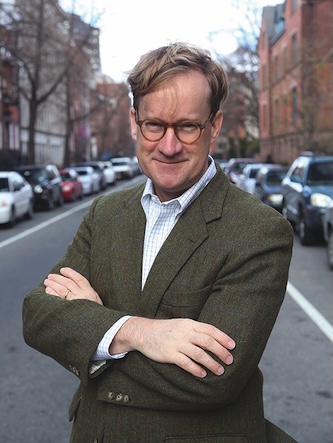
Composer and producer George Steel. Photo: Whitney Lawson
George Steel is a composer, who has won the BMI Jerry Harrington Award for outstanding creative achievement in musical theater and whose commissioned work The Three Kings has become a staple of the Guggenheim Museum’s Christmas concerts. He’s also a conductor, who reopened the Park Avenue Armory in New York with programs of Mahler and Stravinsky and has performed around 100 concerts of Renaissance polyphony with the choral group he founded, the Vox Vocal Ensemble.
For more than 30 years, he has also been a professional concert and opera producer. In 2018, after stints at the 92nd Street Y in New York, Columbia’s Miller Theater, and the New York City Opera, Steel joined the Isabella Stewart Gardner Museum as the Abrams Curator of Music.
The Gardner already hosts what Steel calls “the oldest museum-based concert series in the United States,” a Sunday afternoon concert series that features between 25 and 30 performances a year. But on February 26, 2026, it’s inaugurating a new Thursday evening concert series with a rare Boston-area professional performance of Steve Reich’s seminal minimalist piece Music for 18 Musicians. The Gardner’s website declares that “Thursday Night Music concerts are open seating, single-set performances with no intermission.” Admission to the museum’s galleries is included with the concert ticket.
Steel agreed to answer a few questions about the new series for the Arts Fuse.
The Arts Fuse: What’s the premise behind the new concert series?
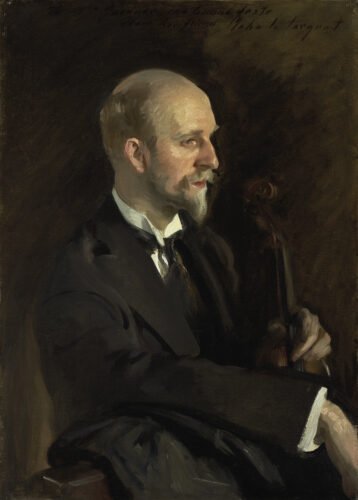
John Singer Sargent’s 1903 portrait of composer Charles Martin Loeffler. Photo: WikiMedia
George Steel: Music is an integral part of what the Gardner Museum is. Music was Isabella’s first love, I think. She opened the museum in 1903 with a concert by the BSO. She had built a perfect music room, and she conceived of the performance of classical music as central to the museum’s life.
The first concert she gave was mostly older music, and the second concert she presented was all music by her friend Charles Martin Loeffler, the composer. A portrait concert of a living composer was the second thing she ever did. So this balance between celebrating great works of the past and supporting and celebrating the music of living composers was something that has been there forever.
Our flagship series is a series of concerts on Sundays at 1:30. But there’s a lot of music in the world that I don’t personally want to hear on Sunday at 1:30. It feels like evening music, and there are different audiences who might come in on an evening. We’re only open one night a week, which is Thursday night, so I’ve been working for a while to try to develop a Thursday night music series.
And we’re launching it this year, with this amazing professional performance of Music for 18 Musicians. It’s Steve’s [Reich’s] 90th birthday, it’s the piece’s 50th birthday, and of course, it’s the U.S.’s 250th birthday. And I would say Music for 18 was probably the most influential piece of American concert music of the last quarter of the 20th century. You could conceivably stretch that to the most influential piece of American concert music since it was written.
AF: Where do you see that influence?
Steel: Well, I mean, every time you turn on the television, you hear the influence of minimalism, but particularly minimalism as colored by Music for 18 Musicians. Oddly, people don’t think about the orchestration, but Steve’s orchestration is amazing. This idea of four pianos and all these mallet instruments, undulating in time — that’s totally his invention. And it’s everywhere. You cannot escape it.
It’s also in the way that American concert music is received overseas, particularly in Europe. There was a long history of it being sort of a watery version of European music — Arthur Foote, God bless him, is sort of light Brahms.
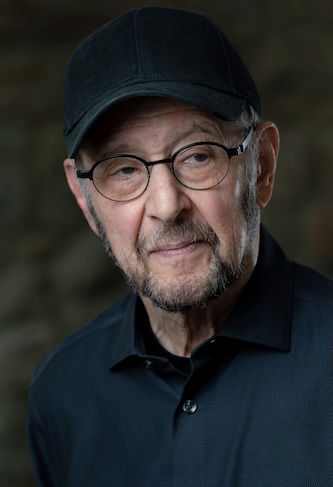
Composer Steve Reich. Photo: Jennifer Taylor
But America constantly produces these mavericks — these nutcases, for want of a better word — who do their own thing that sounds nothing like European concert music. Often, it’s music that embraces every kind of vernacular music. Charles Ives is an obvious example, or Conlon Nancarrow, who wrote for player pianos, or Ruth Crawford Seeger, for that matter.
Steve spent a long time studying West African drumming and adopted a harmonic vocabulary loosely out of rock and roll and jazz. And his music was embraced warmly by European avant-garde composers who would never in a million years have dreamed up anything like it.
Music for 18 represents a moment for him where he was able to bring together two things that he was working on. He talks about this freely, it’s not my insight, but one of them is phasing, which is something that developed out of his studies of West African music. The most obvious example is Clapping Music, which is one bar of music, and it’s a palindrome: three pulses, a rest, two pulses, a rest, one pulse, a rest, two pulses, a rest,
That’s the whole piece, except it’s played by two players. They clap in sync as long as they like, and then at some point, one of them shifts over an eighth note. So the same piece is coming at you asynchronously, and then that player moves over another eighth note and continues to do that until they cycle all the way back to a unison at the end. Or there’s a piece called Piano Phase, where two pianos are absolutely in sync, and then one of the pianos speeds up just infinitesimally until it gets a 16th note away, a moment where you have this moiré, and it’s incredible. In Music for 18, you have this rhythmic machine set up, and it phases in and out.
The other thing he was working on was music based on the breath. So in Music for 18, the bass clarinets and the singers make a great crescendo and recede as they run out of breath. It’s the grid and the wave, the lattice with its moving moiré patterns and the colliding wave.
And the whole piece is based on a sequence of 11 tasty jazz chords, and it cycles through them. But what’s amazing to me is — you know, there’s a lot of minimalism that is very minimal. There’s very little material, and it changes very slowly. But every iteration in Music for 18 over the span of its hour or so is delicious. They have groove, and they have tunefulness, and the orchestration is so varied.
I should mention that David Bowie wrote an article about his 25 favorite albums of all time and included Music for 18, which he had seen in New York in a loft. And that’s the other thing about the piece: it’s a very unusual ensemble, dominated by percussionists, which probably reflects the gamelan music that Steve was studying at the time. It wasn’t concert hall music; it grew out of what was happening downtown in New York in the ’70s.
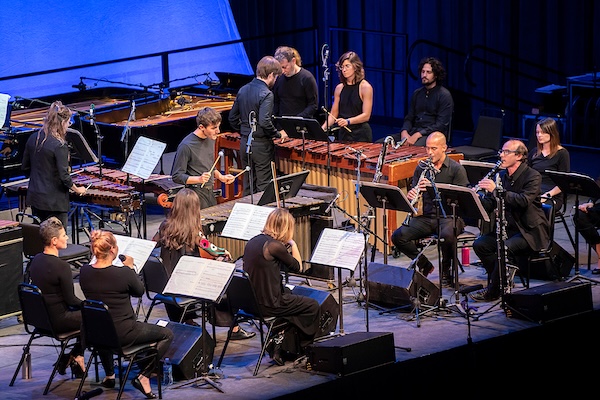
Ensemble Signal in action. Photo: Stephanie Berger
AF: The concert announcement says that these Thursday night concerts are going to be no-intermission, single-piece performances.
Steel: One of the problems we have in our hall is that when we put the tickets on sale, they sell out immediately, months in advance. Younger people tend to buy tickets closer to the performance, and the tickets are all gone. So we’re experimenting with putting the tickets on sale much closer to the event, and the idea is to present something you don’t have to describe in great detail. It’s just like, “We’re doing Music for 18”, and that’s all you need to know. It’s an experience.
AF: Does that concept relate in some way to the museum setting?
Steel: Our concerts are very much — people use this term pretty loosely — but they are curated. There’s a model of curating where you say, “We’re going to spend an afternoon with this artist”, and I certainly do that myself. But Isabella left her collection and her museum “for the education and enjoyment of the public forever”. So I’m focused on education and enjoyment — and discovery. When you’re at a museum, you move through the collection at your own pace, and you’re always discovering something new. I want to capture that curiosity, energy, excitement, fun — and exposure to a strong point of view, which you certainly are when you’re exposed to Isabella’s particular choices.
Larry Hardesty is the lead singer and songwriter for the band the Hopeful Monsters, whose song “The Inexhaustible West of the Heart” features a three-line portrait of Brian Wilson. He earns a living as a science writer and editor.
Tagged: "Music for 18 Musicians", Ensemble Signal, George Steel