
Film Review: “The Choral” — Stirring Voices
By Peg Aloi
Despite an excellent cast, impressive production values, and the thrilling music at its heart, The Choral often feels as if it is trying to be several films at once.
The Choral, directed by Nicholas Hytner. Screening on February 5 at the Capitol Theatre (Arlington), the Loring Hall Cinema (Hingham), The Cape Ann Community Cinema (Rockport), and The Screening Room (Newburyport), then February 6 through 10 at The Screening Room (Newburyport), West Newton Cinema, and Dedham Community Theatre.
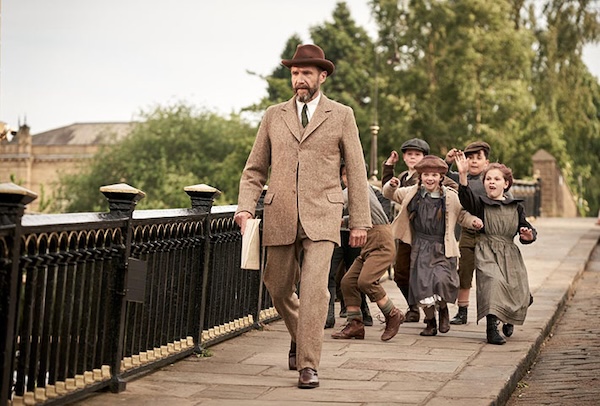
Ralph Finnes in The Choral.
Nicholas Hytner, former Artistic Director of London’s National Theatre, has been lauded as both a theatre director and filmmaker. His films range from ambitious historical narratives (1994’s The Madness of King George, 1996’s The Crucible, with screenplay by playwright Arthur Miller) to more intimate human interest stories, such as 2015’s The Lady in the Van, based on a book by playwright Alan Bennett. It features a stunning performance by Dame Maggie Smith. With The Choral, Hytner collaborates with Bennett once again (his first original screenplay in almost two decades), with additional writing by Stephen Beresford (Pride). This drama, tinged with comedy, is set in Yorkshire in 1916: the traumatic context of the War to End All Wars is palpable from the film’s first moments.
At the start of the film, two young men, friends Lofty (Oliver Briscombe) and Ellis (Taylor Uttley), are beating the fields with sticks to rouse game birds on an estate hunt, for which their payment will be one lone pheasant. Ellis remarks that “the trenches can’t be worse than this.” They ride their bicycles home together, past the dreamy vista of the Yorkshire Dales, its smoking mill stacks set amid rolling farmlands. As the lads discuss the revolutionary chatter surrounding the war, Ellis observes that there’s little chance for change in their village of Ramsden: “we’re fodder for the mill, and we’ll be fodder for the front.” Later that day he accompanies Lofty on his job, delivering letters informing women that their husbands have been killed while fighting on the front. When one recipient bursts into tears and kisses Lofty on the forehead, Ellis makes a joke, implying Lofty should take advantage of the situation: “grief: it’s an opportunity.” It is a sad sign of the times: the shortage of young men and the preponderance of mourning women have created a social imbalance.
This lack of young men is also noticed by the local Choral Society, led by town merchants whose livelihoods are intimately entwined with the war, including the undertaker (Alun Armstrong), the studio photographer (Mark Addy), who takes portraits of volunteers before they depart for the front lines, and the mill owner and alderman (Roger Allam), whose son was killed in battle and whose wife grieves her son in black-clad silence. The choral society is planning its next performance, but learns that the chorus master and the group’s pianist is leaving to join up. After a hasty and heated discussion about finding replacements, they reluctantly decide to hire as chorus master Dr. Henry Guthrie (Ralph Fiennes, excellent as always), an Englishman of respected musical talent who had taken up residence in Germany for years. The man is a taciturn loner who is currently playing piano at a local hotel’s tea room. Accompanied by a gifted pianist of his acquaintance, Robert (Robert Emms), Guthrie is at first energized by the opportunity to work with a choral group performing works by the great masters. But, soon after auditions begin for the ambitious performance of Bach’s St. Matthew’s Passion, a note wrapped around a brick thrown through a window condemns the choice of a German composer.
Henry, undaunted but under pressure, suggests a lesser-known work by Englishman Edward Elgar, famed for his marches such as “Pomp and Circumstance.” In order to perform Elgar’s “The Dream of Gerontius” the chorus must acquire more voices. Guthrie asks current members to help recruit singers wherever they can, including in pubs and shops. The choral society’s snobbish middle class and genteel members must overcome their disapproval of the addition of working class singers, including one talented vocalist, Mary (Amara Okereke), who collects funds for the Salvation Army. In his quest for voices, Guthrie visits the local soldier’s hospital, where three young men wounded in action sing a lively bit of Gilbert and Sullivan in three-part harmony. (The songs chosen by auditioning singers are a fascinating lineup of Victorian art songs, some of which I sang in high school, and bawdy music-hall numbers.) There’s a delightful “theatre kid” vibe and energy to the scenes of the amateur singers’ dogged attempts to perfect the difficult Elgar piece. As the newly-grown chorus comes together, flirtations inevitably occur. Ellis sets his sights on Bella (Emily Fairn), whose boyfriend, Clyde, has been reported missing in action. The tenor lead in Elgar’s oratorio is sung by mill owner and patron Bernard Duxbury. Like other long time members, he claims the privilege of performing solos based on seniority.
Clyde (Jacob Dudman) returns home unexpectedly, seriously wounded. He’s eager to return to the choral group, but he’s shattered once he sees that Bella has thrown him over for Ellis. He auditions anyway, his lilting tenor voice tinged with sadness. Henry, who clearly harbors demons in his past, urges the ambivalent Clyde to sing, despite the “rough cards” he’s been dealt. Though Clyde is young for the role of Gerontius, Guthrie cajoles Bernard to take another role, and allow Clyde to sing the lead, in part to honor the young man’s brave sacrifice.
Guthrie’s perfectionism and high standards cause some tension at first, but his love of music is infectious and the singers soon find themselves passionately immersed. Rumors that Elgar will be traveling nearby on the night of the concert throw the town into a tizzy. Meanwhile, Robert learns that the standoffish Henry had a close friendship when he lived in Germany with a young man who is currently serving in the German naval fleet. In a powerful moment of mingled tension and irony, news of a German ship destroyed by the English occurs just as Elgar sends a telegram accepting an invitation to attend the performance. Guthrie soldiers on, but his affect betrays a shift: Fiennes embodies Henry’s inner conflict with artful nuance. Even as the chorus members hold impromptu rehearsals along the canal and in the mill, enjoying making music with one another, the looming spectre of war is never far away. After the chorus’s youngest members, including Lofty and Ellis, receive their conscription letters, the imminent performance takes on a sense of bittersweet urgency.
The narrative is ambitious; there are a number of characters to keep track of. Despite an excellent cast, impressive production values, and the thrilling music at its heart, The Choral often feels as if it is trying to be several films at once (historical drama, elegaic war story, paean to art’s healing power, etc.) None of these land fully successfully, perhaps because they’re diluted by the film’s attempts to include something for everyone. Oddly, one rather obvious dramatic opportunity is all but ignored: the musically-gifted Mary is the only Black member of the choral, and racism was endemic in the English army’s war effort. The dialogue is sometimes awkwardly expository, or, worse, makes characters into mouthpieces for consequential speeches that don’t feel authentic. Despite many moments of artistic greatness, the film seems to lack an emotional center, but perhaps the fleeting glimpses of humanity are the point here
The relationship that holds the most gravitas, for me, is the one between Henry and Robert. Henry’s lonely sadness, Robert’s lonely longing, each realizing that the space between them was unbridgeable, even amid the madness of war, and despite their shared artistic triumph. The actors convey this aching emptiness with barely a word spoken, which is fitting, given the underlying language of music they share. The Choral, despite its occasionally diffuse plot, is a provocative story of the power of art to inspire hope and resilience. In valorizing the songs of a perilous era, the film embodies some simple truths: that music etches indelible memories on our bodies and minds, and that its lingering presence remains, spanning the years, showing us who we are, where we’ve been, and what we may yet become.
Peg Aloi is a former film critic for the Boston Phoenix and member of the Boston Society of Film Critics, the Critics Choice Awards, and the Alliance for Women Film Journalists. She taught film studies in Boston for over a decade. She has written on film, TV, and culture for web publications like Time, Vice, Polygon, Bustle, Dread Central, Mic, Orlando Weekly, Refinery29, and Bloody Disgusting. Her blog “The Witching Hour” can be found on substack.