Classical Music Album Review: Duo FAE’s “Dissidents of the Gilded Age”
By Jonathan Blumhofer
It’s hard to argue that the decision to forge careers as composer-pianists in the teeth of fin de siècle misogyny and rock-set views of musical gender roles wasn’t an act of defiance.
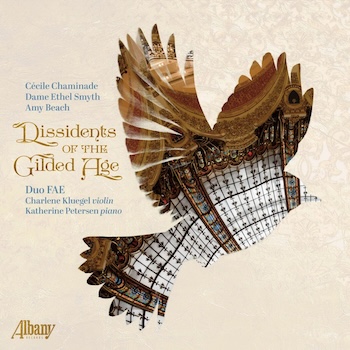
At first glance, Duo FAE’s Dissidents of the Gilded Age seems misnamed: only one of its three composers fits the bill as a renegade. That would be Ethel Smyth, whose activism as a women’s suffrage advocate landed her in prison for several weeks in 1912.
Still, resistance takes many forms, and it’s hard to argue that the decision to forge careers as composer-pianists in the teeth of fin de siècle misogyny and rock-set views of musical gender roles wasn’t also an act of defiance for Cécile Chaminade and Amy Beach. That’s especially true for the latter, who responded to Dvorak’s 1892 assertion that women lacked “the creative power” with, among other things, her Gaelic Symphony. As such, the dissidence on display in these selections is more about leveling a playing field than about blowing anything up.
Take Smyth’s Violin Sonata in A minor. Completed in 1887 and dedicated to Felix Mendelssohn’s daughter, Elizabeth (“Lili”) Wach, the score channels Brahms to a considerable degree. At the same time, there’s a freedom to its structure and harmonic language that is entirely Smyth’s own: indeed, the composer’s manipulation of its tempestuous harmonic progressions and textures signify the arrival of a striking voice—though its gorgeous, third movement “Romanze” is a masterpiece of essentially traditional Romantic lyricism and drama.
Beach’s Violin Sonata (like Smyth’s, it’s in the key of A minor) was completed around the time of her only symphony in 1896. The score is similarly infused with the Brahmsian ethos.
Here, however, elegance and songfulness rule, both in the work’s several tranquil episodes and in its more vigorous, muscular sections. Again, a grand, expansive slow movement sits at the sonata’s center. This Largo, with its sometimes woozy harmonies and employment of violinistic hypermelody (a century before John Adams coined the term), anticipates a bevy of post-Romantics to come, not the least of them being Erich Wolfgang Korngold.
For her part, Chaminade is represented by the Trois Morceaux, which, like Smyth’s sonata, hails from 1887. Certainly, these morsels are lesser efforts than the sonatas, though plenty appealing and terrific demonstrations of the composer’s total command of small forms.
In the latter, the performances from the duo—violinist Charlene Kluegel and pianist Katherine Petersen—are warmly tonal. If the outer parts of the first two movements might benefit from more intensity and excitement, the central portions are well-directed and vigorous. The gypsy-inflected finale (“La Bohémienne”) is thoroughly characteristic.
In the disc’s bigger items, there’s no question of the Duo’s focus. What is problematic is their grasp of the big picture. Too often, there’s the sense of tempos being held back—or of some feeling of restraint or lack of edge—to their interpretations.
Take the pair’s account of the Smyth’s finale. The performance is adequate, but it lacks the spark that it needs to fully come to life. That the Scherzo sounds dynamically monochrome doesn’t help matters.
Similarly, the Beach Sonata drags. For all the charm of this reading—and there’s lots of it, from Peterson’s discreet, first-movement voicings to Kluegel’s soaring take on the Largo and the sense of style that informs the Scherzo’s grace note figurations—the larger rendition plods.
For comparison, Tasmin Little’s and John Lenehan’s outstanding performance of the same work from 2019 on Chandos asserts a similar command of character—and it’s nine minutes shorter (their take, on the same release, of the Smyth shaves about four minutes off of Duo FAE’s timings). That, ultimately, is what holds this Dissidents back: an inner sense of purpose and fire to match what these composers, a century and more ago, clearly possessed.
Jonathan Blumhofer is a composer and violist who has been active in the greater Boston area since 2004. His music has received numerous awards and been performed by various ensembles, including the American Composers Orchestra, Kiev Philharmonic, Camerata Chicago, Xanthos Ensemble, and Juventas New Music Group. Since receiving his doctorate from Boston University in 2010, Jon has taught at Clark University, Worcester Polytechnic Institute, and online for the University of Phoenix, in addition to writing music criticism for the Worcester Telegram & Gazette.
Tagged: "Dissidents of the Gilded Age", Albany Records, Charlene Kluegel, Duo FAE