
Theater Review: “Job” — Terminally Online
By Bill Marx
Job is not so much a game of cat-and-mouse as a highly pressurized coffee klatch.
Job by Max Wolf Friedlich. Directed by Marianna Bassham. Staged by SpeakEasy Stage Company at the Calderwood Pavilion at the Boston Center for the Arts, 527 Tremont Street, through February 7.
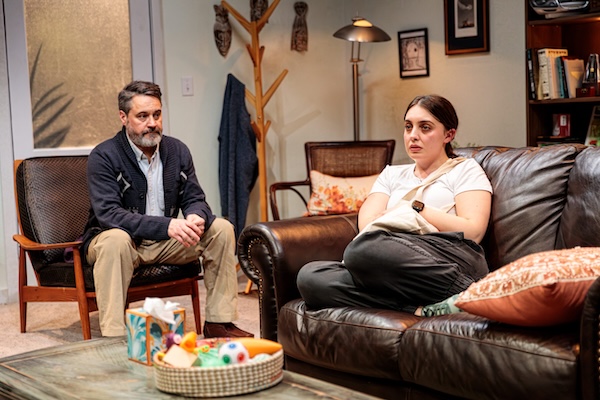
A scene in the SpeakEasy Stage production of Job, starring Dennis Trainor Jr. and Josephine Moshiri Elwood. Photo: Benjamin Rose Photography
The hostage situation is a suspense standby in ’50s movies and plays, though the old creaky plot is far older than that. An innocent person — or members of a picture-perfect family — are held at gunpoint in an enclosed space by an obvious psychopath. Drama is generated by watching the cornered victims attempt to stay calm as they do their best to charm, cajole, trick, or outwit their inevitably wily but insane captor. Will they escape — or end up plugged?
Job recycles the setup, mixing in chic, shiny, computer-age shibboleths: the internet is driving its workers bonkers; alienated youth are becoming murderously detached from reality, drifting into narcissistic self-destruction; and intergenerational warfare is simmering. In this 90-minute two-hander, a millennial content moderator, Jane, has gone berserk. She has a gat in her bag and is holding Loyd, a boomer therapist, captive. She demands that he vouch for her sanity so she can get her job back from an unnamed tech company. How does this guy save his ass? Give the irrational woman what she wants, then call it a day and phone the police? Treat her as if she were a patient who can be treated “toot sweet”? Blab traumatic details about his personal life so she might sympathize with his humanity and disarm? I think he should have turned to God. Sitting through the prosaic SpeakEasy Stage Company production of Job, I felt I had been taken hostage by a sadistic dramatist — I prayed to be put out of my misery.
The addled content manager is nothing if not an emblem of contemporary tech-infused misery. We know she is radically disorientated because, from time to time, we see the action, for a few moments, from her perspective: the lighting goes funny, there’s a raspy electrical sound, and Loyd says strange stuff. Most of the time, Jane spews complaints, confesses various traumas, and makes pithy sociological observations about cultural breakdown to Loyd, who is stuck trying to stick up for a balanced understanding of reality as he fears for his own skin. That said, there are twists and turns in the plot that should not be divulged. Structurally, Friedlich has overstuffed the last third of the play; as the pair slalom down the curving hills of talk, they toss off increasingly hefty hunks of crucial information, picking up speed in an effort to end the proceedings with an eyebrow-raising climax. The problem is that any tension along the way has been dissipated by all the chatter — this is not so much a game of cat-and-mouse as a highly pressurized coffee klatch.
Marianna Bassham’s direction moves along with monochromatic efficiency, never quite nailing emotional highs and lows. Josephine Moshiri Elwood is sufficiently bedeviled, but there’s no sense of the angst, the self-doubt that often accompanies delusion, underneath the character’s defensive shell of rhetoric. Dennis Trainor Jr.’s preternaturally calm Loyd wavers, sometimes comically, between concern and befuddlement.
A program note from Dawn M. Simmons, the artistic director of SpeakEasy Stage, suggests Job has political resonance. Maybe, but that relevance is mostly reserved for Broadway tourist audiences and Boston theater critics, sheltered types who think hearing words like “social media,” “hippies,” and “capitalism” ensures an engagement with the real world. Jane is in enormous mental distress: what she tells us about what our brains are like once they have been fried by technology can be easily discounted. Granted, it is refreshing to hear a full-throttled argument for the transcendent power of the iPhone — who needs the outside world? — but consider the source. In the ’50s, the young woman might have been driven to distraction by multiple-personality disorder. Today, moderating internet content does the trick.
As in so many current American plays, difficult issues are ignored because tackling them would discomfit the comfortable in the seats. Watching Job, I couldn’t help but muse on the cultural anxieties the script was (meekly) tapping into. At the moment, America’s mad king, Donald Trump (with the brute assistance of his police force, ICE), is assaulting our country. He and his administration are being enriched and enabled, in part, by a brood of mad tech bros: Elon Musk, Mark Zuckerberg, Jeff Bezos, Peter Thiel, Sam Altman, etc. Rather than focus on the plight of a victimized underling, why not take on the crazed big cheeses? They are dreaming of immortality, of colonizing Mars with genetically modified supermen, of controlling our globe via robot armies — aren’t their delusions and actions ripe for theatrical examination? Silicon Valley royalty is as “out there” as Jane is. These wannabe godlings are profiting from the tech jobs and mind-numbing services they create, allowing (in some cases, encouraging) objectionable content that decency demands should be censored, filtered, or removed. Of course, Musk and company are funding, with mountains of cash, lobbying efforts to stop legislation that will hold them to account, that will supply ethical/moral boundaries. Who holds a gun against whose head? Grappling with that question would make for great theater.
And it has. Over the centuries, theater has put a spotlight on unhinged rulers and the power hungry who exploit their myopia. A selection of my favorite 20th-century treatments, well worth reviving now, would include Luigi Pirandello’s Henry IV (the dramatist announced he was a fan of Mussolini soon after he wrote it — perfect!); Alan Bennett’s The Madness of King George; and a masterpiece that is too little known, Peter Barnes’s The Bewitched, a Jacobean extravaganza based on the final years of King Carlos II of Spain (reigned 1665–1700), who was afflicted with immense mental and physical disabilities, likely the result of generations of intense Habsburg inbreeding.
The country is in crisis. Democracy is under threat, while “liberal” institutions that should be its strongest defenders are folding or are remaining silent. A second protestor was shot dead, yesterday, by ICE in Minneapolis. It is about time our stages, who claim to care about their communities, step up and put on dramas that express alarm, resistance, and dissent. For far too many of our stage artists and companies, making theater is just another job.
Bill Marx is the editor-in-chief of The Arts Fuse. For over four decades, he has written about arts and culture for print, broadcast, and online. He has regularly reviewed theater for National Public Radio Station WBUR and The Boston Globe. He created and edited WBUR Online Arts, a cultural webzine that in 2004 won an Online Journalism Award for Specialty Journalism. In 2007 he created The Arts Fuse, an online magazine dedicated to covering arts and culture in Boston and throughout New England.
Thank you for stating an obvious and desperate need in theatre today.