
Concert Review: Boston Symphony Orchestra Seeks Unity in “E Pluribus Unum” Festival
By Aaron Keebaugh
Reflecting on our divisive politics, BSO music director Andris Nelsons told the concert audience that, “Every tunnel has light at the end.”
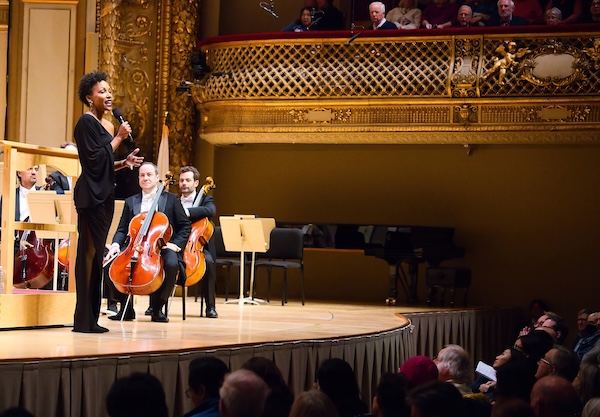
Allison Loggins-Hull introduces Rhapsody on a Theme by Joni at Symphony Hall. Photo: Hilary Scott
“If you hold sand too tightly in your hand, it will run through your fingers.” So wrote singer-songwriter Joni Mitchell in a telegram to Graham Nash as their steamy relationship was coming to an end.
While the couple’s union had been forged in freedom and passion—Mitchell revealed the pleasures of her nontraditional attachment to Nash in her song “My Old Man”—it quickly turned toxic and contradictory. And holding the relationship together despite Nash’s drug use became a challenge too difficult for Mitchell to overcome. Seeking release, she broke it off cold.
Mitchell’s message to Nash, in all its metaphorical whimsy, has pertinent resonance for the Boston Symphony Orchestra’s “E Pluribus Unum” festival, a season-long exploration of music celebrating American democracy as it approaches its 250th anniversary. “My Old Man,” in fact, took center stage this past weekend by way of a performance of a recent work by composer Allison Loggins-Hull. But Rhapsody on a Theme by Joni hints at a troubling reality that sits behind any momentary facade of good feelings: at this polarized moment in our shared politics, the center cannot hold.
Still, on the surface, this score for flute and chamber orchestra strives earnestly for camaraderie rather than yin/yang antagonism. The music unfolds like a miniature concerto; the soloist is given plenty of room to show off over the work’s 14-minute span. Mitchell’s melody, embellished by slippery harmonic shading, provides the skeleton of the piece; above it, the flute line titters, flits, dances, and soars.
That sonic choreography proved easy work for the soloist, BSO principal flutist Lorna McGhee, who shaped the trills, arpeggios, and scale flourishes with breathless ease. Her colorful manipulation of tone cast light on every dimension of the musical line. Low passages sounded like plush velvet; notes in her upper register hovered at whisper’s edge.
But, in its outer passages, this music drives hard. The Coplandesque rhythms cut through successive blocks of sound that see-sawed between strings and winds. Conductor Andris Nelsons led the proceedings with a jam-band vitality.
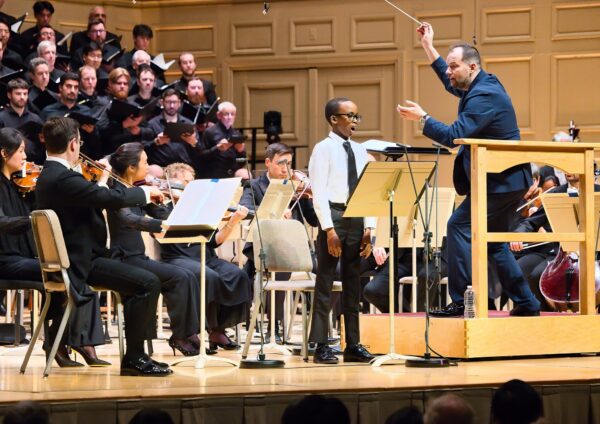
Boy soprano Edward Njuguna performing with Boston Symphony Orchestra in Chichester Psalms. Photo: Hilary Scott
That was also the effect of Leonard Bernstein’s Chichester Psalms, which filled out the first half of the program.
Composed in 1965, this setting of Hebrew Psalms was one of several of Bernstein’s responses to the turbulent ’60s. But unlike his “Kaddish” Symphony of 1963, Chichester Psalms doesn’t so much wrestle with God as cry out for peace. Bernstein, deeply affected by the rising violence between Yasser Arafat’s Fatah and the state of Israel, ended the work with Psalm 133:1 — a plea for reflection and restraint between people of kindred faiths.
The music of Chichester Psalms is both joyous and reverential, and Thursday’s performance channeled that hopeful conviction. Nelsons led an incisive reading of the opening movement’s rollicking mixed meters. The Tanglewood Festival Chorus sang with assurance and rhythmically palpable diction.
The “Adonai” generated prayerful serenity. Young vocalist Edward Njuguna sang with pure tone and Davidic innocence. In this section and in the finale, Nelsons embraced broad tempos that amped up the music’s emotional sweep.
While these pieces invited aspiration and reflection, the program’s second half, featuring pianist Seong-Jin Cho in Tchaikovsky’s Piano Concerto No. 1, delivered grit and pizzazz.
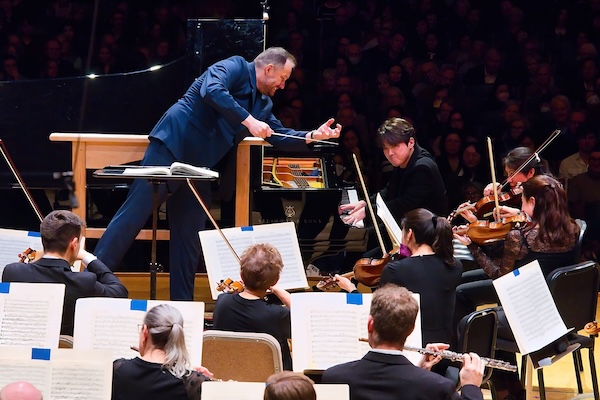
Andris Nelsons conducting Seong-Jin Cho and the Boston Symphony Orchestra. Photo: Hilary Scott
Tchaikovsky’s most popular concerto was born of struggle, albeit personal: the composer was shocked and angered by his mentor Nicolai Rubinstein’s cruel rejection of the piece. Ever since, the concerto, with its jolts and calms, has been treated as a sturdy vehicle for bombast and serenity.
Cho offered plenty of the former. His technique exerted such weighty force that it frequently lifted him off the piano bench. More nuanced passages were also given dramatic flair. Octave runs in the first movement resounded with a metallic ping, while arpeggios cascaded into crashing sonic depths. In the finale, Cho and Nelsons made the jagged rhythms dance with apt Russian bravado.
That said, the South Korean pianist was keenly attuned to the delicacies and mysteries of the score. Cho proved to be an equally fine chamber musician when called for, softening his crystalline tone to match the solo flute and plucked strings of the second movement. Cho’s encore — Chopin’s Waltz in C-sharp minor — also generated solace amidst the emotional tension.
That subtle gesture provided yet another glimmer of hope amid our present calamities. “Every tunnel has light at the end,” Nelsons told the audience, reflecting on our divisive politics. That may be true. But we may have only just entered the abyss, and the darkness could last longer than we anticipate. Let’s pray, as Mitchell intimated in her song, that the journey through turmoil will not prove too devastating.
Aaron Keebaugh has been a classical music critic in Boston since 2012. His work has been featured in the Musical Times, Corymbus, Boston Classical Review, Early Music America, and BBC Radio 3. A musicologist, he teaches at North Shore Community College in both Danvers and Lynn.
Tagged: Anna S. Choi, Boston Symphony Orchestra, Joshua Shilo, Lena Costello, Seong-Jin Cho, Stephen Chrzan