
Musician’s Interview: Atmosphere’s Slug Talks About the Art of Making “Jestures”
By Robert Duguay
“Art can be heartbreaking, but you don’t have to let it break your heart for it to be good. You just have to have the correct relationship with it, understanding that it is a continual exercise.”
It’s hard to imagine a vibrant, independent hip hop scene without Atmosphere. Based in Minneapolis, the duo of rapper Slug (the moniker of Sean Daley) and DJ–producer Ant (Anthony Davis) has been one of the leaders in this musical community since the late ‘90s. Their style is direct, rhythmic, and honest, and their output is prolific. Their 14th studio album, Jestures, was released on September 19 via Rhymesayers Entertainment. The disc’s format is as ambitious as its themes: 26 songs — one for each letter of the alphabet, sequenced A to Z.
As part of their “Winter Carnival Tour,” Atmosphere is going to be headlining a stacked bill at Boston’s House of Blues on January 23. The show starts at 6 p.m., with the likes of Kool Keith, Sage Francis, R.A. The Rugged Man, and Mr. Dibbs rounding out the bill.
Slug and I talked ahead of the concert about the creation of the group’s latest full-length album, making a music video at his old high school, and how, though he loves Boston, Slug would never want to live here.
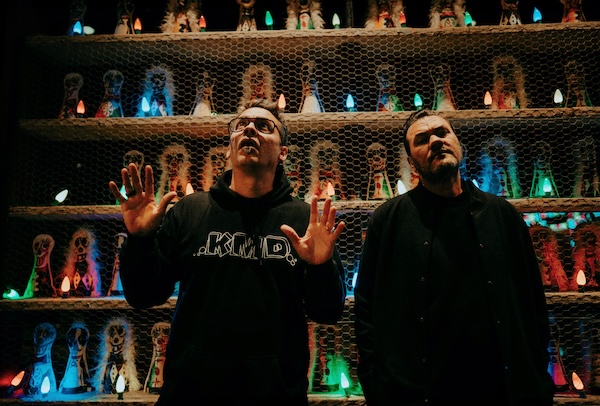
(l to r) Slug and Ant, members of the hip-hop duo Atmosphere. Photo: Samantha Martucci
The Arts Fuse: Regarding Jestures, what was the songwriting and recording process like for you and Ant? There are 26 tracks — was there a constant flow of lyrics and ideas?
Slug: For me, specifically, I unpacked a lot with the prior record, but I did it in a way that allowed me to stay true to myself while still protecting myself, at least to an extent. It was kind of intense at times, so I immediately wanted to do something that was a little bit more lighthearted with what became Jestures. I remember a conversation where we were figuring out what to do next. One of the things we had done on that previous album So Many Other Realities Exist Simultaneously was to make it into a sequence. We actually created the tunes in order, so the first song was the first song we made and then, when we finished that song, we created the second. Then we made the third song. We made the tracks of that project in order — so the record would have a feeling of continuation. We were trying to make hearing it feel like one long ride.
I liked the approach, not because of the concept, but because I liked making the music that way. I appreciated not having to choose among six beats to write to. I liked Ant saying to me, ”This is the one, go make a song.” I appreciated that challenge, so I asked him if we could do that again, and he said, ”Sure.” Then I was like, “What if we made it like the alphabet with each song going A,B,C,D,E,F,G all the way down to Z?” He thought it was funny: so that’s what we were really trying to do, to make each other laugh. We saw that as our job, and that’s what we set out to do.
Ant started feeding me beats, and I would intentionally make certain suggestions, such as requesting that certain beats be shorter because I realized that I could only put 14 minutes on each side of a piece of vinyl. I didn’t want to put out a triple vinyl; if I’m doing the alphabet, I’ve got to think about the listener — I didn’t want to make a two-hour album.
When it came time to get to the next track, Ant would ask me how I was feeling on that day and what direction I wanted to go in. I told him I wanted something fast or something short, so that I could sequence this album in alphabetical order, being aware of the issue of the length of the album. As we got going, it became really cool. He’d give me a beat and I would think of the title first before I started writing. The title is the reason the song exists: it’s the letter “H” or the letter “Q.” All of these restrictions became challenging exercises in creativity, and that’s the part that speaks the most to me.
 Maybe that’s what art is. You deal with the demands of the exercise deciding if you love them, if you hate them, if they entertain you or if you learned anything from working with them. My children make art, some of them very seriously, and that’s one of the things I want them to understand and respect — art is a playful form of exercise. They don’t have to do it the way I do, but viewing it through that lens is liberating.
Art can be heartbreaking, but you don’t have to let it break your heart for it to be good. You just have to have the correct relationship with it, understanding that it is a continual exercise.
AF: You and Ant have released a few music videos for Jestures. The latest, for the track “Jester,” has the pair of you rapping around the campus of a public school in Minneapolis. What is the name of the school, who had the idea to shoot a video there, and what was the filming experience like?
Slug: I graduated from that school 35 years ago — it was my high school. The reason why I wanted to shoot there was because I still live in the neighborhood, and it hasn’t changed that much. It still looks very similar to how it looked when I went there, so I liked the vibe and the feel. The building reminds me of old brick establishments on the East Coast, but here it’s planted in the middle of nature. There were overgrown weeds and grass during the summer we shot it.
Honestly, the visuals have zero to do with the lyrics of that song. In fact, you can almost call it a visualizer instead of a video because there’s really no concept to it. I just knew that I wanted that look and my friend Zoo, who shot the video, also had ideas, so it was a chance for us to collaborate, to see what we could do together. Again, that brings me back to the idea of art being made up of exercise, which is weirdly how I view the art of music videos now — through the same lens.
AF: All of Atmosphere’s records have been released through the record label Rhymesayers Entertainment, which you co-own. Streaming services have become a major player in how people consume music, so the landscape has totally changed when it comes to putting out new material. As both an artist and a business owner, what are your thoughts on the music industry today? And did you ever feel that releasing an album with so many tunes was a risk because some of the songs might be lost in the shuffle?

Slug: Even though I do own a portion of the record label, I’m a horrible businessman. I don’t go to the meetings. In fact, I rarely even show up to the Atmosphere meetings. I’m a flaky artist type. They know this about me, and they accept it because that’s what friends do. That said, I don’t see things through a new lens. Streaming? Who cares? I have opinions about it, and most of them are negative, but I don’t make music for streaming, I make music for vinyl. As a kid, that’s how I consumed music, so I’m going to be stuck in that mindset for better or for worse, probably for the rest of my life.
When I make music, I envision that it’s being listened to on vinyl, on a turntable. So, as I said before, I’m very aware of how long a record must be because it has to fit on two pieces of vinyl. What song do we want to start side B with? Streaming doesn’t even dictate what side B starts with — it’s like a playlist. For me, it’s very important which song you hear first. It takes you roughly three to five seconds to flip over that vinyl disc, maybe more if you’re really careful. What’s the first song you’re going to hear when you start side B? What if they play side B first? I consider what the first song on each side might be — the first song someone hears on the record. To answer your question, f*** streaming. That’s just how I feel.
I don’t judge anybody regarding how they listen to music. I feel that it’s important for people to build their own relationships with music and figure out how they want to listen to it. Some people only listen to it in the car, some people only listen to it when they’re doing dishes or they’re cleaning the house. I’m not here to judge anybody on how they listen to their music. I don’t expect anybody to be the same kind of nerd that I am.
AF: Atmosphere has a show coming up at the House of Blues in Boston. You and Ant have a lot of history when it comes to performing around here and in the surrounding areas. What are your thoughts on coming back?
Slug: I love Boston, but I don’t think I could live there. It’s too big, it’s got way too many people, and there’s too much movement. I’m used to Minneapolis, where it’s like medium big. But I do love spending time in Boston. I’ve had a lot of good times back in the day when I was younger — I used to party here. I’ve had a lot of great memories after shows and kickin’ it. I’ve made a lot of friends in the city.
The rap scene out of Boston has always been phenomenal. But as of now I’ve got too many kids to really keep up with what’s happening across the country’s cities like I used to. When I was tuned in, Boston was definitely a top five market in the country.
Rob Duguay is an arts & entertainment journalist based in Providence who is originally from Shelton, CT. Outside of The Arts Fuse, he has also written for DigBoston, Aquarian Weekly, Providence Journal, Newport Daily News, Worcester Magazine, New Noise Magazine, Manchester Ink Link, and numerous other publications. While covering mostly music, he has also written about film, TV, comedy, theater, visual art, food, drink, sports, and cannabis.