
Book Review: Imagining a World Beyond Prisons — Anna Terwiel’s “Prison Abolition for Realists”
By Bill Littlefield
Prison Abolition For Realists makes a strong case for persevering in a contest that will probably take a long time to win.
Prison Abolition For Realists by Anna Terwiel, University of Minnesota Press, 234 pages, $24.95 (paperback)
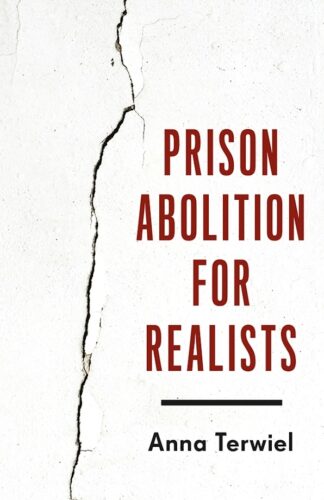 The call for the abolition of prisons has taken many forms. Some argue convincingly that, in and of itself, incarcerating men and women constitutes cruel and unusual punishment, which makes the practice unconstitutional. There is also the perception that, though prisons are allegedly concerned with helping with rehabilitation and “correction,” the truth is that they are committed to isolation and punishment, so for that reason the system is hypocritical and indefensible. And then there’s this: even folks who feel that locking up lawbreakers is necessary to protect the public have to acknowledge that incarceration doesn’t work to further that end. A recidivism rate of about 70% underlines that discouraging fact. Nearly three quarters of the people who are released from prison return within three years, though that’s often the result of an insignificant parole violation rather than because they’ve committed another crime. Who benefits from the current penal system? The folks (including corporations) who build, staff, and service prisons, along with those who profit from convict labor. Meanwhile, the toll that incarceration takes on the families of those who are jailed and on their communities is immense.
The argument for continuing to lock up people who break the law is blunt rather than nuanced: what else are you going to do with them?
That rhetorical question has stymied many who’ve argued for the abolition of prisons. But it doesn’t discourage Dr. Anna Terwiel, an assistant professor of political science at Trinity College in Hartford, Connecticut, who is the co-director of Trinity’s Prison Education Project, which offers credit-bearing classes to incarcerated people. In Prison Abolition For Realists, Terwiel evaluates the most significant arguments that have been put forward for the elimination of incarceration, from authors including Michel Foucault, Liat Ben-Moshe, and Angela Davis. Terwiel’s preference is for Davis’s arguments. This is not surprising. Davis has been researching the rationale, mechanics, and consequences of incarceration for decades. Her experience includes 18 months as a political prisoner in the Marin County Jail in California. She was eventually acquitted and went on to pursue an academic career and write extensively about the oppression of minority men and women by various means, including incarceration.
For Terwiel, Davis maintains that believing society has no alternative to locking people up when they break the law reveals a lack of imagination. Her contention is that the question “What else are you going to do with them?” misses an elemental point. Thinking about the abolition of prisons requires coming up with more ambitious ideas for their replacement. As Terwiel writes, “For Davis, the rejection of how the United States punishes is an entry point into a broader refusal of the current order and a commitment to reshape it along democratic socialist lines.”

Anna Terwiel is Assistant Professor in the Department of Political Science at Trinity College in Hartford. Photo: courtesy of the author
Terwiel characterizes Davis’s position as “agonistic abolitionist politics,” by which she seems to mean that the struggle for systemic change is built into the process. There will be wins and losses in the evolution to finding a more humane, constructive end. Many who’ve argued for the abolition of prisons have worried that achieving what they’re after might have consequences they haven’t anticipated, including violent, destructive responses from the state. Davis assumes that the battle to rid the nation of prisons will include the fight for “broad structural change far beyond jails and prisons.” But unlike other abolitionists, Davis “provides a kind of sketch of the kind of society prison abolitionists seek to create.” She traces her “sketch” back to Reconstruction and sees contemporary efforts to establish “quality education, free healthcare, and other progressive movements” as part of the same, on-going, often-interrupted struggle.
Prison Abolition For Realists makes a strong case for persevering in a contest that will probably take a long time to win. What the author terms “a realist political theory and project” seems not so realistic in a time when the administration is committed to the racist violence and cruel ignorance, a mindset that has for too long filled this nation’s prisons with so many people of color. But imagining as “real” a time when access to decent housing, medical care, work with fair compensation, and various other rights is universal will no doubt inspire those involved in the struggle to continue agitating for a more just system.
One of the particular issues treated in this valuable book is the debate between those who argue that the effort to reform prisons and jails is worthwhile, and those who see in such an effort the attitude that if conditions just weren’t as bad, incarceration would be acceptable. Part of what’s most compelling in Davis’s argument as interpreted by Terwiel is that there is no contradiction there. The struggle is multi-faceted. You can argue that incarcerated folks should have air-conditioning rather than having to suffer in Texas cells where the temperature can make them feel as if they’re being “cooked.” You can argue simultaneously that the incarceration itself is obscene. This may help to explain how an abolitionist can work in a program that helps bring a college education to incarcerated students.
Bill Littlefield volunteers with the Emerson Prison Initiative. His most recent novel is Mercy (Black Rose Writing).