The 20th Annual Francis Davis Jazz Poll: Debut Jazz Albums
By Tom Hull
It takes a peculiar combination of talent and luck to win this category. By luck, I mean getting your one-and-only shot at a debut album enough promotion to be recognized.
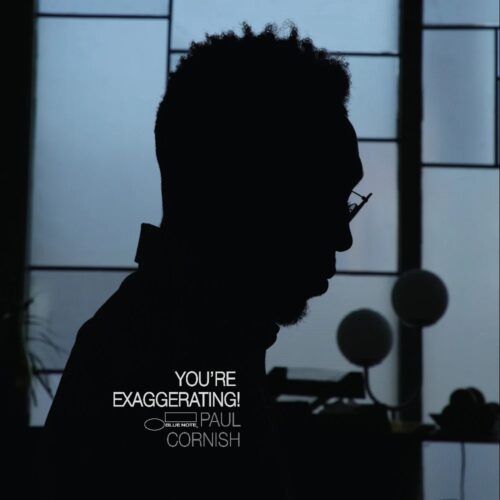 Francis Davis established the Debut category in his first 2006 poll. He wanted to see more recognition of young talent, noting at the time that five of the top-ten finishers in new jazz albums that year were over 70 — Ornette Coleman won in the poll’s only real landslide — and that the youngest top-ten finisher was 50 (Nels Cline). Francisco Mela won that first poll, and has been followed by many notables, with Tyshawn Sorey, Immanuel Wilkins, and Patricia Brennan faring especially well in later polls.
But, as Francis noted, interest in the category was “lukewarm,” and so it’s remained every since, with rare exceptions: the ones I just mentioned, plus Ryan Truesdell in 2012 and Kamasi Washington in 2015 — both landslide wins with albums that finished 4th overall, but they haven’t become regular leaders. Both have one later top-50 album: Washington came in 12th in 2018, Truesdell.)
It takes a peculiar combination of talent and luck to win this category. By luck, I mean getting your one-and-only shot at a debut album enough promotion to be recognized. But while few albums have such luck, it still takes talent to prevail. Thus, when I questioned how useful this category was, Francis rattled off the list of previous winners as proof of the category’s merit. But as far as I know, no one has ever tried to compile a list of the major figures the category overlooked. While winning proves something, losing doesn’t prove a thing.
While this year’s list was as competitive as ever, the top five says also says something about luck. Paul Cornish and Brandon Woody were fortunate to have their first albums released on a major label, although Blue Note deserves credit for working hard to break new talent. At least they, and singer Tyreek McDole (on Artwork, which has had success with Kenny Barron and Sullivan Fortner, 70 and 17 in this year’s New Jazz Albums), were previous unknowns.
On the other hand, Thomas Morgan and Marcus Gilmore have been around for decades, with 154 and 106 album appearances, but they became eligible when I loosened up a rule to only count albums where they are the first named artist. The reason for that rule change was to stop disqualifying unheralded artists who merely filled out a credit. (Caelan Cardello, who came in tied for 8th, is another example who in the past would have been ineligible.)
Voters were asked to designate any of their top-ten New Albums to be counted in the Debut Albums category, and to vote for up to three additional debut albums. There is no point system, so totals are sorted by votes. The top 9, with 4 or more votes each, are:
1. Paul Cornish, You’re Exaggerating! (Blue Note) 23
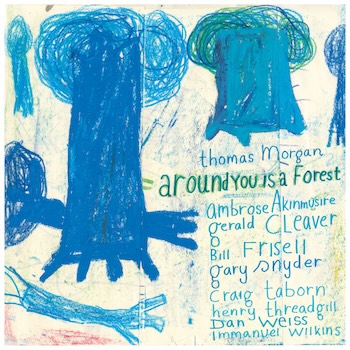
2. Thomas Morgan, Around You Is a Forest (Loveland Music) 17
3. Tyreek McDole, Open Up Your Senses (Artworks) 14
Brandon Woody, For the Love of It All (Blue Note) 14
5. Marcus Gilmore, Journey to the New: Live at the Village Vanguard (Drummerslams) 9
6. Lex Korten, Canopy (Sounderscore) 6
7. Rin Seo Collective, City Suite (Cellar Music) 5
8. Caelan Cardello, Chapter One (Jazz Bird) 4
Milena Casado, Reflection of Another Self (Candid) 4
A total of 83 albums received votes: 4 got 3, 17 got 2, and 52 only got 1 vote (62.6%). The full list is here.
Among the leaders above, several received votes in New Jazz Albums: 5: Thomas Morgan, Marcus Gilmore; 3: Paul Cornish, Brandon Woody; 2: Tyreek McDole, Rin Seo; 1: Caelan Cardello. Also in Vocal Jazz: 17: Tyreek McDole; 1: Lex Korten. Also in Latin Jazz: 1: Milena Casado.
Support for the category remains “lukewarm,” as 74 critics (44.3%) did not vote for anyone, and only 42 (25.0%) voted for 3 or more albums. Francis initially wondered whether “the fetish for tradition (as opposed to innovation) that took hold in the ’80s has had the long-term effect of chasing younger players, as well as younger audiences, away from jazz.” I’m more inclined to see the problem as inherent in its definition: to win a poll, you have to be well known, but for jazz musicians recognition is almost always built up gradually over time.
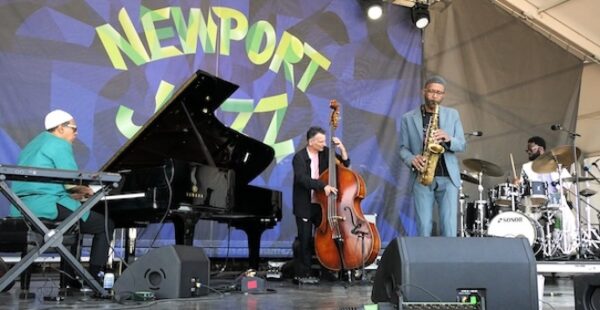
Marcus Gilmore’s Centennial Tribute to Roy Haynes at Newport Jazz in 2025. Photo: Paul Paul Robicheau
An obvious comparison for this category is baseball’s rookie of the year award, but it takes little thought to see why this works in baseball much better than in jazz: baseball is organized so you only get to the majors after proving yourself, and even so they don’t disqualify you for a brief appearance; baseball players do a limited number of things, and they are easily (if imperfectly) compared by statistics; baseball players develop and age almost predictably (so if you’re comparing two similar players, the younger is more likely to have a better future). None of this is true for jazz musicians.
The only parallel that comes close is the idea that record labels can be grouped into tiers, where a top-tier label has a much better chance of winning than a smaller one. I’ve joked that Debut is really for the artist who saved their virginity for Blue Note, but even that rarely happens (Cornish and Woody this year; Wilkins and Joel Ross among recent winners).
The definition for eligibility has always been negative: anyone who’s headlined a previous year’s album is excluded; and first albums by groups are only allowed if every member is still eligible. Voters have always had trouble with this category, particularly as we’ve never wanted to stack the deck by offering nominee lists. It’s also been rough on the vote counters, who have to reject votes that can’t be rationalized by differences of opinion.
I think this year’s most egregious pick was Béla Fleck, or maybe Craig Taborn & Nels Cline, but the one I rejected most often was Marshall Allen, whose New Dawn was hyped as his debut — one can certainly be charmed by the idea that a 100-year-old can get a fresh start — but wasn’t remotely close: Discogs credits him with 34 albums plus another 366 performance credits since he joined Sun Ra in 1961, whose ghost band he has not just led but revitalized. Had I let his votes pass, he would probably have finished 5th.
If I had carefully researched every vote, I could have rejected more votes. I was asked about Morgan and Gilmore early on, and tried to write up my rulings on their eligibility, and a few more albums as I encountered them. But I didn’t research every album, figuring that artists I’ve never heard of are likely to qualify. I’m sure I made mistakes, but I doubt they did much harm.
I have little doubt that strictly enforcing the rules would have knocked out most of the groups and a few others further down the list. One should be even more wary than usual in interpreting these lists. Light voter turnout is evidence that even the voters often find this category confusing. Without any authoritative list of eligible albums, everyone was left to their own wits to figure out what to vote for and why. This is really true of every category, but is even more so here: every voter gets dealt a different hand, and has to come up with some notion of how to play that hand.
For instance, when I filled out my own ballot, I ignored two group records (Deepstaria Enigmatica and Heat On) that I eventually allowed others to vote for. (Both groups had ineligible veterans, but were led by eligible musicians.) I also missed Nils Agnas, only revising my ballot when someone else voted for his record. (I remembered him as part of the Agnas Brothers, but he younger and missed out on their albums; he’s so young he’s cited Zoh Amba, our fluke Debut winner in 2022, as inspiration.) He at least fits the spirit of the category quest. My other two votes strayed wide: Colin Hancock was a first-time bandleader, but his featured singer was Catherine Russell, who’s been a top vocalist for decades, and whose father goes back so far he gave an upstart named Louis Armstrong a job. And I voted for Morgan, because his record is a uniquely personal vision, whereas everything else he’s ever done has aimed to make other people sound good. It’s a rare debut artist who waits so long to get the message right.
Notes
Tagged: 2025 Jazz Poll, Debut Albums, Jazz Critics Poll, The 20th Annual Francis Davis Jazz Poll