
The 20th Annual Francis Davis Jazz Poll: New Jazz Albums
by Tom Hull
This was one of the closest New Jazz Albums contests ever.
 I was taken aback when one of this year’s more prominent mid-year lists exclaimed: “What a year it’s been for great music — as opposed to, say, everything else.” Like many clichés, this one offers comfort only so long as one doesn’t tug at it. I know that music has helped ease my way through many hard times, and that even in the direst of times, art can embody resistance and offer hope, raising your spirits and strengthen your resolve not just to survive. But, in America at least, there’s never been a regime so repressive, so hostile to the human spirit. Even music feels different this year. Is that because it is different? Or is it just me, as my senses have been deadened by the constant news of horrors?
I’m not just talking about politics here, although Trump, with his fanatical allies and reticent adversaries, has turned the public sphere into something unprecedentedly malignant. Even as one who has remained relatively unscathed by events, I’ve been overwhelmed by this massive disconnect between what I see in my everyday life and how the world is reflected through our estranged media. Or maybe it is the media: only 5 of the 66 albums Rolling Stone touted as “great music” wound up in my top-91 non-jazz albums of 2025. That I came up with a personal high of 91 attests to the fact that musicians are still hard at work, even if most are getting scant attention.
Part of the value of this poll is that, by virtue of its breadth and depth, it brings us back to reality. And what it shows, I think, is that not much has changed in 2025, in jazz at least, relative to recent years stretching back almost to the inception of the poll. When you read Francis Davis’s essays, you find a great deal of concern over the notion of consensus. Only the first poll, in 2006, produced a winner that most voters agreed on: Ornette Coleman, for his first album in nearly a decade (and, as it turned out, his last album, but he made it seem so easy that no one suspected), was listed on 80% of the ballots. The 2007 winner (Maria Schneider) dropped to 44.8% of ballots, and no one since Jason Moran in 2010 has topped 40%. Since 2001, six albums have won the poll with less than 30%.
Cover art for Patricia Brennan Of the Near and Far
This year’s winner, Mary Halvorson, appeared on a pretty average 31.1% of the ballots. When you look at the list below, you’ll notice a lot of the same names that have dominated the upper echelons of the polls for a decade or more: especially Halvorson (with 8 previous top-10 albums), last year’s winner Patricia Brennan (who also plays on Halvorson’s record), Ambrose Akinmusire (who also plays on Linda May Han Oh’s fourth-place record), Steve Lehman, Vijay Iyer (who teamed up with Lehman and Tyshawn Sorey for Fieldwork), Wadada Leo Smith, James Brandon Lewis, and Charles Lloyd. Nor are Nels Cline and Branford Marsalis strangers to the poll, although they’ve placed high less regularly. (This is Cline’s third top-10 and 11th top-50 album; Marsalis has two top-10 and six top-50 finishes.)
But a tendency for a central cast of characters to snag all the leading roles isn’t necessarily a consensus. To have consensus, however, you have to have common experiences and language, and that’s been fragmenting at least since I started mapping the music universe in 1977. (I know because Don Malcolm and I tried mapping it in 1977. Don recently suggested we should try again, but admitted we may need more dimensions this time.) Ornette was a singularity, aided by the first poll being limited to a tight “circle” of 30 NYC-affiliated critics. Even Francis admitted that beyond Ornette there was no consensus in 2006, let alone later.
On the other hand, if you look at the standings closely enough, you may start to see some cracks, where outsiders are starting to break through. I’ll mention some examples further down, but for now let’s just stipulate that the expanding electorate, diminishing concentration of major labels and media, reduced production costs, irregular promotion, and the never-ending search of artists for change and/or attention are all playing a role. This is probably bad for business, but it generates a surfeit of delights for those lucky enough to find them.
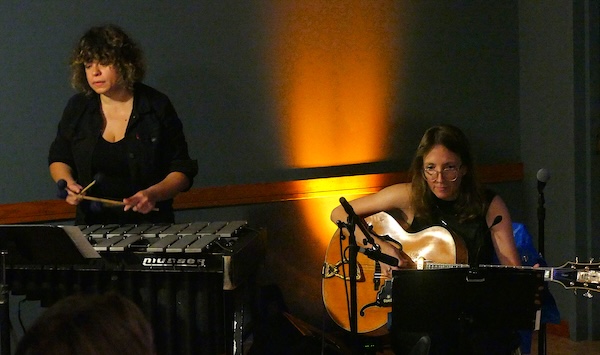
Mary Halvorson (right) with Patricia Brennan at Regattabar in 2025. Photo: Paul Robicheau
The defining characteristic of jazz critics isn’t expertise or connections, but curiosity (the drive to find new experiences) and generosity (an eagerness to share their discoveries with others). The unique value of this poll is that we’ve condensed the efforts of a large number of the world’s most devoted jazz critics into a set of tables and comments. The essays here will help you start to unpack them, but there is much more to discover. This won’t stop the world from sucking, but it may help you survive.
Voters were asked to pick up to ten new jazz albums released in 2025 (or 2024 albums that were “new to them” in 2025). Jazz was whatever the voters thought it was, and no votes were rejected or even questioned because they didn’t fit our own preconceptions. An album was considered “new” if all of the music on it was recorded within the last ten years (i.e., in 2016 or later), and none of the music had previously been released. The totals are sorted by votes (the number in parentheses), with ties broken by points (the preceding number).
Here are the top 64 new jazz albums (down through 6 votes):
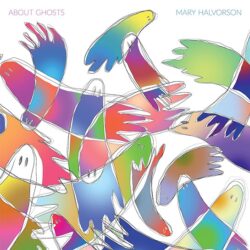
- Mary Halvorson, About Ghosts (Nonesuch) 90.5 (53)
- Patricia Brennan, Of the Near and Far (Pyroclastic) 89.6 (50)
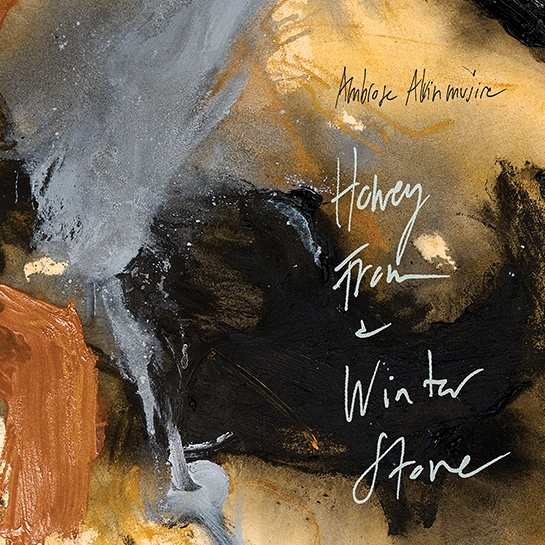
- Ambrose Akinmusire, Honey From a Winter Stone (Nonesuch) 71 (41)
- Linda May Han Oh, Strange Heavens (Biophilia) 64.3 (41)
- Amina Claudine Myers, Solace of the Mind (Red Hook) 63.4 (36)
- Steve Lehman Trio + Mark Turner, The Music of Anthony Braxton (Pi) 53.5 (31)
- Fieldwork, Thereupon (Pi) 47.6 (28)
- Vijay Iyer & Wadada Leo Smith, Defiant Life (ECM) 38.5 (26)
- James Brandon Lewis Quartet, Abstraction Is Deliverance (Intakt) 44 (25)
- Nels Cline, Consentrik Quartet (Blue Note) 34.2 (24)
- Branford Marsalis Quartet, Belonging (Blue Note) 39.2 (23)
- Sylvie Courvoisier & Mary Halvorson, Bone Bells (Pyroclastic) 36.8 (23)
- Craig Taborn – Nels Cline – Marcus Gilmore, Trio of Bloom (Pyroclastic) 31.3 (21)
- Ivo Perelman & Matthew Shipp String Trio, Armageddon Flower (TAO Forms) 30.6 (20)
- Webber/Morris Big Band, Unseparate (Out of Your Head) 28.9 (20)
- Isaiah Collier – William Hooker – William Parker, The Ancients (Eremite) 31.1 (19)
- Sullivan Fortner, Southern Nights (Artwork) 30.2 (19)
- Miguel Zenón Quartet, Vanguardia Subterranea: Live at the Village Vanguard (Miel Music) 26.4 (16)
- Myra Melford, Splash (Intakt) 22.7 (16)
- Charles Lloyd, Figure in Blue (Blue Note) 23.1 (14)
- Tomas Fujiwara, Dream Up (Out of Your Head) 18.2 (13)
- Mark Turner, Reflections On: The Autobiography of an Ex-Colored Man (Giant Step Arts) 19.1 (12)
- James Brandon Lewis Trio, Apple Cores (Anti-) 16.4 (12)
- Marshall Allen’s Ghost Horizons, Live in Philadelphia (Otherly Love/Ars Nova Workshop) 17.7 (11)
- The Hemphill Stringtet, Plays the Music of Julius Hemphill (Out of Your Head) 16.6 (11)
- Brandee Younger, Gadabout Season (Impulse!) 15.5 (11)
- Yazz Ahmed, A Paradise in the Hold (Night Time Stories) 15.4 (11)
- أحمد [Ahmed], سماع [Sama’a] (Audition) (Otoroku) 17.3 (10)
- Fred Hersch, The Surrounding Green (ECM) 16 (10)
- Joe Farnsworth, The Big Room (Smoke Sessions) 15.7 (10)
- Pat Thomas, Hikmah (TAO Forms) 14.3 (10)
- John Scofield & Dave Holland, Memories of Home (ECM) 12.9 (10)
- Cosmic Ear, Traces (We Jazz) 12.9 (9)
- Henry Threadgill, Listen Ship (Pi) 12.1 (9)
- Cécile McLorin Salvant, Oh Snap (Nonesuch) 15.3 (8)
- Tim Berne – Tom Rainey – Gregg Belisle-Chi, Yikes Too (Screwgun/Out of Your Head) 14.5 (8)
- Ches Smith, Clone Row (Otherly Love) 14.4 (8)
- Rodrigo Amado, The Bridge: Further Beyond (Trost) 14 (8)
- Marshall Allen, New Dawn (Mexican Summer) 13.8 (8)
- Billy Hart Quartet, Just (ECM) 12.5 (8)
- Jaleel Shaw, Painter of the Invisible (Changu) 12.2 (8)
- David Murray Quartet, Birdly Serenade (Impulse!) 11.8 (8)
- Arturo O’Farrill & the Afro Latin Jazz Orchestra, Mundoagua: Celebrating Carla Bley (Zoho) 11.4 (8)
- The Necks, Disquiet (Northern Spy) 11.2 (8)
- Jon Irabagon, Server Farm (Irabbagast) 10.9 (8)
- Aaron Parks, By All Means!! (Blue Note) 10.6 (8)
- John Patitucci, Spirit Fall (Edition) 9.4 (8)
- Matthew Shipp, The Cosmic Piano (Cantaloupe Music) 12.9 (7)
- Keith Jarrett, New Vienna (2016, ECM) 10.2 (7)
- Anouar Brahem, After the Last Sky (ECM) 9.8 (7)
- Mats Gustafsson – Ken Vandermark – Tomeka Reid – Chad Taylor, Pivot (Silkheart) 9.1 (7)
- Gonzalo Rubalcaba – Chris Potter – Eric Harland – Larry Grenadier, First Meeting: Live at Dizzy’s Club (5Passion) 9.1 (7)
- Dan Weiss Quartet, Unclassified Affections (Pi) 9 (7)
- Adam O’Farrill, For These Streets (Out of Your Head) 8.6 (7)
- Amir ElSaffar, New Quartet Live at Pierre Boulez Saal (Maqām) 14 (6)
- Wadada Leo Smith & Sylvie Courvoisier, Angel Falls (Intakt) 11.5 (6)
- Artemis, Arboresque (Blue Note) 11 (6)
- Makaya McCraven, Off the Record (International Anthem) 9.6 (6)
- Mulatu Astatke, Mulatu Plays Mulatu (Strut) 9.4 (6)
- Chicago Underground Duo, Hyperglyph (International Anthem) 8.6 (6)
- Carl Allen, Tippin’ (Cellar) 8.5 (6)
- Al Foster, Live at Smoke (Smoke Sessions) 8 (6)
- Joe Lovano, Homage (ECM) 7.3 (6)
- Nicole Glover, Memories, Dreams, Reflections (Savant) 6.8 (6)
The full list of all 576 albums that received votes is available here. You can browse the individual ballots in pages of 20, or you can look up individual voters here. Each line in the totals/ballots ends with an arrow which will list everyone who voted for that album, with links to their ballots.
Lists could be ranked or unranked. Albums on ranked lists were counted using a sliding scale starting at 3.0 for 1st place, 2.4 for 2nd, 2.0 for 3rd, 1.8 for 4th, and on down to 1.0 for 10th. Albums on unranked lists were awarded 1 point each. (In effect, they were all treated as 10th place albums, but we didn’t want to penalize voters who for whatever reason don’t like to rank, so the totals are sorted by votes (in parentheses), with points (the preceding number) only used as a tiebreaker for albums with the same number of votes. All 168 voters submitted ballots in this category, with only 5 (2.9%) voting for fewer than the maximum 10 albums. 39 voters submitted unranked lists (23.2%).
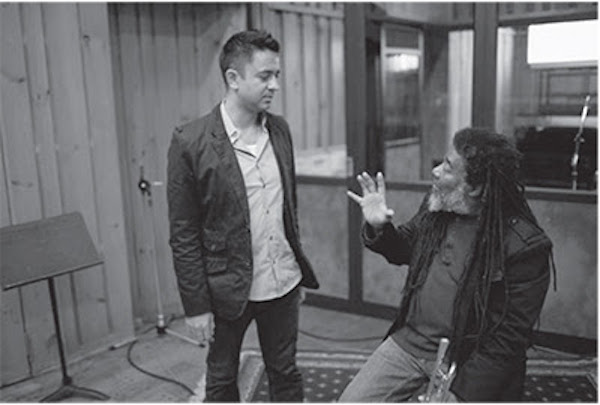
Vijay Iyer (l) and Wadada Leo Smith (r) in the studio. Photo: courtesy of ECM.
This was one of the closest New Jazz Albums contests ever. The closest, officially, occurred in 2015, when Rudresh Mahanthappa (Bird Calls) and Maria Schneider (The Thompson Fields) wound up with an identical 350 points. The rule then, long used by Pazz & Jop, was to sort by points and break ties in favor of the album with the most votes, which was Bird Calls 53-49. But Francis declared a tie, emphasizing Schneider’s higher points/votes ratio.
The second closest election on points was in 2014, when Steve Lehman (Mise en Abime) led Wadada Leo Smith (The Great Lakes Suites) by 12 (266-254), but Lehman also had an edge in votes 40-32. The third closest was 2018, when Wayne Shorter (Emanon) led Henry Threadgill (Dirt . . . and More Dirt) by 26 (259-233), yet lost the vote count 34-36. Shorter was deemed the winner back then, but this year’s switch to sorting by votes, following 2024’s introduction of a more compressed points scheme, would have flipped the 2018 election.
Aside from 2018, this year’s winner, Mary Halvorson, tied for the lowest-ever vote margin, with +3 over Patricia Brennan. This matched two +3 wins by Vijay Iyer, in 2009 and 2012, but Iyer had substantial points margins (+33.5 and +30), whereas Halvorson’s point margin was a razor thin +0.9. Had Halvorson not appeared on the last ballot counted, Brennan would have finished with an anomalous 0.1 point margin, which would have been the only time votes and points had split other than Shorter and Threadgill in 2018.
 Under those circumstances, I wonder whether Francis would have declared a tie, as he did in 2015. I also wonder whether he might have sacked me for fiddling with his points scheme — something which he allowed, but admitted to never understanding. But I have no idea offhand whether his old point scheme would have tipped the balance in favor of Brennan. That would take considerable number-crunching, and I’d just as soon let the mystery be.
I wrote more about the points/votes ratio in the Rara Avis essay, where a 4th place Anthony Braxton box came within 0.2 points of the winner, but for here I just want to say that the pair of numbers on each line (points and votes) give you two pieces of information that are often in tension with each other: how popular a record is (votes) and how intensely voters like it (points). You see hints of this further down the list. A re-sort by points would have dropped Nels Cline from 10 to 12, adding Branford Marsalis to the top ten. It also would have allowed The Ancients to move up from 16 to 14. It would have swapped 19-20, 21-22, and reshuffled 23-25. And the standings only get more volatile. Under the old rules, the last album added to an unranked list was given 5.5 points, more than any of the last five added to a ranked list.
I always believed that leading in points is a better gauge than leading in votes, but I was persuaded to sort by votes because I didn’t have a good answer to the charge that I was discriminating against voters who insisted on submitting unranked lists. And because I’m basically a one-person, one-vote guy, willing to trust democracy even though I’m often disappointed by it. But I also believe that ranked lists provide more useful information, and that a reasonable points scale better reflects that information. The old one favored first over tenth place albums by 10-to-1; the new one reduces this to 3-to-1. Francis didn’t want to adopt the Pazz & Jop points system, where each rank is independently assigned a point value from 30-to-5, because he didn’t want the hassle of keeping track of all those numbers, and also because it’s more work for the voters, which makes them less likely to vote.
So when you look at these number pairs, remember that they’re vying with each other to tell you something. Chances are they’re both right, and that what’s wrong is thinking we can reduce comparisons to a single authoritative “winner take all” number. Also remember that we’re missing what is perhaps the most critical number, which is how many voters have actually heard any given album. Big labels (like Blue Note, Nonesuch, and ECM) have advantages here, but savvy publicists can compete by focusing on known voters (some labels that are getting attention beyond their size are Pyroclastic, Pi, Out of Your Head, and TAO Forms — I could name publicists here, not least because they’re much more attentive to my needs than the majors are). But once in a while, I see an album with no publicity that I’ve noticed crack the charts, as [Ahmed] did this year (28th place, with an even more remarkable 10th place in 2024). It often has a high points/votes ratio, suggesting that if more people heard it, it would rise quickly in the poll.
 While I’d be reluctant to declare a tie even if points and votes had split, I want to caution you against any sort of “winner take all” mentality. Brennan not only finished a very close second, she played on Halvorson’s About Ghosts, and also on five other albums that received votes, by Tomas Fujiwara (13), Arturo O’Farrill (8), Adam O’Farrill (7), Dan Weiss (7), and Dave Douglas (3). On the other hand, Halvorson joined with Sylvie Courvoisier for the 12th ranked Bone Bells, and also played on Adam O’Farrill (who played on both top albums, as well as his father’s 2nd place Latin Jazz album), Ches Smith (8), and Jacob Garchik (4).
When artists release multiple albums, one always wonders about the possible effect of vote splitting. The most obvious case of that this year was with two-time winner James Brandon Lewis, whose two albums — Abstraction Is Deliverance (25 votes) and Apple Cores (12) — didn’t share a single voter. Add them together and you get a possible 5th place finish. Similarly, none of the 6 voters for Marshall Allen’s New Dawn also voted for his Ghost Horizons album. By the way, no one voted for the third of his centennial albums, The Omniverse Oriki, my pick of the litter, but one I found too late for my ballot.
Less directly comparable albums may also have split the vote, but not without exception. Steve Lehman’s Plays the Music of Anthony Braxton won our mid-year poll, but fell to 6th here. One possible explanation could be vote-splitting with the later-released 7th place Fieldwork album, although 10 of the latter’s 28 voters voted for both. Fieldwork also shared 4 voters with the 8th place Vijay Iyer & Wadada Leo Smith album.
Eight of Bone Bells‘ 23 voters also named Halvorson’s About Ghosts. And 11 voters named both Ambrose Akinmusire’s Honey From a Winter Stone and Linda May Han Oh’s Strange Heavens, the bassist’s trio with Akinmusire and Tyshawn Sorey. Those two albums came in 4th and 5th, with 60 voters picking just one.
One thing to note here is that the field spreads very wide, quite fast. Only 17 albums (down to Sullivan Fortner) appeared on 10% of the ballots. Only 17 more (34 total) appeared on 5% of the ballots. My dividing line for the top-64 chart is at 3.5%. Beyond that, there are 16 albums with 5 votes, 15 with 4, 36 with 3, 79 with 2, and a whopping 367 with only 1 vote (63.7% of the total). Comparisons that far down the list are pretty arbitrary, but chances are you’ll find music you love scattered all through the list — and well beyond, but I’ve always found top-ten lists to be way too limiting. My own The Best Jazz Albums of 2025 doesn’t stop until I’ve A-listed 90 new jazz (+ 6 late 2024 discoveries) as well as 29 (+2) Rara Avis items. I haven’t counted yet, but a fairly safe guess is that a third of those didn’t receive any votes in this poll. For context, I also provide a list of all the other albums I’ve heard from 2025. While I’ve heard 890 jazz albums released in 2025, and have been cramming ballot picks since I started counting, I still haven’t heard roughly a third of the albums that received votes in this year’s poll.
Notes
Gary Finney: Art Blakey famously stated that “Jazz washes away the dust of everyday life.” In today’s challenging times, for the 168 critics participating in the 20th Annual Francis Davis Critics Poll, jazz is now relied upon to wash away the “crap” from every day life. Jazz has always been a big umbrella, and the fact that 576 new jazz albums were identified as being among the year’s best assures that regardless of personal taste, there was plenty new music in 2025 that “hit that sweet spot,” not just for the poll’s participants, but for all aficionados of this music. Sullivan Fortner, Steve Lehman, Yazz Ahmed, Carl Allen, Ambrose Akinmusire . . . the breadth of this 100 year old artform in represented within this poll.
James Koblin: Creative music is so vast that many narratives of 2025 could be written; one of those narratives is about the towering importance of Anthony Braxton. Braxton, who turned 80 years old in 2025, has long been an outsider figure to jazz (he once quipped “jazz is only a very small part of what I do”), but in 2025 the jazz world crowned Braxton as one of its leading figures.
Celebrating Braxton’s birthday, Roulette Intermedium in NYC hosted a multi-part gala and celebration of his genius, and DownBeat put him in their Hall of Fame. Among 2025 recordings, one of the most electrifying was Steve Lehman’s The Music of Anthony Braxton, an album whose fire demolished the concept that Braxton is “cerebral.” Braxton’s student Mary Halvorson has long been heir apparent, and About Ghosts was not only the consensus pick of the year, but confirmed the continued development of Halvorson’s composing and the incredible chemistry of her “Amaryllis” band, all of the members remarkable bandleaders in their own right.
In 2025, Braxton’s circle of influence could be seen in the ongoing vitality of the AACM, as members Wadada Leo Smith, Roscoe Mitchell, and Amina Claudine Myers came out with outstanding 2025 releases. Some of the most powerful music of the year was on the archival digital release by Burning Ambulance of Quartet (England) 1985, a reminder of how potent Braxton’s music remains. In 2025, you could hear great jazz records that had Marilyn Crispell, Gerry Hemingway, Taylor Ho Bynum, Ingrid Laubrock, Tomeka Reid, Nels Cline, Greg Saunier, Ted Reichman, Joe Fonda, and I’m sure many others who have played with and been influenced by Braxton. 2025 was the Year of Braxton.
Tagged: "About Ghosts", Mary Halvorson, The 20th Annual Francis Davis Jazz Poll