
Film Review: “Cover-Up” Reminds Us Why Investigative Journalism Still Matters
By David Daniel
Given the current administration’s attacks on independent journalism, Cover-Up couldn’t be timelier.
Cover-Up, directed by Laura Poitras and Mark Obenhaus. Streaming on Netflix

A scene featuring Seymour Hersh in Cover-Up.
In November 1969 the world got news of a claim that, in March of the year before, American soldiers, under direct orders, had murdered hundreds of civilians in a village in Vietnam. The allegation was shocking. Unarmed women, children, and older men had been massacred and our government had kept it secret. Understandably, news outlets were skittish about publishing the story but, in the end, once they were provided with credible sourcing and photo documentation, several dozen U.S. newspapers ran the story on their front pages. Initial response was muted. Some critics argued that reporting of this kind — critical of the U.S. military — aided the enemy. Before long, however, a chorus of witnesses, the public outcry, and, in time, Congress stepped up. The Nixon administration was forced to acknowledge the events and their subsequent cover-up.
The reporter on this story was Seymour Hersh. He was 32 at the time, and the scoop earned him a Pulitzer Prize and considerable visibility as an investigative reporter. More news coups from him followed: the secret U.S. bombing of Cambodia, the CIA’s domestic spying, the mistreatment and torture of prisoners by US military and civilian personnel at Abu Ghraib prison in Iraq. Hersh proved to be a master at cultivating leaks about misconduct and wrongdoing (and at times barbarism) committed by governments and corporations. And, while these entities were wary of him, Hersh’s sources came to trust him and his dedication to speaking truth to power.
Born in Chicago in 1937, Hersh was educated in public schools and as a teen helped run the family’s South Side dry cleaners. After high school, Sy, as he was known, enrolled in night classes where, in the best tradition of a meritocratic education, he was singled out and encouraged to attend the University of Chicago, where he took a degree in history. He had no interest in continuing the family business, so he began to work for newspapers, going from copy boy to police beat reporter. He was an admirer of the muckraking style of I.F. Stone and, in time his strong writing skills and journalistic ethics led to his commitment to telling stories about people victimized by powerful systems. When he was working in the Pentagon press pool, he would duck out of pro forma briefings and cultivate relationships with young officers. Possessing the savvy of a winning card player, he would reveal just enough knowledge to make it seem as though he had more. He was conscientious about protecting his sources; people felt confident to go directly to him with leaks. The crimes, and attendant cover-ups, of presidents, foreign leaders, and the military-corporate nexus came under his scrutiny, and the powerful took note. On one of Nixon’s secret tape recordings, he growls to Henry Kissinger, this guy’s “a son of a bitch, probably a communist agent…” before adding, “but he’s usually right.”
Playing no favorites, Hersh doggedly tracked stories where they led, willing, even, on occasion, to nip at the hands that fed him. When The New York Times, for whom he was then working, was timorous about pursuing the first leaks about the Watergate break-in, Sy pushed to get the story covered. The Times gave in only after it was clear The Washington Post had scooped them. When not employed by a particular outlet, Hersh freelanced stories for The New Yorker, The Atlantic, Ramparts, The Guardian, and others — he has published eleven books. These days, at 88, Hersh continues to report, though at this point he has opted for self-publishing on Substack.
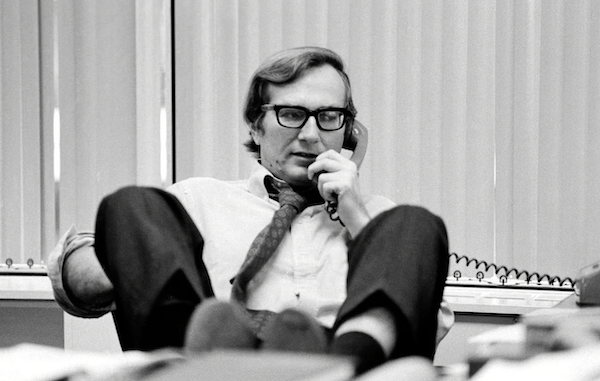
A scene featuring a young Seymour Hersh in Cover-Up.
Cover-Up gives a fair account of many of Hersh’s stories, some of which remain viscerally disturbing. It also gives us abundant face time with the man himself. At once patrician and street-rumpled, Sy Hersh is amiable, quick-witted, and kvetchy; he labors in an office crowded by untidy heaps of ring binders and dog-eared yellow pads. He seems to be perpetually on the beat: working the phone or on foot, making cold calls to cull potential leads.
As a journalist, Hersh has been criticized for an over reliance on unnamed sources and his use of single-source stories. At times, he has feuded with editors over these issues. He has been wrong about some stories, such as his erroneous reporting about who was responsible for the use of chemical weapons in Syria. But Hersh has his defenders as well. At The New Yorker, where some of his most explosive work appeared, the fact checking is stringent and his editor, David Remnick, insists that Hersh’s reporting for the magazine always checked out. Despite some misses, and an occasional whiff of a conspiratorial mindset, the scope and seriousness of Hersh’s work is undeniable — it’s difficult to see Hersh as anything other than a patriot.
Given the current administration’s attacks on independent journalism, Cover-Up couldn’t be timelier. As Trump wags the dog (or would that be dogs?) with the threat of unauthorized wars, the role of investigative reporting is more vital to democracy than ever. Federal officers are shooting citizens and in response the government is limiting transparency and elbowing the courts aside. A sitting senator and retired naval officer is pilloried for underlining a military demand for lawful behavior that — had the young soldiers in My Lai and Abu Ghraib been reminded of it — they might not have followed illegal commands that led to a permanent stain on America. Draconian new guidelines for journalists — that there must be Defense Secretary approval of Pentagon reporting — betray a willful ignorance of the First Amendment. Fortunately, at least for now, many in the media have shown the good sense to refuse.
At the conclusion of Cover-Up, when asked why he does what he does, Hersh meditates a moment before saying with emotion: “You can’t have a country that does it” — meaning torture, murder, and lie. An invaluable moral touchstone for these days of national turpitude.
Another Arts Fuse view of Cover-Up — at the 2025 New York Film Festival
David Daniel is an Arts Fuse reviewer and a Boston Globe contributor. He is a former military journalist.
5 Comments
Leave a Comment

Hersh is an investigative legend with all the attendant personality quirks. In his later years, he sometimes chased dubious conspiracy theories buoyed by his own perceived self importance.
But make no mistake, in his prime, he was the man! A fearless journalist who actually took the notions of a free press and an informed citizenry to heart. America forever owes him a debt.
Thanks for the article. I had assumed Hersh was dead, but I looked him up and found he has a Substack blog. Your article brought him back to life for me.
Timely. One can only hope he has inspired others.
Unfiltered, unfettered, at home on the ground, Hersh has always had the knack for finding seismic tipping point coups like My Lai & Abu Ghraib. A courageous patriot indeed. It’s obvious that, as a former Army journalist, Daniel knows this territory first-hand and well.
Thanks for the reminder of the Netflix doc and who Hersh was. He shouldn’t be forgotten.