
Concert Review: Mozart Still Draws a Crowd –The Boston Artists Ensemble Perform the Prussian Quartets
By Aaron Keebaugh
The performances made one thing clear: what had in Mozart’s day been a failed musical venture now makes for show-stopping pageantry.
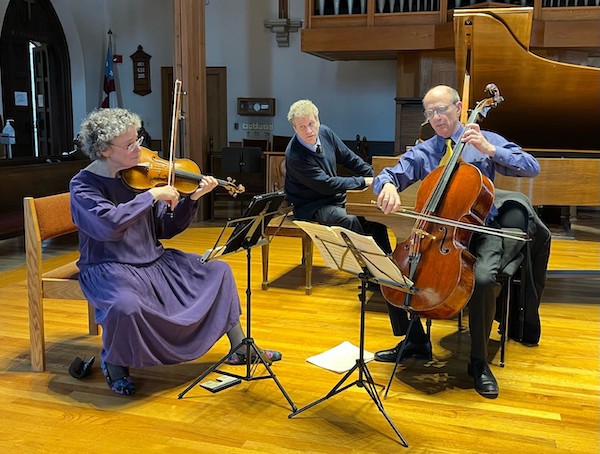
Boston Artists Ensemble in action 2022. Photo: Diane Fassino.
By the spring of 1789, Wolfgang Amadé Mozart was out of luck and out of cash.
The composer’s abysmal fortunes appeared to turn for the better after a trip to Berlin brought word that Prussian King Friedrich Wilhelm II wished to meet him. But Mozart’s hopes for serious business turned out poorly: the royal refused an audience with the musician, shuffling him off to the director of royal chamber music, Jean-Pierre Duport. It took Mozart a month to finally meet with, and to perform for, the King at the Royal Palace.
The disappointment didn’t stop Mozart from seeking long-term employment, but the king only agreed to commission a modest amount of music, including six string quartets. Alas, the promised payout never came. A disgruntled Mozart, as a result, only completed three of the quartets, which he ultimately had to print at his own expense.
Because of Mozart’s patron-scant predicament, these so-called “Prussian Quartets” became vehicles for personal expression. For a composer who typically wrote with ease, the work on these quartets proved difficult. “I am forced to sell my quartets, all that hard work, for a trifle,” he wrote to Michael von Puchberg in June 1790, “just to get some cash into my hands and meet my immediate obligations.”
Yet, if the Prussian Quartets brought Mozart little financial security in his day, they went on to become a main draw for ensembles who dare to explore their musical swings between exalted joy and dark introspection. The Boston Artists Ensemble filled two sold-out performances concentrated on these works this past weekend in Salem and Brookline. The performances were not spot-perfect, but the musicians still tickled listeners’ fancy with sweeping lyrical vibes.
In his Prussian Quartets–K. 575, 589, and 590–Mozart eschewed Haydn-esque formal homogeneity in favor of the juxtaposition of contrasting emotional elements. Musical tensions coil around abrupt shifts in rhythmic shapes — a chromatic canvas ties all of the shifts together. That said, there are also moments of Italianate warmth that, in the right hands, rise to the surface. Mozart extended special attention to the cello in these pieces, which is often given an equal part in the lyrical dialogue.
Unfortunately, the Boston Artists Ensemble took a little time to become comfortable with the music’s mercurial mood swings and constantly shifting textures during Friday night’s performance in Salem’s Hamilton Hall. Much of the String Quartet in D major, K. 575, came off as unfocused. Rhythms meant to be uniform were not always lining up; the softer passages sounded brittle and out of balance.
But the performance strengthened as the piece progressed. Cellist Jonathan Miller and violinist Nicholas Kitchen traded silvery passages in graceful musical dialogue. That conversation continued into the Andante, which was gallant but lacked the called-for finesse. The Menuetto moved with purpose, despite its thorny blend of elements. By the finale, the ensemble had found its footing, the musicians blending their colors to maximize tension and vitality.
The String Quartet in B-flat major, K. 589, was generally more successful. By this point, the musicians were comfortably dovetailing their approaches as they leaned into Mozart’s extremes. Together, they leaned into the fervent sturm und drang of the Allegro and warm depths of the Larghetto. The Menuetto aptly lilted, offset by a furious Trio. The Allegro assai channeled the necessary sonic energy to lift off into a Mozartian flight of fancy.
With the String Quartet in F major, K. 590, the Boston Artists Ensemble attained its full swing, conveying as much brusque sincerity as it did playful verve. They sharpened their unified blend to a razor point — the opening bars sounded almost Beethoven-ian. Elsewhere, they modulated to treat the sinuous lines with sensitivity. Phrases rose and fell like gently lapping waves in the Allegretto. The Menuetto and Trio bounded with rustic zeal. The return to intensity in the finale brought the audience to its feet.
The performance made one thing clear: what had in Mozart’s day been a failed musical venture now makes for show-stopping pageantry.
“They say sex sells,” one wit put it before the performance. “But actually it’s Mozart.”
Aaron Keebaugh has been a classical music critic in Boston since 2012. His work has been featured in the Musical Times, Corymbus, Boston Classical Review, Early Music America, and BBC Radio 3. A musicologist, he teaches at North Shore Community College in both Danvers and Lynn.
Tagged: Boston Artists Ensemble, Jonathan Miller, Nicholas Kitchen