
Television Review: “Plur1bus” — WTF is Happening?
By Peg Aloi
Vince Gilligan’s new series is ambitious, visionary, and artfully realistic, teeming with topical and timely references that make us wonder if, indeed, this shit might actually be happening in the real world, too.
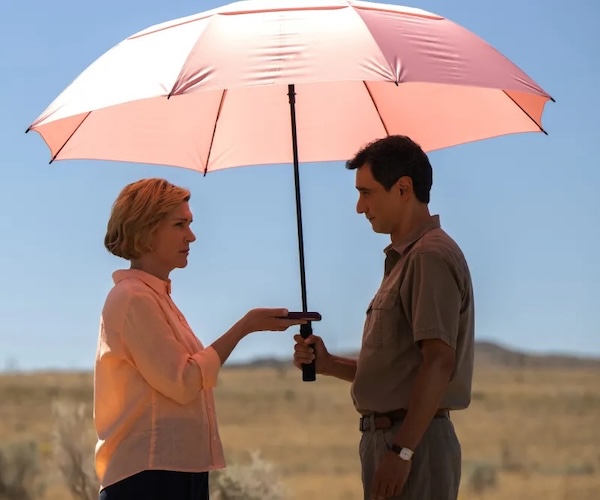
Rhea Seehorn and Carols-Manuel Vesga in a scene from Plur1bus. Photo: Apple
Well, what better way to close out the craptastic year that was 2025 than with a brilliant new series that posits a swift and all-encompassing eradication of what makes us human? This new series from Vince Gilligan, creator of the immensely popular and critically acclaimed series Breaking Bad and its spin-off series Better Call Saul (along with the apocryphal one-off special, El Camino) offers all the brilliance of its predecessors, with a confident genre swerve from crime drama to speculative fiction. Gilligan’s new story is ambitious, visionary, and artfully realistic, teeming with topical and timely reference points that make us wonder if, indeed, this shit might actually be happening in the real world, too.
Speculative fiction, as opposed to science fiction or fantasy or even dystopian fiction, is charged with closely reflecting current trends in society, serving up plausible, if horrifying, scenarios and outcomes. The hugely-successful Black Mirror anthology series (created by Charlie Brooker) is an apt example: the title refers to our dangerous addiction to screens (televisions, computers, and smartphones). Black Mirror’s terrors are two-fold but dovetailed: technology’s rapid advancement and its sweeping changes bring about an erosion of humanity’s most crucial impulses (compassion, empathy, and learning). Black Mirror cleverly envisions social media as a damaging force that manipulates outcomes in the real world through distraction and misinformation — propaganda as a weapon and an instrument of profit.
In contrast, Plur1bus avoids the miasma of social media by imagining a world where mass communication has been suddenly and irrevocably disrupted. It has been replaced by an (almost) unimaginable reality in which 99% of the human race appears to be communicating telepathically with one another. The show’s opening sequence is low key but compelling: at a remote astronomy station with huge telescopes, two astronomers meet after hours to explore an exciting discovery one has made: a remote signal from space displays patterns compatible with alien contact. Soon enough, more astronomers join them — jovial but focused — to proffer their own theories and parse the various implications. The astronomer who discovered the signal has a sudden epiphany about its true nature: his face tenses with wonder and concern.
A digital time counter running across the screen (a recurring narrative device) announces that a year has passed. A military lab is conducting rigorous medical experiments on rats. An accident occurs; something odd is unleashed that is infectious and, apparently, lethal for many. Yes, we’ve seen this storyline before, but this time it is different. This pathogen affects peoples’ minds — and behavior.
Meanwhile, fantasy romance author Carol Sturka (Better Call Saul’s Rhea Seehorn, brilliant in this complex role) is reading aloud at a bookstore from her latest novel to rapt fans. In a cab en route to a hotel, a drained Carol lets it slip to the cab driver that her books are “mindless crap.” Her manager and partner Helen (Miriam Shor) comforts her, and encourages her to work on a more ambitious project. They arrive home to Albuquerque and go to a bar for a drink. We learn Carol may have struggled with a drinking problem in the past. A TV screen shows a headline about a nearby military base on lockdown. Then, very quickly, things go badly.
After a couple days of utter chaos, Carol learns she is one of about a dozen people on the planet who appear to be unaffected by the rogue pathogen. Those with the condition who have survived refer to “the joining” as the moment when their minds all melded. Essentially, these are people who know everything that has ever happened, and who know how to do everything, from flying a plane to open heart surgery. They smile and speak in unison and “just want to help.” Carol is understandably freaked out and retreats to her huge empty house to figure out what to do. Drinking scotch and watching Golden Girls reruns help her come to terms with the new world. She decides to contact other survivors who escaped the beehive effects of the pathogen, hoping they’ll also want to resist being part of the newly robotic humanity.
As Plur1bus has unfolded, many have debated the symbolic or metaphorical center of the story. At first, a cheeky mention in the end credits — “This show is made by humans” — sparked speculation that it was about AI. This makes sense, given the fact that everyone readily spouts information and agrees about everything. Even though they’re sometimes wrong and oddly naïve about human behavior. Another obvious metaphor: the ongoing COVID pandemic. Some have theorized that COVID is a man-made virus, inadvertently released into the general population, where it then caused relatively rapid and widespread death. In Plur1bus, those left to pick up the pieces after their loved ones died in front of them are strangely chipper. Their hive mind of helpfulness mimics a few of the COVID pandemic’s most egregious memes: You do you! We just have to live our lives! Given that we are facing myriad public health dangers, climate collapse, and encroaching fascism, it’s time to admit that Americans are increasingly vulnerable to propaganda, yet apparently unable to recognize our own complicity: as if we somehow, I dunno, all agree that this is fine. Think of the meme of the cartoon dog drinking coffee in the burning room. I could go on, but I digress: suffice it to say, the parallels in Plur1bus with the COVID era are eerily similar: in both cases, humanity appears to be both deluded and doomed.
As daily horrors unfold, Carol, battling a post-traumatic onslaught of fear, grief, boredom, and loneliness, is determined to resist “joining” and wants her fellow survivors to help her save humanity. But they don’t seem to like her much, especially when her angry outbursts may be causing more mass casualties. Meanwhile, the “joined” cater to Carol’s every whim, including, in one incredible sequence, filling with impressive speed and efficiency her neighborhood’s empty grocery store with food, making it just the same as before tragedy struck. That brings up another odd metaphor worth pondering: what could humanity achieve, if we could all simply agree on what needed to be done, and work together to make it happen? Then again, the food supply situation is a central plot point that is dire and horrific. Carol briefly finds some comfort and distraction in a new friendship but, unsurprisingly, dark truths continue to burst through the shiny surface of this utopian lovefest. An unlikely comrade appears, traveling a long way. The season finale ends on a wild cliffhanger — Carol realizes she must take drastic measures in order to try and save the earth. I mean it sincerely when I say, I really hope the world is still here so we can find out what happens in Season 2.
Peg Aloi is a former film critic for the Boston Phoenix and member of the Boston Society of Film Critics, the Critics Choice Awards, and the Alliance for Women Film Journalists. She taught film studies in Boston for over a decade. She has written on film, TV, and culture for web publications like Time, Vice, Polygon, Bustle, Dread Central, Mic, Orlando Weekly, Refinery29, and Bloody Disgusting. Her blog “The Witching Hour” can be found on substack.