
Film Reviews: DOC NYC– The Fugs, Midwives, and Racial Strife in Canada
By David D’Arcy
Extensive and eclectic, DOC NYC is a sampling of documentary films for the coming year. These favorites are worth searching out.

A scene from FUGS FILM!. Photo: DOCNYC
FUGS FILM! introduces a musical group of satirists who were eager to break every taboo to an audience more than half a century later. This band of provocateurs — well educated, with an insistent libido, and a gut instinct for transgression — was a fixture on the New York avant-garde rock scene for much of the ’60s. Its mix of radical politics and sexual frankness kept the police in pursuit. They ended up wearing handcuffs as other musicians of that time wore beads.
The raunchiness helped with publicity. Primed by protesting the war in Vietnam, young people were eager to violate taboos. And The Fugs made protests fun. The titles of the band’s songs alone drew fans – “Group Grope,” “I Feel Like Home-made Sh__,” “Kill for Peace,” “Slum Goddess of the Lower East Side,” “I Couldn’t Get High,” “(After the Prom) Saran Wrap,” and “Nothing,” the latter a dirge by co-founder Tuli Kupferberg that sounded like a Jewish prayer that kvetched about everything. The Fugs sometimes even made it to television. Co-founder Ed Sanders, a poet and publisher with an NYU degree in ancient languages, was on the cover of Life magazine in 1967.
The documentary is filled with archival images (mostly stills) that pile on information like a collage or a scrapbook. Director Chuck Smith (2019’s Barbara Rubin and the Exploding New York Underground) revisits the New York counterculture, where the newspaper of record on the Lower East Side, for at least a few years, was the East Village Other, not the more established Village Voice. The best excerpts of the group’s performances (rare high quality, given the time) comes from Swedish television. If the clips in the doc aren’t enough, there’s more footage available from Swedish online sources.
The Fugs were nothing if not confrontational, starting with the band’s name, which Sanders lifted from a euphemism deployed by Norman Mailer in The Naked and the Dead. Lillian Hellman, when she met Sanders, asked him if he was “that guy who can’t spell fuck.” Sanders got it right — at least from Hellman’s perspective — when he founded the journal Fuck You / A Magazine of the Arts. Much more context, from Sanders’ perspective, can be found in his 2011 memoir Fug You: An Informal History of the PEACE EYE BOOKSTORE, the FUCK YOU PRESS, the FUGS, and Counterculture in the Lower East Side.
The Fugs’ performances were just as deliberately unpolished – mostly three-chord folk rock, infused with mystical incantations and with vocal harmonies that made the Grateful Dead sound on key, plus guitar solos that never seemed quite there. Sanders, with co-founders Kupferberg and Ken Weaver, had voices that were strong enough to carry – a good thing, since their crowds were a noisy bunch.
Sanders, who studied Greek and Latin at NYU after escaping the Midwest, is thoughtful, as is Kupferberg, which is a surprise, given how out of control his frenetic dancing seemed onstage. Key moments are also provided by other band members. John Anderson joined The Fugs as a bass player after dropping out of Yale University. He lifted the band musically, as almost any competent musician would have, but then he was drafted. Anderson explains that, when he made pro forma protests at his draft board to receive a deferment, an examiner noted that he had gone to Yale, and argued that if he were good enough for Yale, the army should take him. It did. When Anderson returned from Vietnam, his fellow Fugs, who were absolutists in their opposition to the war, shunned their former bandmate.
Anderson offers his recollections as Jackie Anderson, a remarkably youthful woman more than fifty years later. Another musician who improved the sound of the band, Danny Kootch (Kortchmar), was a guitarist who went on to a long career with James Taylor, Linda Ronstadt, Don Henley, and others. Kootch left The Fugs because he “kind of wanted to play with real musicians who knew what they were doing.”
That inept music was good enough for Fugs fans, and for the mainstream press as well. Richard Avedon photographed them. In Fug You, Sanders writes that the respected writer George Plimpton wanted to join The Fugs on tour as a member of the band, and then write about his adventures. The group turned him down. It’s hard to imagine how he would have hidden his plummy accent and gentlemanly manners — he would have had to, if he wanted to be credible as one of the band. No matter. The Fugs were hot and Plimpton was game.
Another fan was novelist/critic Elizabeth Hardwick, whom Sanders quotes at length in Fug You. In 1967, she opined approvingly about him in The New York Review of Books:
“The Fugs are neither art nor theater but noise (‘total assault’) and a plea for free speech. Still, they made all sorts of popular entertainment obsolete. After [the song] “Coca Cola Douche” it is not the easiest thing in the world to sit through the first half of The Apple Tree [a 1966 Broadway musical directed by Mike Nichols] and watch Barbara Harris and Alan Alda in the Garden of Eden, trying to ‘evolve’ a word for love. The Fugs are soft liberal exhorters to ‘Group Grope’. There is a schizophrenic sweetness and dirtiness about them, and the leader of the group, Ed Sanders, is a dismayingly archetypal American… Neither he nor his “Slum Goddess of the Lower East Side” is an aphrodisiac, but they are wildly funny because he and his songs have trapped the infantilism of smutty little boys. To be clean and well-dressed and to be concerned about homosexuality or four-letter words, that is the real madness. It is not free sex, but free speech they celebrate: dirty words, dirty feet, laughter. The Fugs are ideologues of some kind, not orgiasts. Their ideas are few and simple, and all of them are pacific.” Well stated but, just for the record, The Fugs were celebrating free sex.
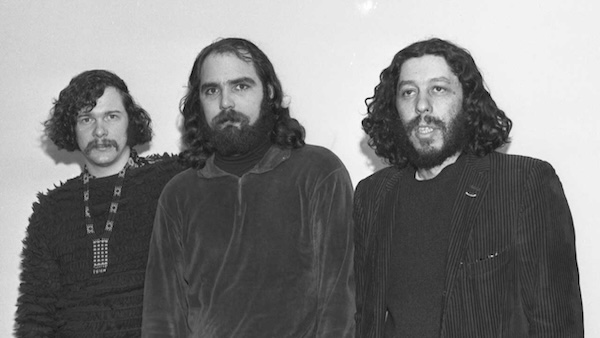
The Fugs: (l to r): founders Ed Sanders, Ken Weaver, and Tuli Kupferberg. Photo: DOCNYC
There were limits. The Fugs eventually got a record contract with Atlantic, where they would have joined Otis Redding and Aretha Franklin. It’s hard to see musical affinities there, but that label would have sold their records. And they prepared a new album for release in 1967. The recording included the song, “Coca Cola Douche”, which was played for members of the family of Ahmet Ertegun, Atlantic’s president. The puerile lyrics (“My baby ain’t got no money/But her snatch it tastes like honey/’Cause she makes that Coca-Cola douche”) weren’t written to charm executives’ wives — and they weren’t charmed. The record deal was cancelled, which meant that a Fugs album would not be released along with Sgt. Pepper’s Lonely Hearts Club Band in the summer of love.
The band never quite recovered from that rejection, although their next album was released by Reprise. Sanders, a poet and later a journalist after The Fugs broke up, says in the film that it became too much for him to manage the band. Still, the founders and other musicians regrouped for more tours before The Fugs disbanded permanently.
Described by a New York Times music critic as “the musical children of Lenny Bruce, the angry satirist,” FUGS FILM! reminds us that popular satire would never again be as irreverent or as frank, although The Mothers of Invention had their moments. Note that the Mothers of Invention were conceived, like The Fugs, with a more unsettling name (“The Mothers”).
No word yet on a release date for this doc, but don’t look for anything like a Fugs reunion on one of those PBS vintage pop music fundraisers. The material remains too transgressive for the mainstream. In the meantime, the curious should turn to Sanders’s memoir Fug You, and to J. Hoberman’s recently published cultural history of downtown New York in the ’60s, Everything Is Now.

A scene from Arrest the Midwife. Photo: DOCNYC
Also at DOC NYC was Arrest the Midwife, a mainstream documentary currently on the fest circuit destined for screening on PBS. Its setting could not be more different than the East Village in the sex-hungry days of The Fugs.
We are in upstate New York and north central Pennsylvania and dealing with Mennonite and Amish communities on both sides of the border. They have a lot of children. They tend to have those children at home. There’s not much of a choice. It’s not just that their communities are insular. Hospitals tend to be far away from where they live.
As the film begins, a local midwife from outside those sects, who has delivered close to 1000 babies in that area, is accused by New York State of practicing her specialty illegally. She is also charged with murder in the case of a baby who died. The women of her region, some of whom see a divine plan in the child’s death, rally around her. New York won’t quash the charges. The woman could spend much of the rest of her life in prison, and she won’t take a plea. Several other midwives face charges as well.
Arrest the Midwife has the look, the earnest seriousness, and the single-minded focus of a made-for-Public-TV product. The issues appear to be simple, though complexity begins to creep in once the filmmakers take a closer look. In a country where disputes over abortion rights dominate politics — from the Supreme Court to the operations of the US Mail — here is a story of women prosecuted for delivering babies, which midwives can do freely in another state only a few miles away.
It’s rare that any documentary gets inside of insular religious communities. Director Elaine Epstein finds a strain of unlikely feminism among religious women who are protecting themselves and their families in a story fraught with contradictions. The women who were charged in this film are spared the most severe punishments allowed by law – that’s a matter of record, but apologies for the spoiler. But, as hospitals that treat women in rural areas (when they treat them at all) are closing under pressure from draconian health care cuts, the story is far from over.
A scene from True North. Photo: DOCNYC
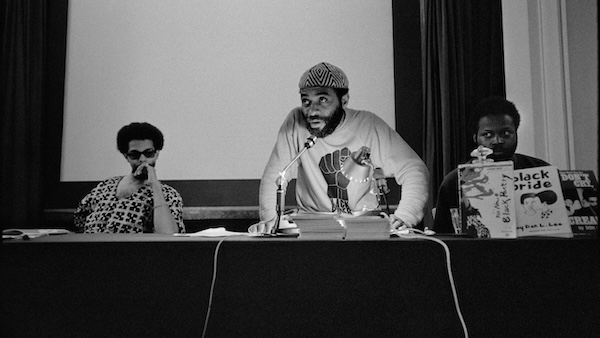
DOC NYC also gave its audience the rare chance to see True North, a look back to Canada in the ’60s, when Black students in Montreal held their own protests against discrimination at universities.
The story, directed by Michele Stephenson (2023’s Going to Mars: The Nicki Giovanni Project, directed with Joe Brewster), came as a revelation to Canadians when the film premiered in September in Toronto. Shown in New York, the doc was a reminder that Canada wasn’t as perfect as some might think it is, especially given US policy these days.
The key event in the film is the occupation by Black students of a computer lab in 1969 at Sir George Williams University (now Concordia). The confrontation with police, charged with emptying the place, left some students arrested, others beaten and others deported. Protestors said they had been treated unfairly by professors, and we hear testimony about that. We also learn about escaping slaves passing into Canada via the Underground Railroad (some of whose descendants were part of the demonstrations) and the surge in Black immigration to Canada from the Caribbean after World War II. In then-white Canada, being Black meant being invisible, we’re told. Let’s not forget that the founder of McGill University owned slaves and that Montreal (now officially a Francophone city) also maintained a strict, exclusionary division of English-speakers from its French-speaking majority back in the ’60s.
Canadian activists were inspired by Civil Rights demonstrators in the US, but their small numbers held them back. Amplified by a rich visual archive, True North reveals how they made their presence felt.
David D’Arcy lives in New York. For years, he was a programmer for the Haifa International Film Festival in Israel. He writes about art for many publications, including the Art Newspaper. He produced and co-wrote the documentary Portrait of Wally (2012), about the fight over a Nazi-looted painting found at the Museum of Modern Art in Manhattan.
Tagged: "Arrest the Midwife", "True North", Ed Sanders, Elaine Epstein, FUGS FILM!, Ken Weaver, Michèle Stephenson, The Fugs