
Film Review: “Marty Supreme” — A Thrilling, Empty Trip Through Ego and Excess
By Steve Erickson
It can’t be denied that Marty Supreme is effective as a wild trip. It’s an immersive experience — not an analysis of its self-adoring antihero.
Marty Supreme, directed by Josh Safdie. Screening at Somerville Theatre, AMC Theatres, Kendall Square Cinema, Alamo Drafthouse Cinema, and other movie houses throughout New England.
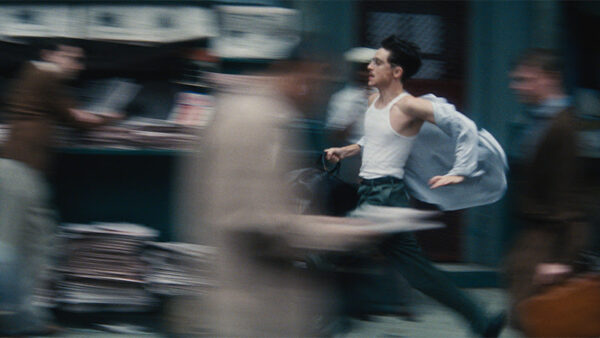
Timothée Chalamet on the run in Marty Supreme. Photo: A24
Marty Supreme acts like a top that’s spinning across a table, seemingly out of control as it darts close to the edge. The brother duo of Benny and Josh Safdie have directed five features together. They’ve stopped working as a unit, at least for now, but Josh’s directorial style hews close to what they have done before. The Safdie brothers approach draws on the coked-up rush of Goodfellas, but they have developed their own take on the accelerated buzz. Uncut Gems pulls off the rare trick of evoking the pleasure that would draw someone into addiction — gambling, for its antihero — hooked on the constant danger and stress that inevitably follows. Their films make viewers feel as if they are participating — at a safe distance — with someone who is taking grave risks. (Longtime Safdie collaborator Ronald Bronstein, a co-writer, co-editor, and producer on Marty Supreme, generated that same feeling — without any guard rails — in his one directorial effort, Frownland.) The Smashing Machine, directed by Benny and released earlier this year, departed from this keep ’em on the edge of their seats vision — but that earlier aesthetic dominates Marty Supreme.
It’s 1952, and Marty Mauser (Timothée Chalamet) is a salesman at a shoe store, owned by his uncle, on New York’s Lower East Side. When his friend Rachel (Odessa A’zion) enters the store, they go into the back for a quickie, which leads to her pregnancy. (She’s married to another man.) Marty then heads off to a ping-pong championship in London, where he lives well beyond his means. He meets famous actor Kay (Gwyneth Paltrow), who’s lived out of the spotlight in a marriage to an abrasive businessman named Rockwell (Kevin O’Leary). Marty and Kay start an affair. When Marty finds that he is unable to pay a fine, he has to hustle his way out of the debt via some elaborate, dangerous adventures: at one point, a gangster (Abel Ferrara) is injured when Marty’s bathtub crashes into the room below.
Chalamet, one of Marty Supreme’s producers, clearly intends the film to propel him to a new level of stardom and acclaim. He’s participated personally in A24’s elaborate marketing campaign, going well beyond the usual talk show and red carpet appearances. As Marty, he’s glammed down, sporting a unibrow, mustache, and acne scars. Marty may start out looking like a nebbish, but the narrative flips that stereotype on its head. He’s a virtuoso athlete both in the bedroom and on the ping-pong court, and very comfortable whipping out a gun to get his way. Marty may be sweaty and agitated, but Chalamet’s charm makes his character’s unruly, antisocial behavior palatable. To portray Bob Dylan convincingly in A Complete Unknown, the actor spent a year learning how to sing like the musical icon. For this role, Chalamet mastered table tennis — he demonstrates his skill in long shots of him playing on the court.
In Marty Supreme, Chalamet’s effort to step up his craft as a competitive sportsman fuses with his dubious devotion to his ego, a love affair that the filmmakers share. It’s not enough that Marty can get laid at the drop of a hat; the opening credits, which immediately follow the film’s initial sex scene, superimpose his name over footage of swimming spermatozoa. These images send a message: “Who cares if he’s a jerk? He’s a vital force of life.” The ending of the story returns to this idea of narcissism triumphant.
Set shortly after World War II, Marty Supreme is also a specifically Jewish story. Interviewed by newspapers in London, Marty says that he’s Hitler’s nightmare. He accepts casual antisemitism — such as Wally (Tyler Okonma) advising him “don’t be a greedy Jew” — as part of the sociopolitical territory. The narrative winds up with the Japanese organizers of a ping-pong tournament proposing that Marty kiss a pig — a gesture of barely hidden antisemitism.
Given all that’s going on — sexually, egotistically, and politically — the film goes out of its way to bite off more than it can deal with. Staging a flashback in Auschwitz is risky. Imagining a man covering his body in honey for other prisoners to lick off his torso is more baffling than shocking — not offensive, but gratuitously weird. What is the point? One scene stops far short of sexual assault, but it strongly implies a sadomasochistic dimension to Rockwell’s exercise of power.
The mood of sustained tension is greatly enhanced by the film’s deft sound design. Voices and sounds are jammed up against each other. Even what could be relatively innocuous scenes are filled with grating noises, such as bird cries. This ever-busy soundscape has a near-subliminal impact, juicing up the film’s rhythm. On top of that, the story’s pacing speeds up considerably in its final third.
Marty’s attractiveness to women is presumed rather than established. As critic Bilge Ebiri argues, “His successful seduction of her [Kay] makes no actual sense other than the fact that the movie needs their coupling to happen.” And Safdie went overboard with casting celebrities, using recognizable figures who aren’t professional actors in both major as well as cameo roles: Ferrara, David Mamet, writer Pico Iyer, and Okonma — aka rapper Tyler, the Creator — making his rookie film appearance. O’Leary, a star of the reality TV show Shark Tank and a MAGA pundit, performs a variation on his boorish rich guy persona. Some of these bits turn into distractions: a flex about the contents of Safdie’s iPhone. At one point, I wondered “Is that Isaac Mizrahi?” I waited until the end credits to confirm that it was.
It can’t be denied that Marty Supreme is effective as a wild trip. It’s an immersive experience — not an analysis of its self-adoring antihero. That manic quality, as fun as it is, is a major flaw because it undercuts the possibility of a much-needed critical perspective.
Steve Erickson writes about film and music for Gay City News, Slant Magazine, the Nashville Scene, Trouser Press, and other outlets. He also produces electronic music under the tag callinamagician. His latest album, Bells and Whistles, was released in January 2024, and is available to stream here. He presents a biweekly freeform radio show, Radio Not Radio, featuring an eclectic selection of music from around the world.
Have to agree. Too much flash not enough rhythm. Overwhelming sound track.
If you’re into nonsensical chaotic subplots and gratuituous violence, this film is for you. I thought I might be seeing a thought-provoking, character-development film, ala “The Hustler”, especially after watching Chalamet’s work on the Bob Dylan bio. What a dissapointment.
This is the first time I’ve been to a movie theater in about 3 or 4 years. Well, it might be another 3 or 4 years, after watching this piece of garbage masquerading as artistry.
I couldn’t disagree more with this review — it was an amazing piece of work, a rollercoaster ride and a modern fable of the other’s – the immigrant- in this case the Jew- frenzied attempt to make it to the top of their dreams in a crass bigoted world of those already holding all of the golden opportunities. There is no time for the slow builds of analysis- you either sink to the bottom of it’s enormous victim pit, you settle down in a safe boring compromise of licking someone’s boots your entire existence, or if you’re smart and talented-you through sheer desperate ambition swim with the sharks to beat the bastards at their own game.
Kay’s sexual attraction to this near nobody kid is believable because she recognizes he’s a reflection of her younger self this crass kid -Marty- she wants him because she wants herself back before she took the comfortable seat at the head of a sadistic Devil’s sellout table.
Clearly the reviewer isn’t familiar with struggle in the America of killer capitalism and the desperate attempts to be exceptional lest you become one of its ubiquitous victims.
I suggest you see it again through the eyes of those struggling to survive in a culture that hates the hubris of its underdogs. The dog is called Moses because everyone is searching for the promised land.
Nah, it sucked. A chaotic mess caused by an unlikable, selfish narcissist that repeatedly steps on his own dick in eye-roll inducing manners, that ends in a wishy-washy fashion that came out of left field. If you like yelling and screaming nonsense that goes nowhere, have a couple kids and maybe you’ll find out (like Marty) it was what really made you happy all along. 🤮
Excellent analysis, Sandra. Better than this facile review by an incurious critic, who didn’t bother to read up on the reasons for the Holocaust flashback scene or think beyond the “likability” of the protagonist. Suggest listening to Wesley Morris’s podcast episode about the film, which has some good analysis.
The struggle in America has been shown in much better ways, many times previously. Key’s attraction to the boy is just filler crap, the main character is a bad version of Rocky with even less dramatic input or emotional depth. Casting a black taxi-driver just to make us sympathize with Marty’s poverty is borderline racism, and the dog is called Moses because the film-maker believed this is something clever. He even included the line about who built the pyramids – and you obviously bought all of it.
By the way, your endorsement of Marty (“if you’re smart and talented-you through sheer desperate ambition swim with the sharks to beat the bastards at their own game”) feels like a description of Jeffrey Epstein.
I’m still convinced the dog is Moses Cleaveland, whatsoever that is. And everybody knows the ping pong was AI but the cake is Timmy’s.
Music soundtrack seriously questionable; 1950’s imagery, 1970’s and 1980’s tunes playing?? Incidental music weird choices too.
Comment of central character giving a piece of the Pyramids to his mother saying ‘we built these’; really?? Really??
A good yarn but messing with history way too much.
Theme seemed to be do whatever to whoever to get what you want. You’ll be admired, or you’ll find your audience, even if it’s a few incongruous GI’s hanging out in Tokyo.
Seriously unlikeable central character, in an interesting-ish story about naked ambition with predictable bitter-sweet ending — great casting and memorable faces, those same old traumatized themes coming through.
The love of a baby, new life, held up at the end, if only that love extended to Gazan babies right now.
It’s a terrible movie.
A horrible movie by all means. The problem with Marty’s character is not that he is an asshole but that his personality doesn’t evolve at all. Most subplots are there for no reason. Mrs Kay? The dog? The black friend (as the ‘Brutalist’ taught us, we must cast black friends to Jewish characters so their minority status is underlined)?
Nothing comes out of these subplots or characters, they just fill filmic time with grotesque violence and loudness. Throwing into this mess yet another Holocaust story in the form of Auschwitz-honey-licking scene, the crap about the stone from the pyramid that ‘we’ built, the predictably anti-Semitic white Americans, the uncle, the mom, the rich Greek Americans, they all seem just an excess of self-indulgence.
Perhaps, film-makers in this country should start exploring other some other narratives. With the return of global brutalism, ethnic cleansing in Gaza and Sudan, unnecessary escalations in Latin America and the Middle East – 60 school girls assassinated today today in Iran by Americans and Israelis, brutality on the streets, and the Big Tech, Big Oil, and Media planning their next corrupt moves on some island owned by another ‘Marty’ – there is plenty of material for any filmmaker willing to stop the masturbation phase and grow up.