
Concert Review: Heavy Metal’s “Saddest Day” Festival — A Glorious Gift for Happy Fans
By Scott McLennan
For heavy music fans, the Saddest Day was a very good day.
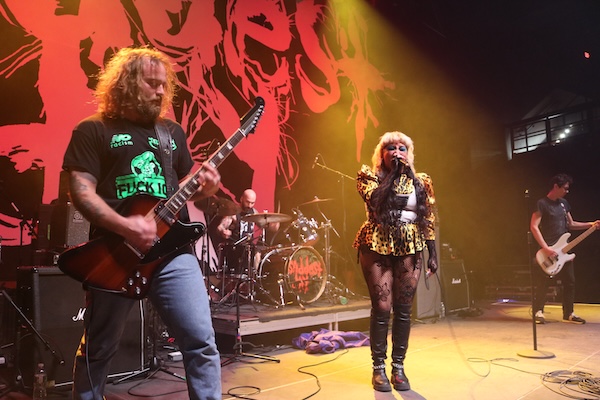
Stress Positions in performance at this year’s Saddest Day festival. Photo: Scott McLennan
Converge’s inaugural Saddest Day event did not come wrapped in festive packaging or appear to conform to seasonal traditions. Its mission was to gather together a collection of bands to deliver sets of aggressive music that covered a broad spectrum of what’s offered in the heavy-music underground.
But there may not have been a more joyous or giving event in the Boston area last Saturday than the Saddest Day, which ran for roughly nine hours at The Roadrunner in Brighton.
It was a celebration of community — an acknowledgment of family along with the need to take the necessary time to express gratitude and love. There were also gifts — mainly musical ones, like hearing bands play in Boston for the first time, or for the first time in ages.
Of course, those who aren’t able to appreciate a dark twist or a little irony, such as christening your holiday-timed event Saddest Day, would most likely not have been on board for the myriad contrasts and contortions in the music played by Converge and the bands it handpicked to perform at Saddest Day.
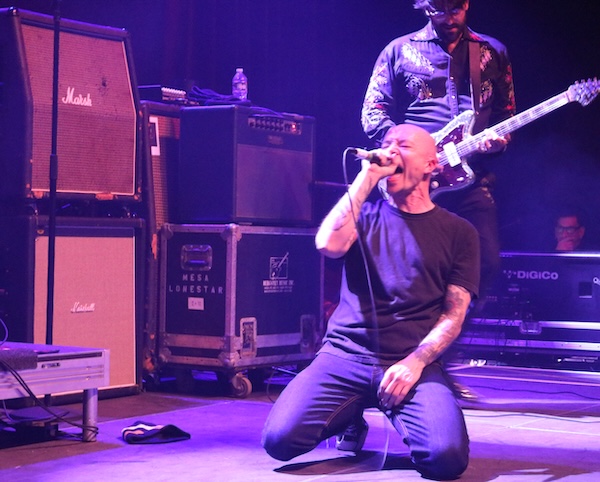
Touché Amoré singer Jeremy Bolm and guitar player Nick Steinhardt in performance at this year’s Saddest Day festival. Photo: Scott McLennan
The lineup included Touché Amoré, Coalesce, The Hope Conspiracy, Full of Hell, Soul Glo, Year of the Knife, Stress Positions, and Wormwood, with Converge delivering the night-closing set.
Saddest Day also presented exhibits by artists connected to the heavy-music scene (including works by Converge singer Jacob Bannon); there was also a festival-style vending area where concertgoers could browse and buy records, clothing, and other punk and metal ephemera.
Converge transformed the Roadrunner performance area, closing off the venue’s elevated stage and turning it into a production area. In its place, Converge installed a smaller stage, one closer to the ground and free of any barricades — it shrank the space between performers and audience. Bands shared sound gear and drums, which cut down on turnaround time between the half-hour sets most groups played, before the festival welcomed contributions from the upper echelons — Coalesce, Touché Amoré, and Converge — who were onstage for a bit more performance time.
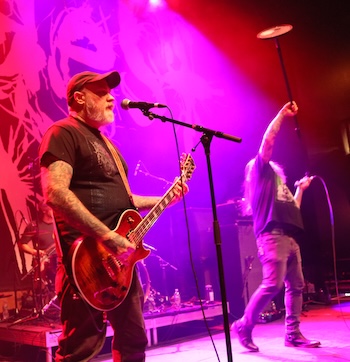
Wormwood’s guitarist Chris Pupecki and singer Mike Morowitz at this year’s Saddest Day festival. Photo: Scott McLennan
Wormwood launched Saddest Day with its thundering, sludgy sound. The all-star lineup of musicians from Doomriders and The Red Chord first came together to create Wormwood in 2014. Since then, they have added singer Mike Morowitz, whose unhinged delivery serves as the perfect counterbalance to the heavy surge of the band’s music.
Pivoting from the epic sprawl of Wormwood, Stress Positions made its Boston debut with a set filled with slash ’n’ burn punk songs. Still, as lean and frenetic as the tunes were, singer Stephanie Brooks found ways to infuse nuance, along with theatrics, into the performance.
Year of the Knife continued its triumphant comeback from a 2023 van crash that severely injured its band members. Singer Madi Watkins still moves somewhat tentatively, but her vocal delivery was spot-on as she energetically burrowed into favorites such as “Fatal” and “Dust to Dust,” and invigorated the new “An Exercise in Pain.”
Soul Glo was the band at the festival that leaned furthest into punk rock’s political side, pretty much condemning both sides of the ideological aisle, excoriating the ways race and identity are shaping social realities — neither left nor right was tagged as righteous. “If I Speak (Shut the Fuck Up)” opened the set that challenged anyone — Black or white — who might be uncomfortable with or critical of Soul Glo’s hardcore sound. Guitarist GG Guerra taps into the kind of wild guitar frenzy that Funkadelic and other Black artists have used to deliver scathing social and political commentary. He was at his most powerful when Soul Glo launched into a version of “Gold Chain Punk (whogonnabeatmyass)” — which felt as if hardcore were venturing into new territory.
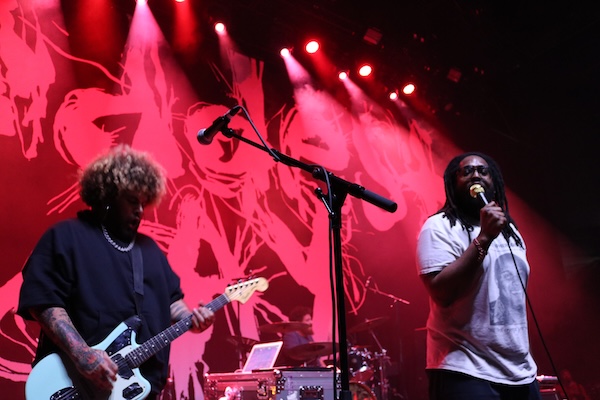
Soul Glo’s GG Guerra and Pierce Jordan at this year’s Saddest Day festival. Photo: Scott McLennan
Just before Saddest Day, Full of Hell parted ways with founding guitarist Spencer Hazard. But second guitarist Gabe Solomon had no trouble carrying the extra burden in a set that came across with the fury of sculpted noise. Singer Dylan Walker prowls the stage, pausing only to add or adjust how electronics were infused into the band’s thick metallic sound. Songs blur one into the next, distinguished mainly by wide changes in dynamics that span from the gloomy to the chaotic. As extreme as Full of Hell got, the band was a favorite with both Saddest Day fans and the other bands. Converge brought the group out during its set to perform “Axe to Fall.”
The Hope Conspiracy, a Boston band that was an early adopter of a heavy sound that fused metal and hardcore, returned last year after a hiatus with the powerful album Tools of Oppression/Rule by Deception (produced by Converge guitarist Kurt Ballou). The band’s set concentrated on the new recording, and for good reason — the songs connect well with today’s political turbulence. The Hope Conspiracy also pulled a bunch of songs from the band’s classic album Death Knows Your Name. The band’s hometown hero status was affirmed by the crowd reaction — it was nothing short of berserk.
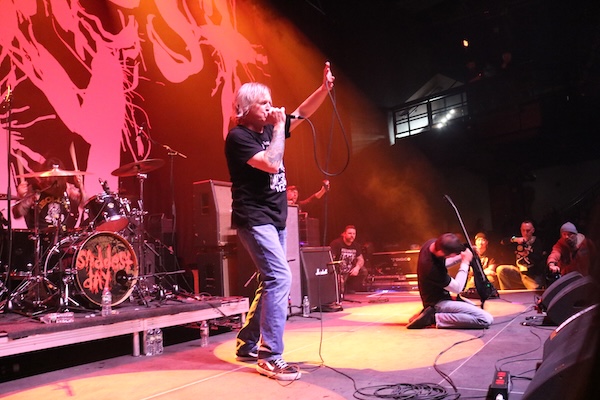
Coalesce performing at this year’s Saddest Day festival. Photo: Scott McLennan
Progressive hardcore group Coalesce had not played in Boston for more than 15 years, before the band returned as part of the Saddest Day lineup. The band’s angular and confrontational sound still resonated, even though the energy of singer Sean Ingram’s performance has moved from physical violence to something resembling spiritual anguish. The thrill of having Coalesce back in action drew out Cave In singer Stephen Brodsky, who joined the band for “Wild Ox Moan.” Later, Touché Amoré singer Jeremy Bolm joined Coalesce for a cover of Minor Threat’s “Seeing Red.” Coalesce brought its set to full boil with a version of “They Can’t Kill Us All” in which the band left everything on the stage.
Touché Amoré has been a leading band in the so-called post-hardcore years of, well, hardcore. Post-hardcore is distinguished by a concern for more melodic songwriting that works through emotional themes, such as love and loss. Even as it waded through the sad contours of “New Halloween” and served up the disenfranchisement of “Nobody’s,” the band managed to project optimism and positive energy. Touché Amoré was also the only band you felt had a little country music swing buried deep in its sound.
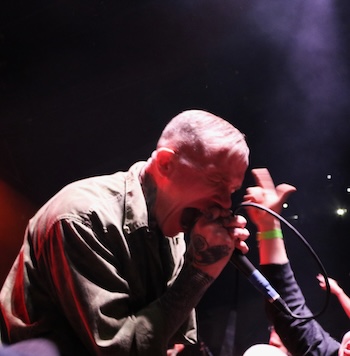
Converge’s singer Jacob Bannon performing at this year’s Saddest Day festival. Photo: Scott McLennan
Converge sealed the deal on Saddest Day with the kind of set that a fan might have drawn up. The band opened with the title track to its forthcoming album, Love Is Not Enough, and later offered up the new tune “We Were Never the Same,” also destined for a disc to be released in February.
The band served up plenty of favorites live, such as “Dark Horse” and “All We Love We Leave Behind,” as well as the aforementioned special guest-version of “Axe to Fall.”
But Converge also pulled out songs it had not played in years — decades in some cases — including “Conduit,” “My Unsaid Everything,” “Towing Jehovah,” and “Lonewolves.”
Through it all, Converge’s flexibility and precision were a continual marvel. This band has been artfully messing with musical boundaries and conventions since 1990 — and it continues to challenge itself.
Drummer Ben Koller, who was recently involved in a serious car accident, conjured up complex, head-spinning beats. Ballou and bassist Nate Newton let loose torrents of bottom-scraping grooves and aspirational riffs, often setting up a dynamic push and pull between each other.
The sonic mayhem aptly swirled around Bannon, who brings to life the pain and promise embedded in Converge’s songs, singing each number as if his life depended on it.
As thoughtful and precise as Converge is, the band still embraces the raw energy of punk and metal, perhaps in no way tighter than with the track “Concubine,” a number whose opening notes triggered a massive mosh pit, followed by a level of stage diving that probably required Roadrunner to restock its supply of Band-Aids and ice packs.
Converge ended its regular set with “The Broken Vow,” one of three songs pulled from the iconic 2001 Jane Doe album, which reimagined the artistic possibilities for heavy metal and hardcore. But there was little doubt the band wouldn’t return to deliver an encore performance of the song the festival was named after — and, sure enough, Converge brought down the house with an exhaustive version of “The Saddest Day.”
For heavy music fans, it was a very good day.
Scott McLennan covered music for the Worcester Telegram & Gazette from 1993 to 2008. He then contributed music reviews and features to The Boston Globe, Providence Journal, Portland Press Herald, and WGBH, as well as to The Arts Fuse. He also operated the NE Metal blog to provide in-depth coverage of the region’s heavy metal scene.
Tagged: Coalesce, Converge, Full of Hell, Soul Glo, Stephanie Brooks, Stress Positions, The Hope Conspiracy, Touche Amore, Wormwood