
Concert Review: Boston Baroque and Making Handel’s “Messiah” Fresh
By Aaron Keebaugh
Boston Baroque served up a lithe and vital performance of the Messiah that felt rich, personal, and gloriously lived in.
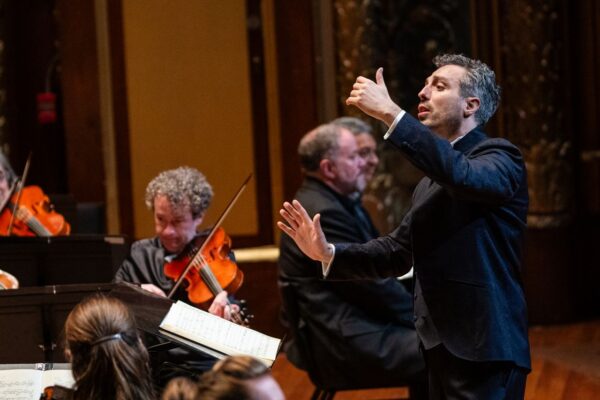
Guest conductor Filippo Ciabatti led Boston Baroque in a performance of Handel’s Messiah. Photo: courtesy of Boston Baroque
Few works are linked more intimately to the holiday season than Handel’s Messiah. With its message of hope and deliverance — and a moving score to match — the oratorio routinely fills programs of many of Boston’s choral and period instrument ensembles this time of year.
Miraculously, these performances usually don’t feel like stale holiday specials. Conductors are driven to go deep into the music, looking to uncover details that often go unnoticed. There is an unspoken responsibility to keep renditions fresh and lively. Boston Baroque has accepted that mission for decades — the group has performed Messiah every year since 1981. The ensemble’s familiarity with the piece yields returns, a mature vision that keeps listeners coming back for more. The program note for Boston Baroque’s latest Messiah puts it plain: Handel’s masterpiece is a well that never runs dry.
At Jordan Hall last weekend guest conductor Filippo Ciabatti made good on the claim, leading Boston Baroque in a lithe and vital Messiah that felt rich, personal, and gloriously lived in.
Ciabatti led with bold waving gestures that generated both musical mystery and revelry. On the surface, the sounds he coaxed from the period instrument orchestra came off as standard for early music readings: tempos were quick; he eschewed breadth for clarity and crispness; and choral passages didn’t so much flow as bound forward in short phrases that knit together into larger melodies.
But that approach provided an unusually effective backdrop for the evocative singing supplied by the guest soloists. Soprano Amanda Forsythe, mezzo-soprano Paula Murrihy, tenor Thomas Cooley, and baritone Roderick Williams worked in tandem to infuse the recitatives and arias with biblical fire and conviction. Along the way, each explored dramatic depths that have not often been explored in this music. What emerged were rounded and complicated characters grounded in spiritual assurance.
Cooley conveyed warmth, intensity, and everything in between. His bell-toned voice captured the excited anticipation of “Ev’ry Valley” and the righteous rage of “Thou shalt break them.”A single phrase could encompass more than one mood. That made “The rebuke hath broken his heart” feel as poignant as one of the contributions from the Evangelist in Bach’s St. Matthew Passion.
In contrast, Williams contributed the force of a stalwart and unyielding Old Testament prophet. His clarion baritone resounded powerfully in “The people that walked in darkness.” “Why do the nations so furiously rage together?” surged with anger at a misguided desire for vengeance. But, by Messiah’s end, Williams’s tone tipped toward the certainty of the Gospel — things will turn out for the best. “The trumpet shall sound” thundered like a Sunday sermon, with Steven Marquardt’s trumpet solo matching the vocalist’s bold conviction.
Murrihy effectively seesawed between emotional extremes, her character searching for but not always finding solace. Anger underscored the pathos of “He was despised,” as if she herself had been responsible for Christ’s suffering. Murrihy’s dark tone could just as easily turn bright in “O thou that tellest good tidings of Zion.” “O death, where is they sting” also felt secure in heavenly promise.
Topping it all off was Forsythe, who sang with the glow of eternal optimism. Her lines were buoyant, her melismas sparkling with every turn. Her vocal flourishes captured the resonant hope of “I know that my Redeemer liveth” and the rippling musical reveries of “Rejoice greatly.” Forsythe reveled in the sheer joy of “How beautiful are the feet of them” as it led into the trumpeting chorus “Their sound is gone out into all lands.”
There and elsewhere, the singers of Boston Baroque choir sang with clarity and sensitivity. “And he shall purify” shook with seismic energy in its brisk tempo. So too did “His yoke is easy,” the music fittingly light and airy.
The more famous choruses were equally colorful. The “Hallelujah” exaltation was charged with celebratory zeal. “All we like sheep” glowed with pastoral warmth.
The orchestra provided the singers with stately support, aided by a fluid continuo. Ciabatti delivered plenty of musical surprises to brighten the season. May yours be just as merry.
Aaron Keebaugh has been a classical music critic in Boston since 2012. His work has been featured in the Musical Times, Corymbus, Boston Classical Review, Early Music America, and BBC Radio 3. A musicologist, he teaches at North Shore Community College in both Danvers and Lynn.
Tagged: Amanda Forsythe, Boston Baroque, Filippo Ciabatti, Paula Murrihy, Roderick Williams