
Classical Album Review: Fernande Decruck, Concertante Works, Vol. 2
By Jonathan Blumhofer
Though none of the works exhibit the stylistic flashiness of Fernande Decruck’s better-known contemporaries, they all suggest a musician of singular—and sometimes idiosyncratic—vision.
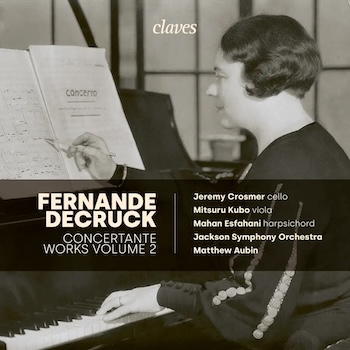 Fernande Decruck was a French composer who fell through the cracks of history. An accomplished organist and teacher (Olivier Messiaen, another organist-teacher-composer, counted among her students), she spent part of her life in the United States, where her husband played in the New York Philharmonic. After returning to France in 1937, she taught, performed, and composed until her premature death at 57 in 1954.
The four items on the Jackson Symphony Orchestra’s (JSO) survey of Decruck’s concerti, the second volume in an ongoing cycle, span her American years and second residency in France. Though none of the works exhibit the stylistic flashiness of the composer’s better-known contemporaries, they all suggest a musician of singular—and sometimes idiosyncratic—vision.
Take the Sonata for Saxophone (or Viola) and Orchestra. Written in 1943, the instrumentation is, by any definition, unique. Its four movements, too, follow a path that’s logical (even as the heroic ending isn’t quite earned), if hardly predictable, steeped in the coloristic French tradition but with surprising little nods, seemingly, to the likes of William Walton and Kurt Weill.
On this album, we get the version for viola and orchestra with the solo part capably rendered by Mitsuru Kubo. She, the JSO, and conductor Matthew Aubin capture the music’s shifting atmospheres well, particularly the ominous, wave-like episodes in the outer movements and the roiling turbulence of the “Fileuse.” If the intonation of the combo sometimes doesn’t feel entirely secure, they imbue the tender “Noël” section with sweetness and warmth.
For its part, Les Trianons, a 1946 suite for harpsichord and orchestra, channels the French Baroque with a mid-20th-century twist. Indeed, some of its riffs and rhythmic patterns suggest cleaned-up Bartók—though that composer would likely never have written the Andante’s duet between harpsichord and alto saxophone.
No less a virtuoso than Mahan Esfahani is on hand to lend his prestige and vigorous precision to the proceedings and both pay off. For ensemble blend and rhythmic security, it’s hard to imagine a stronger performance. And of character, too: the middle movement’s conversations between soloist and members of the ensemble come out very well, as do that part’s plays of tension and release. The outer sections are vivid and motoric.
Decruck’s Cello Concerto, on the other hand, offers a vision of subdued (or at least quieter) virtuosity. Dating from 1932, this is the album’s earliest selection and the music’s youthfulness sometimes tells: the finale’s very proper fugue doesn’t really fit, either within that part or with the larger piece. At the same time, the serenity of the opening movement never lacks for confidence and the central Adagietto demonstrates a fine grasp of musico-structural proportions.
Jeremy Crosmer is the soloist and, though his sound isn’t the biggest, his playing fits the Concerto well. The first movement is lush and lyrical, its cadenza lovingly done. So is the second, which calls to mind Holst and Ravel in some of its scoring. That stodgy fugue notwithstanding, the finale’s stormy outer sections move with attitude.
Filling out the disc is Les cloches de Vienne: Suite de Valses. The convoluted story of how Aubin reconstructed the score is told in the liner notes and it’s done justice by the JSO’s lilting performance, which reveals music that, for form, color, and tone, is more Parisian than Viennese—but, at the end, closes with a haunting surprise.
Jonathan Blumhofer is a composer and violist who has been active in the greater Boston area since 2004. His music has received numerous awards and been performed by various ensembles, including the American Composers Orchestra, Kiev Philharmonic, Camerata Chicago, Xanthos Ensemble, and Juventas New Music Group. Since receiving his doctorate from Boston University in 2010, Jon has taught at Clark University, Worcester Polytechnic Institute, and online for the University of Phoenix, in addition to writing music criticism for the Worcester Telegram & Gazette.
Tagged: Claves, Fernande Decruck, Jackson Symphony Orchestra, Mahan Esfahani, Matthew Aubin