
Children’s Book Reviews: Lighting Up Winter Holidays
By Cyrisse Jaffee
A trio of holiday stories— two celebrate friendship, one features a stagestruck chicken.
Lost and Found Hanukkah by Joy Preble. Illustrated by Lisa Anchin. Chronicle Books, 2025
The Polar Bear and the Ballerina, written and illustrated by Eric Velasquez. Holiday House, 2025.
Interrupting Chicken Saves the Nutcracker, written and illustrated by David Ezra Stein. Candlewick Press, 2026.
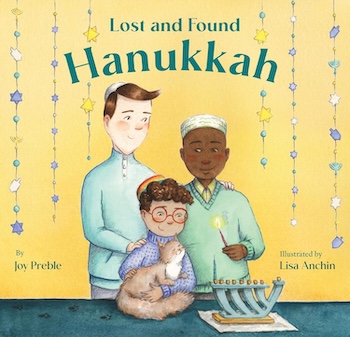 In Lost and Found Hanukkah, a little boy named Nate, with curly hair and big, red glasses, lives with two dads—Daddy and Abba. Nate loves Hanukkah and all its traditions – lighting the menorah each night, eating “mountains of potato latkes and jelly donuts,” and spinning the dreidel. But he and his family have just moved into a new apartment, and now his beloved menorah is missing.
None of the menorahs sold at a nearby store named Amy’s seem right. During their visit, the shop cat named Kugel dashes out the door. When Nate learns that Kugel loves latkes, too, he devises a plan to find the lost cat. Luckily Nate finds Kugel hiding under a branch of a tree. Inspired, Nate fashions his own menorah from the tree branch.
Amy joins the family to celebrate the first night of Hanukkah—with jelly donuts and a new kitten for Nate— and suddenly the new apartment feels a lot more like home. After Daddy tells the story of the Maccabees, Nate explains, “…Hanukkah means rededication, which is something beginning again. You miss what you had before, but you celebrate what you got back.” Nate still misses his old neighborhood and best friend, but says that “We’ve rededicated now—Aba, Daddy, and me in our new home, with our new cat and new friend…” An Author’s Note adds more information about Hanukkah and its customs, as well as a recipe for latkes.
This sweet, gentle story about love, family, traditions, and belonging, is enhanced by the friendly and endearing illustrations by Lisa Anchin. The snowy, urban (perhaps gentrified?) setting adds a sense of coziness to the story. And the diverse characters (Abba wears a kufi, Daddy a yarmulka, and Nate’s shirt has a rainbow on it), offer subtle yet important messages about identify, acceptance, and the beauty of embracing different cultures.
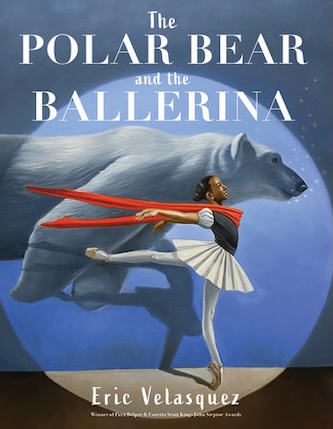
The Polar Bear and the Ballerina is another celebration of friendship, this time told in a series of exquisitely rich oil paintings. The wordless story opens with a 4-panel spread (two pages that open up) showing a group of young, African American dancers being photographed in front of a splendid polar bear swimming behind them. (The music is provided by African American drummers and the signs indicate that the dancers are part of a Harlem troupe.) One of the girls forms an instant friendship with the bear. When her red scarf is left behind, the bear is determined to return it to her.
Defying boundaries (and logic), the bear leaves its home, astonishing passersby, to get to the ballet. The bear’s presence causes traffic jams and consternation. When the bear is refused entry to the theater, it lets out a growl that summons the girl, who escorts the bear to a special seat in the audience (much to the irritation of the grown-ups around it). Her lovely pas-de-deux with the bear, whose image is projected behind her, brings the house down.
The juxtaposition of the little girl and the large bear is heartwarming, and the combination of reality and fantasy makes for a gentle but spellbinding tale of art, acceptance, and kindness. The art has a dreamy yet realistic appearance, with the bright red scarf linking the white of the little girl’s tutu and the white of the polar bear.
A quick note before the story begins offers a few facts about polar bears. A note at the end portrays the fictional Chloe Maldonado (the girl in the story), a soloist in the “Harlem Children’s Ballet” who creates the character of the Red Scarf Girl for a dance entitled “The Polar Bear and the Ballerina.” This unusual addition perhaps conveys an underlying message, given that ballet—and other forms of “fine” art—were inaccessible to people of color (audiences and artists). However, in this book, art is open to all people (and bears, too).
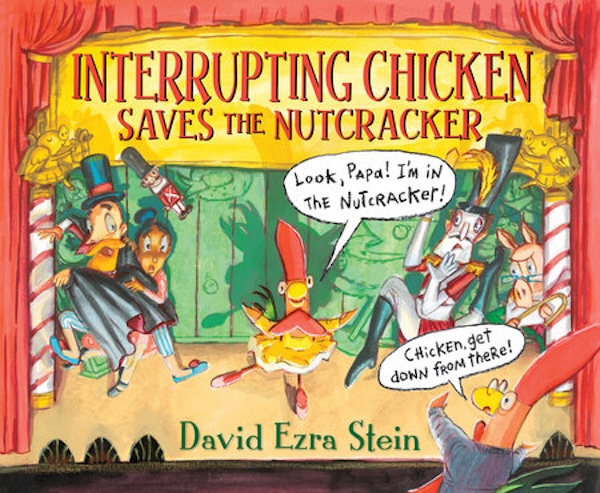
Another ballet is featured in Interrupting Chicken Saves the Nutcracker. As you may guess by the title (and some kids who may already be familiar with the chicken in question), the little red Chicken is excited to be going to see the Nutcracker with Papa.
Despite his repeated reminders that she has to behave, Chicken can’t help herself. She interrupts the classic ballet more than once, much to the dismay of the ballet’s narrator and dancers—and Papa. She jumps on stage to show Clara her red tutu, she saves the nutcracker that Fritz and Clara are fighting over, then ties the Mouse King to the Christmas Tree. Oh no!
Papa and Chicken are asked to leave. But at the last minute, they save the day when Chicken, realizing she has taken said nutcracker by mistake, rushes back with an alternative ending.
This cheery tale may have your own audience interrupting, too, as they laugh over Chicken’s antics. Kids who are familiar with the Nutcracker will especially appreciate the humor, but since the Nutcracker story is retold within the narrative, all will be able to relate to Chicken’s irrepressible spirit and creativity.
Cyrisse Jaffee is a former children’s and YA librarian, children’s book editor, and a creator of educational materials for WGBH. She holds a master’s degree in Library Science from Simmons College and lives in Newton, MA.
Tagged: "Interrupting Chicken Saves the Nutcracker", "Lost and Found Hanukkah", "The Polar Bear and the Ballerina", David Ezra Stein, Eric Velasquez